 Skip to content
TREATMENTS AND PROCEDURES
Injection Treatments
Injection treatments in orthopaedics: diagnostic and therapeutic purposes, when ultrasound guidance helps and why the preparation depends on the diagnosis.
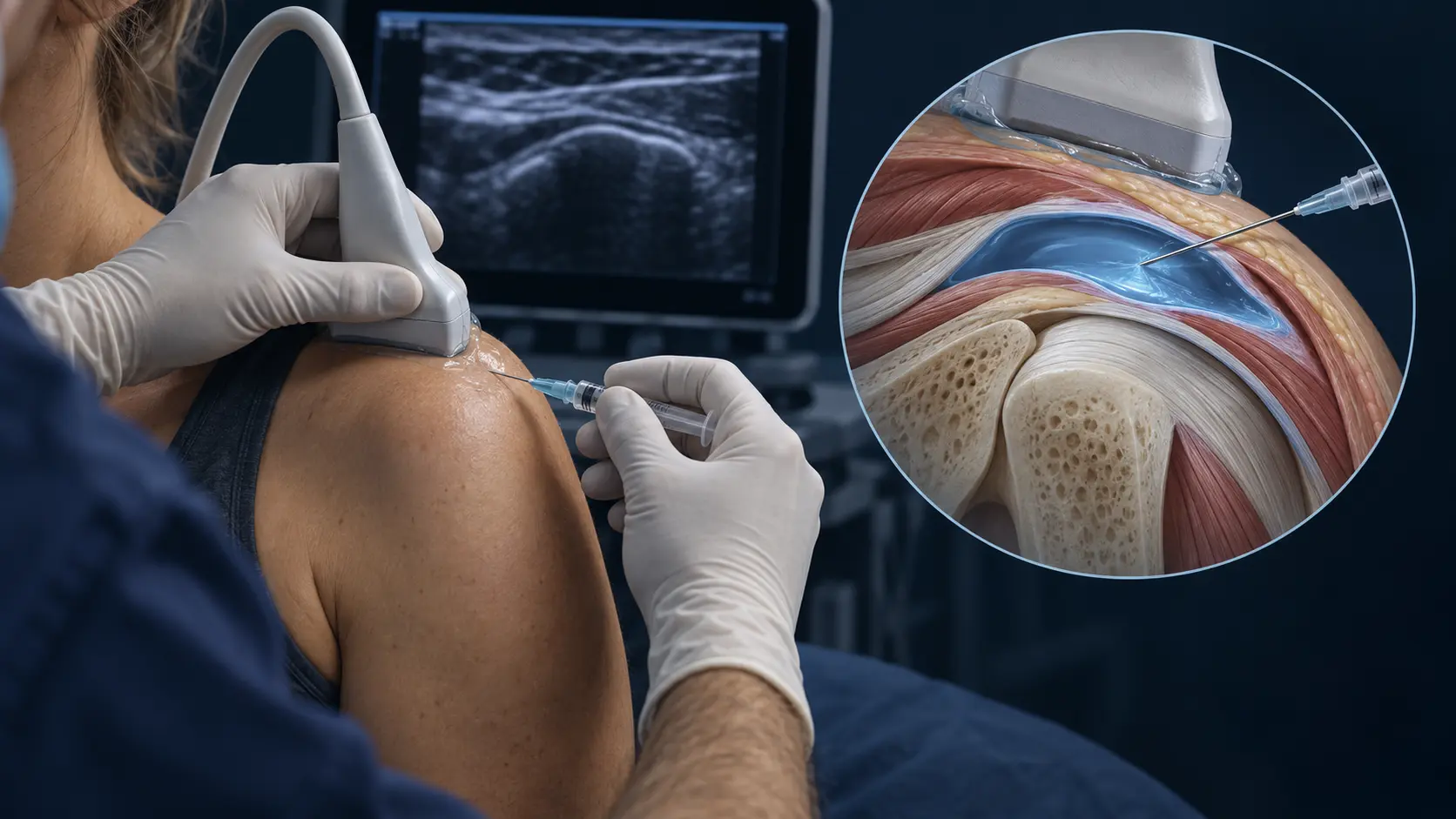
Why might an orthopaedic surgeon consider an injection?
- Diagnostic purpose — temporarily anaesthetising a structure may help determine whether it is the source of pain.
- Pain-relieving or anti-inflammatory purpose — local medication is used in selected conditions when there is an appropriate indication.
- Biological or symptomatic purpose — preparations such as platelet-rich plasma or hyaluronic acid are used for selected problems, but effectiveness depends on the diagnosis and evidence quality.
Ultrasound-guided injection
Ultrasound shows the needle and its position relative to the joint, tendon, bursa, nerve or vessel. Not every injection requires ultrasound, but image guidance improves precision for many deep or small structures. Read Ultrasound-Guided Injection — When Is It Useful? (in Polish).
Nerve hydrodissection
Injecting fluid around a nerve under ultrasound guidance differs from an ordinary joint or bursal injection. In carpal tunnel syndrome, it is termed median nerve hydrodecompression or hydrodissection. Its role depends on disease severity and it should not delay effective surgical decompression when there are signs of progressive nerve injury. Details: Median Nerve Hydrodecompression and Hydrodissection in Carpal Tunnel Syndrome (in Polish).
Diagnostic injection
When several structures could cause similar pain, temporary relief after anaesthetising one may be diagnostically useful. It must still be interpreted with clinical and imaging findings. See Diagnostic Injection — What Does Temporary Relief Tell Us? (in Polish).
Aspiration and injection are different
The main purpose of aspiration is to obtain or remove fluid. This may be diagnostically important, for example to establish the cause of an effusion. Medication may then be considered if indicated. Read Joint Aspiration — Why Is Fluid Collected? (in Polish).
Do all preparations work the same way?
No. Steroids, hyaluronic acid, local anaesthetics, PRP and other preparations differ in purpose, mechanism, risks and evidence. “Newest” should not automatically mean “best”. Selection depends on the diagnosis, stage, previous treatment and expected effect.
An example of a targeted procedure: barbotage
In calcific rotator cuff tendinopathy, injection may be part of a more complex ultrasound-guided procedure. Barbotage is not a generic “injection for shoulder pain”, but a procedure for a specific problem. Details are available in Rotator Cuff Calcification — When to Observe, When to Treat and What Do We Know About Barbotage? (in Polish).
What should be established before treatment?
- the diagnosis and purpose of the injection,
- medicines taken, particularly anticoagulants and antiplatelets,
- allergies, active infection or other contraindications,
- whether the result will influence the next treatment decision.
The key principle: an injection is a tool selected for a particular clinical problem. It should not replace a proper diagnosis or create a treatment pathway disconnected from the condition.
Medical author
Tomasz Poboży - orthopaedic surgeon, MD, PhD — specialist in orthopaedics and musculoskeletal traumatology.
This educational material does not replace an individual consultation or medical examination. Last updated: 12 September 2026.