 Skip to content
FOR PATIENTS · NONSURGICAL REHABILITATION
Subacromial impingement — exercises and rehabilitation
The programme starts by improving the function of the muscles that stabilise the shoulder. In a very painful shoulder, isometrics may be used first, followed by progressively greater range, lever arm and loading.
Tomasz Poboży, MD, PhD
How does subacromial impingement develop?
The rotator cuff tendons and the subacromial bursa lie beneath the acromion. Symptoms may be related both to structural changes, such as osteophytes or acromioclavicular osteoarthritis, and to impaired movement control and muscular coordination.
Rehabilitation is especially important when functional factors dominate. Exercise does not remove osteophytes, but it can improve movement control, strength and load tolerance even when structural changes coexist.
Read: Subacromial impingement — symptoms, causes and treatment →
Programme principles
- There is no rigid calendar; progress when the previous stage is well tolerated.
- Mild discomfort may be acceptable, but exercise should not cause steadily increasing pain or a clearly worse shoulder the next day.
- For a very painful shoulder, begin with isometrics. If light band exercise is tolerated, isometrics are not mandatory.
- Starting with a physiotherapist is advisable to check technique and resistance.
STAGE A · VERY PAINFUL SHOULDER
Isometrics — tension without movement
Start with 4–5 gentle contractions of about 10 seconds in each direction, with 15–20 seconds of rest.
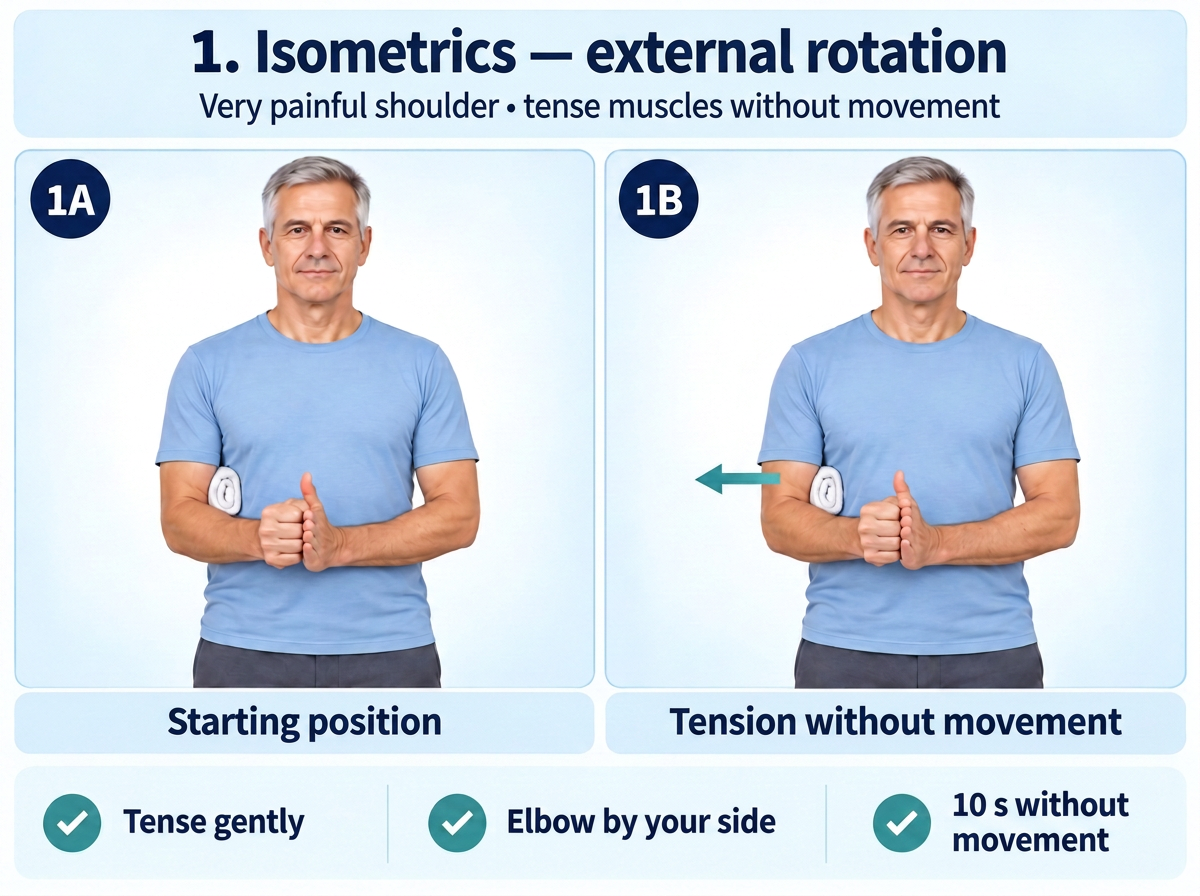
1. Isometric external rotation
Keep the elbow by your side. Try to rotate the forearm outward while the other hand blocks visible movement.
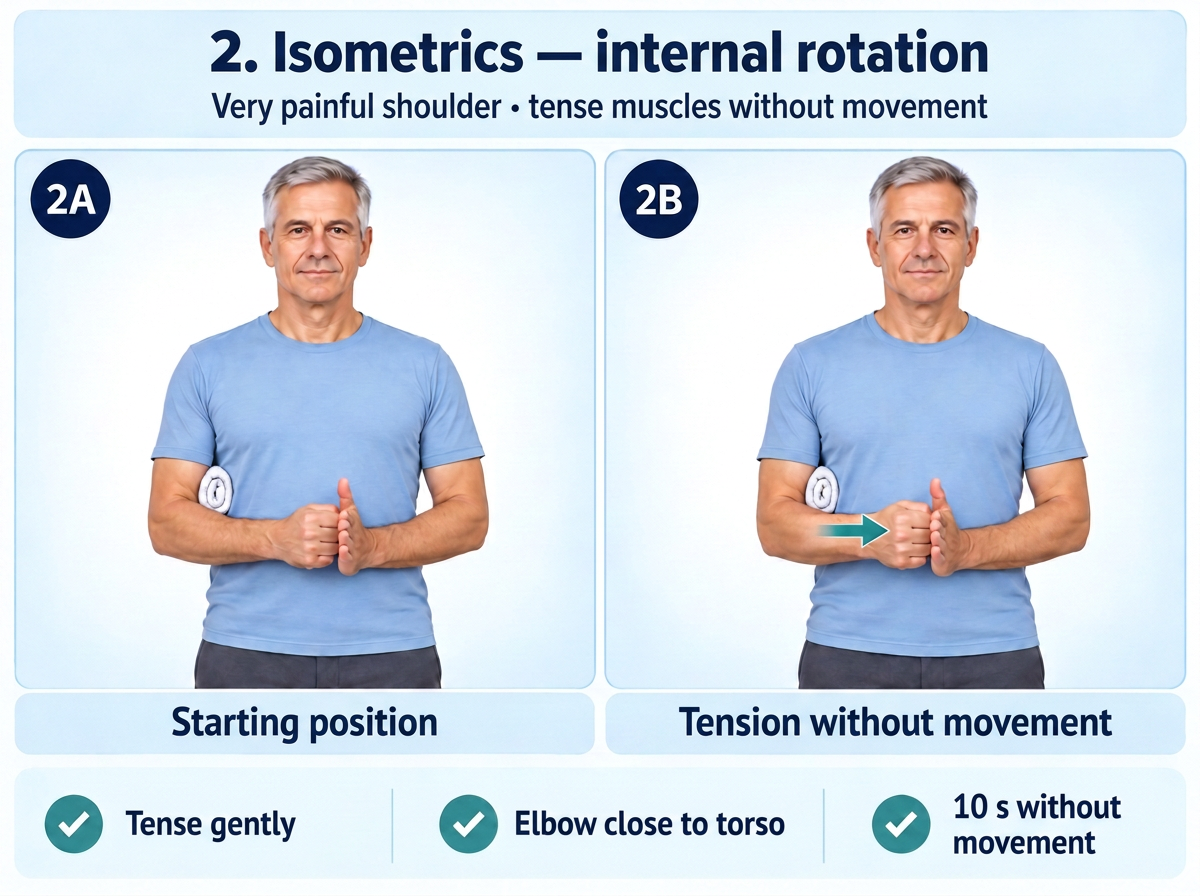
2. Isometric internal rotation
Try to rotate the forearm toward the abdomen while the other hand prevents movement. Keep the trunk and elbow still.
STAGE B · RESISTED MOVEMENT
Both rotations with a light band
A practical starting point is 1–2 sets of 8–12 repetitions, about 3 days per week.
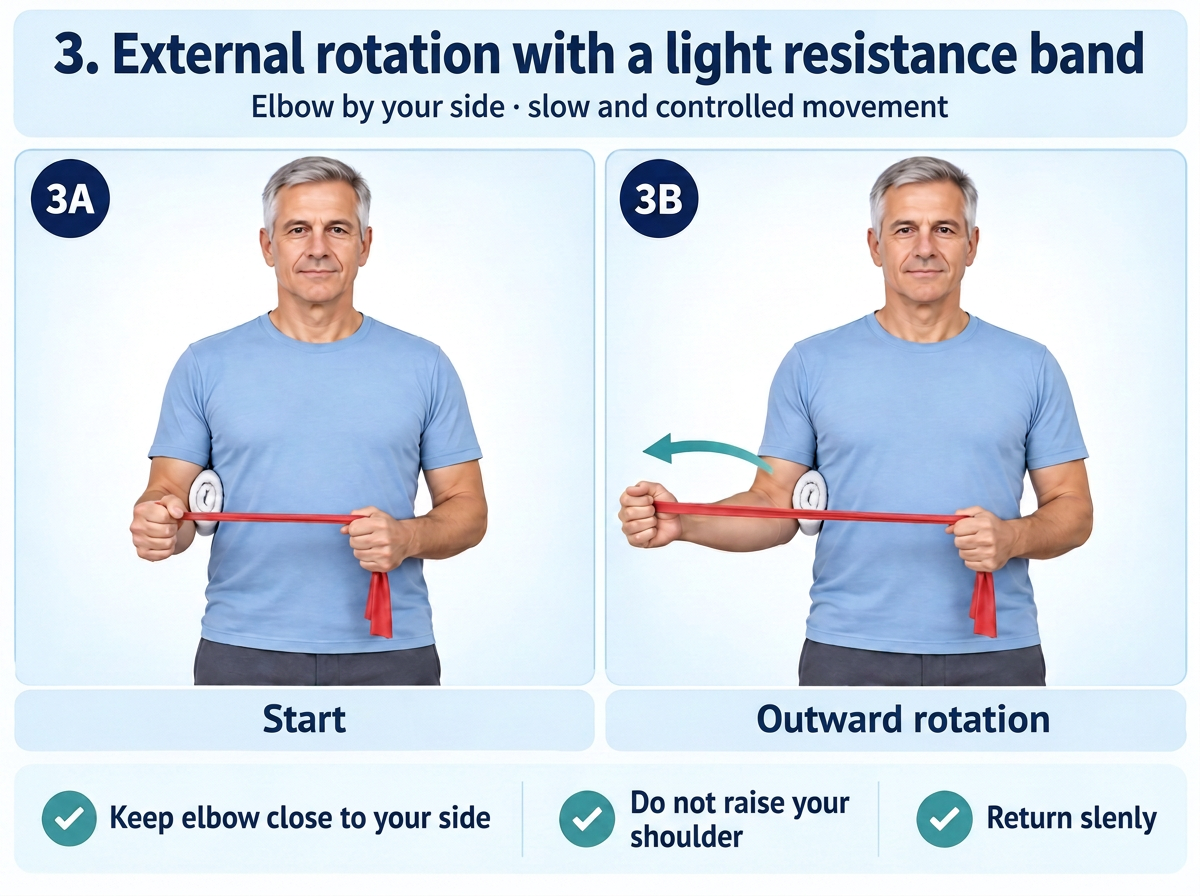
3. External rotation with a light band
Keep the elbow flexed to about 90° and close to the trunk. Slowly move the hand outward, then return under control.
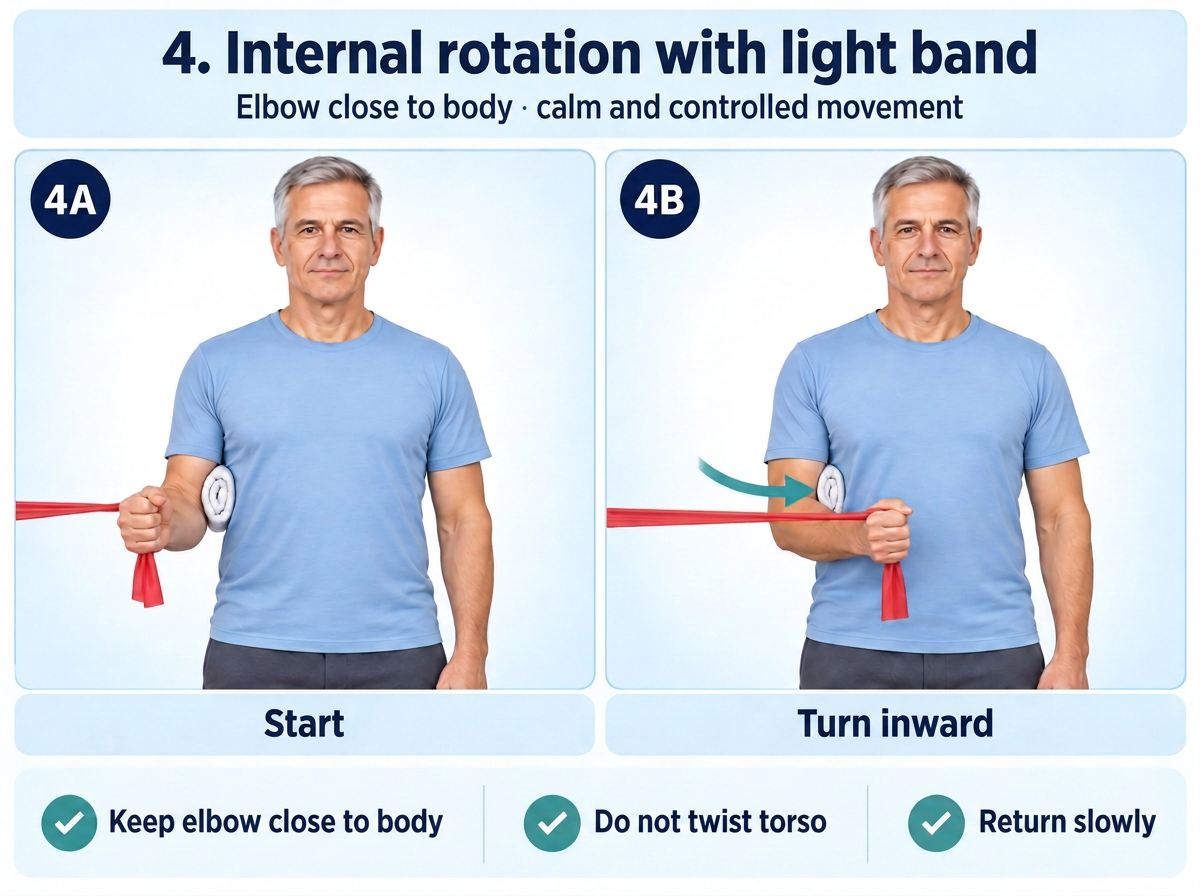
4. Internal rotation with a light band
Stand side-on to the anchor point. Keep the elbow by the trunk, rotate the forearm toward the abdomen and return slowly.
STAGE C · GREATER RANGE
Elevation and progressive loading
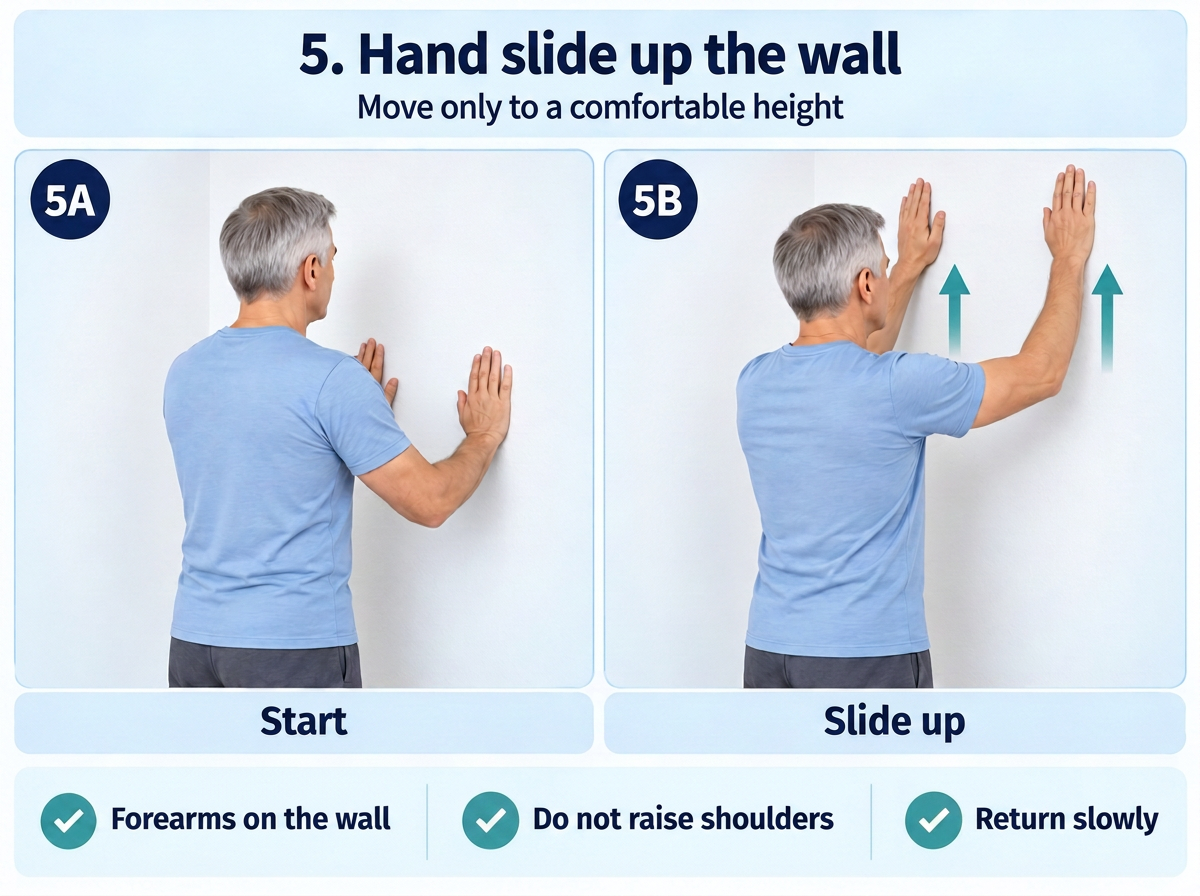
5. Wall slide
Slide the hands upward only to a comfortable height. Do not force end range or shrug the shoulders.
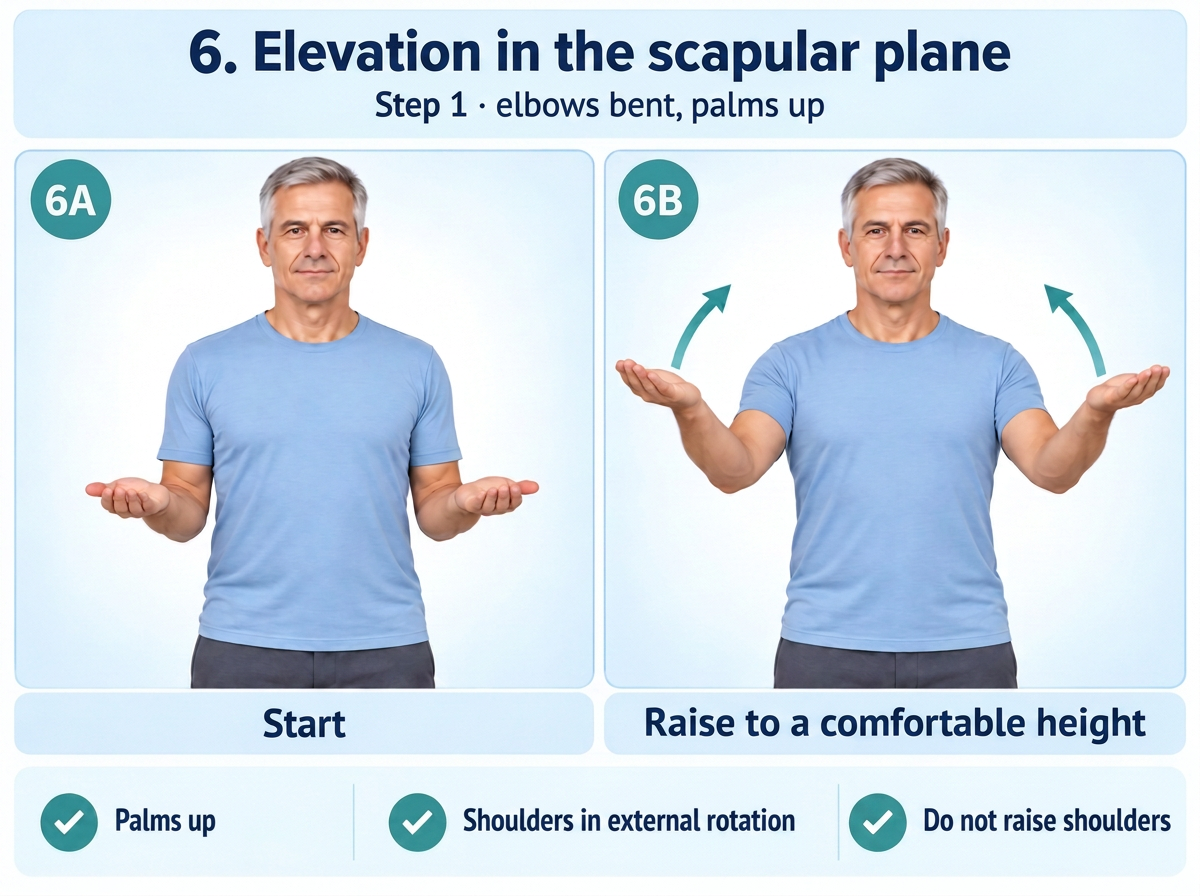
Scapular-plane elevation progression
Raise the arms about 30–45° anterior to the frontal plane. Begin with the easier position, then lengthen the lever arm and progress to less favourable hand positions.
6. Stage 1 — elbows bent, palms up
Bending the elbows shortens the lever arm and usually reduces the moment at the shoulder.
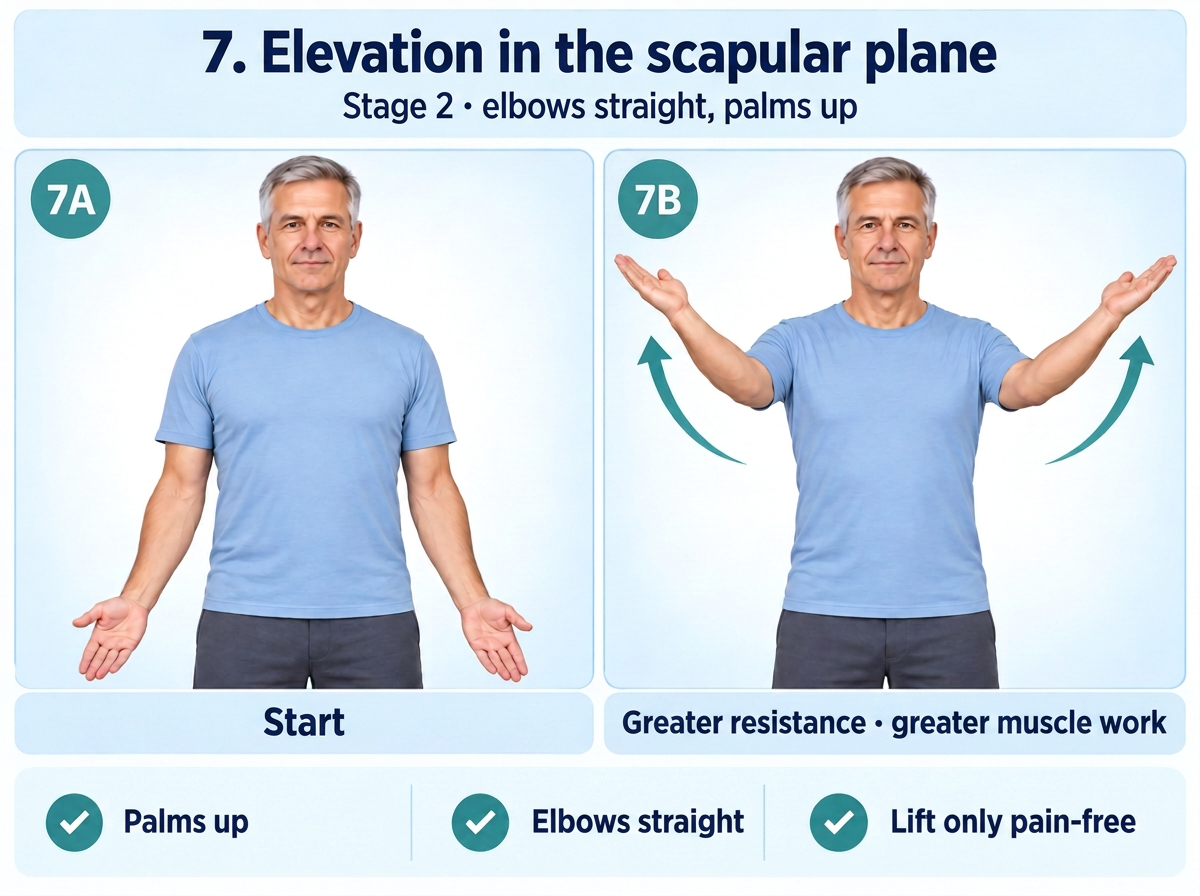
7. Stage 2 — elbows straight, palms up
If the previous exercise is well tolerated, straighten the elbows. The longer lever arm increases the shoulder moment and muscular demand.
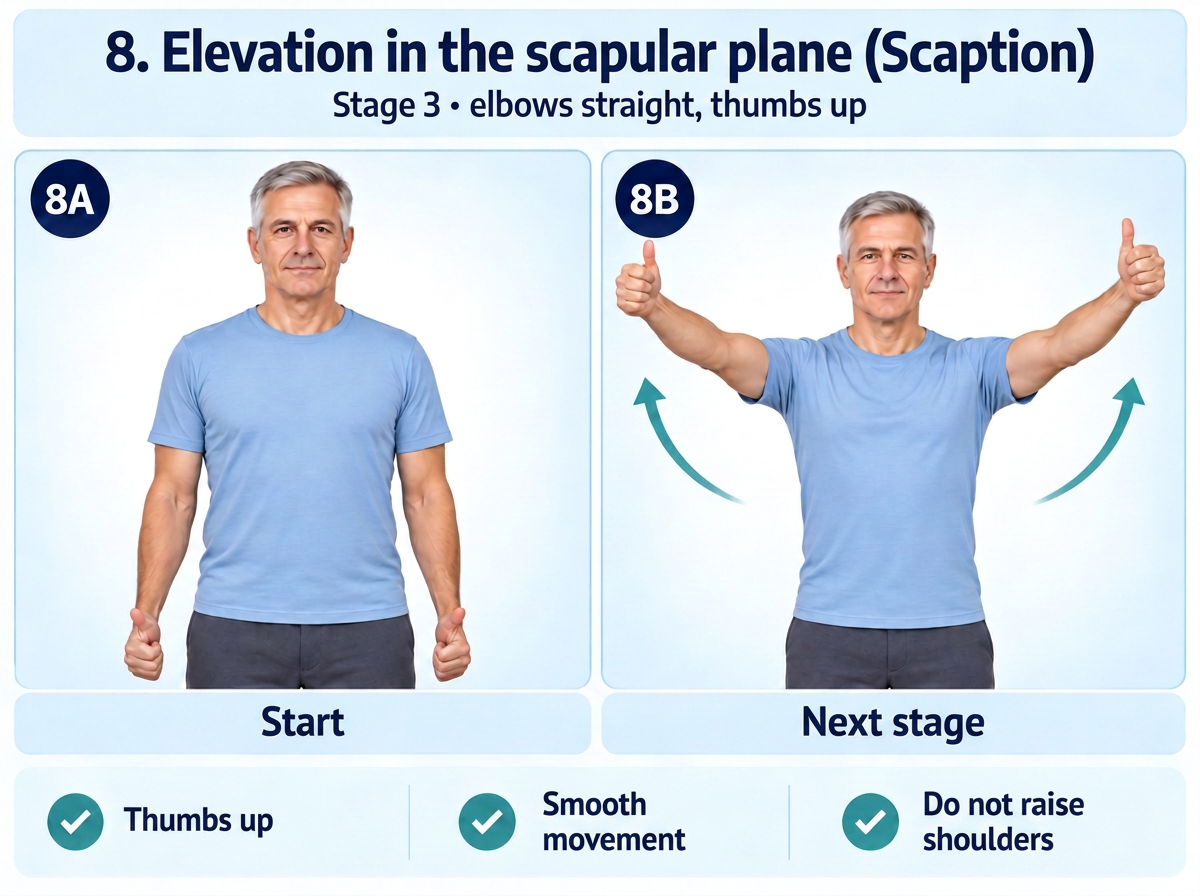
8. Stage 3 — elbows straight, thumbs up
Progress to straight elbows with the thumbs pointing upward only when the earlier position is smooth and well tolerated.
STAGE D · LATER PHASE
Weight-bearing and more provocative positions
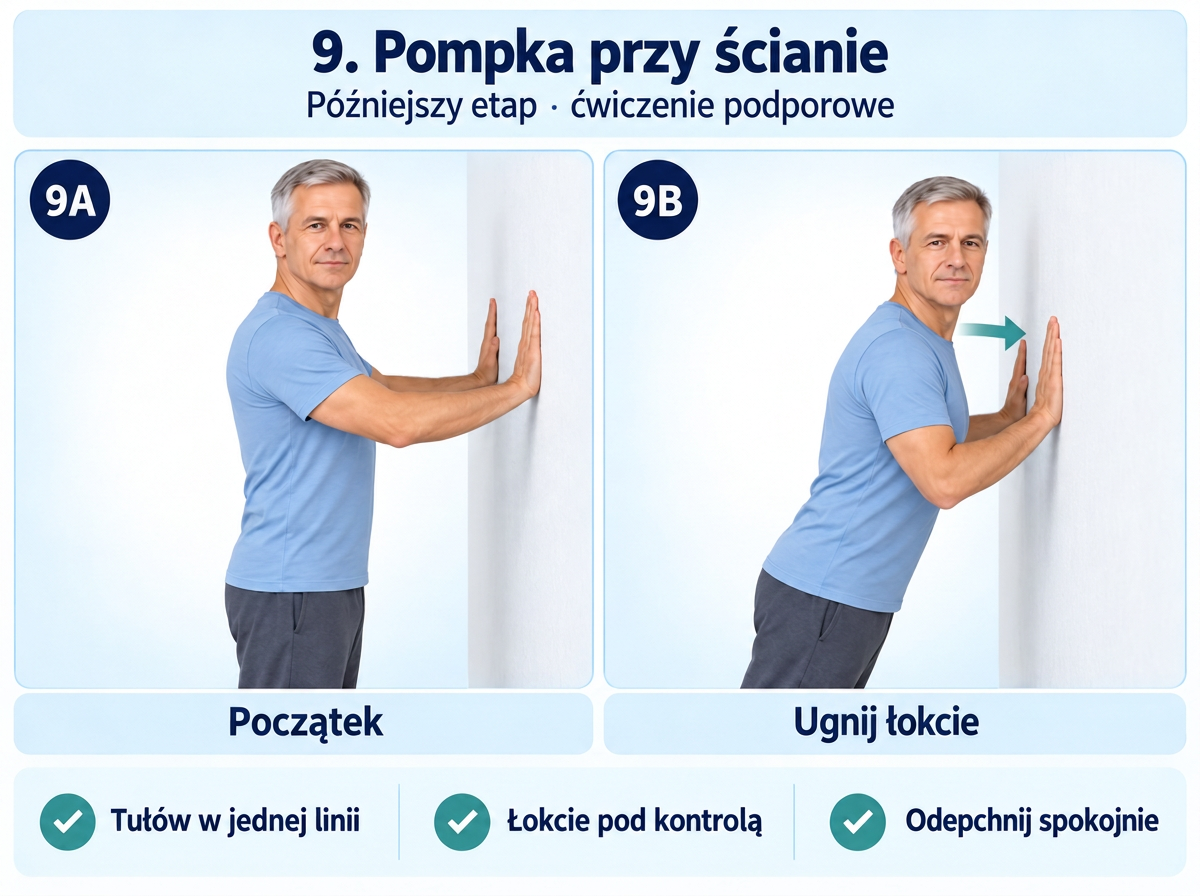
9. Wall push-up
Keep the trunk in one line, bend the elbows under control and push gently back from the wall.
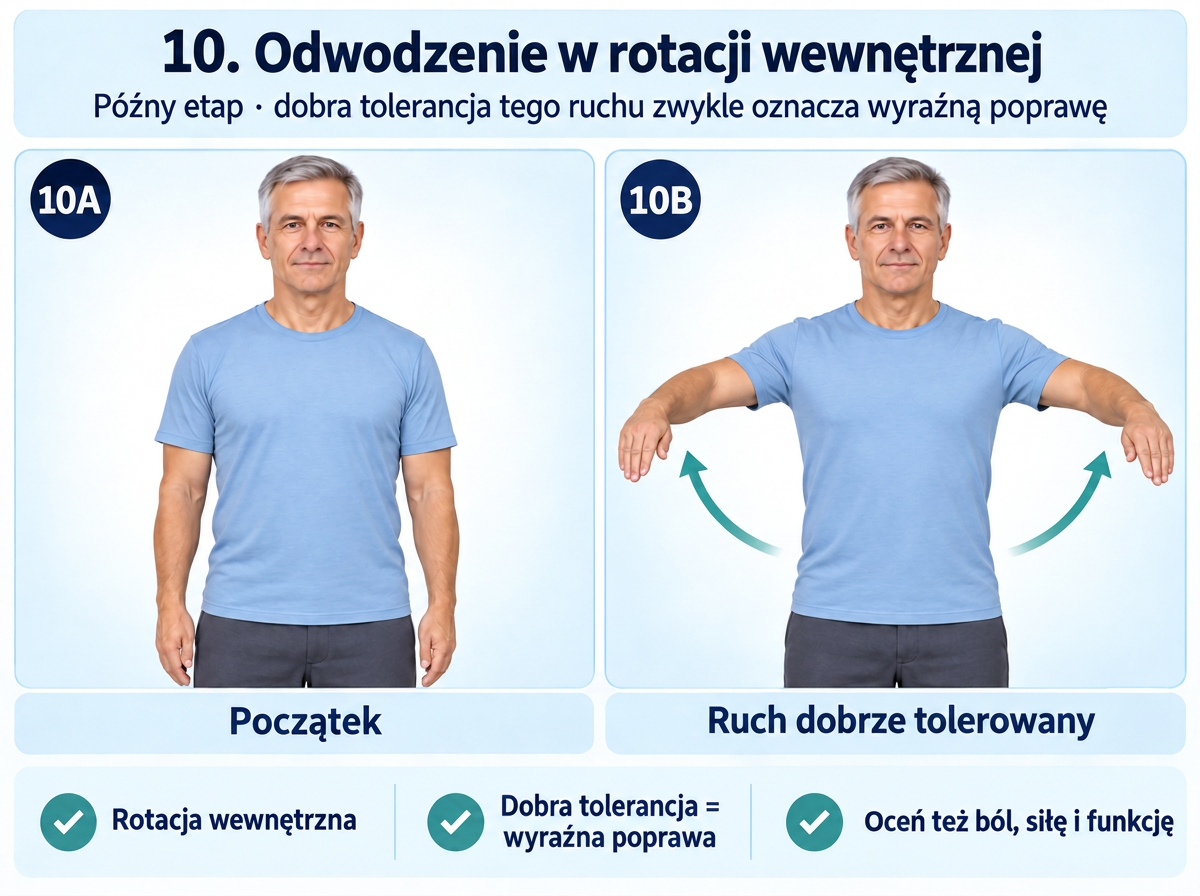
10. Abduction in internal rotation — final progression
For many people this is a more provocative position. If it can be performed smoothly, through the required range and without significant pain after the earlier stages, it is a useful clinical sign of improved shoulder tolerance. It does not by itself prove complete recovery.
Related English resources
Subacromial impingement — symptoms, causes and treatment →
After arthroscopic subacromial decompression — postoperative rehabilitation protocol →
The nonsurgical programme and the postoperative protocol are separate pathways and should not be used interchangeably.
When should exercise stop?
Stop a set for sharp or rapidly increasing pain, new weakness, numbness or a feeling that the shoulder is slipping out. A recent injury with inability to lift the arm, deformity, marked swelling or a hot red shoulder with fever requires prompt medical assessment.