 Skip to content
PATIENT INFORMATION · ADULTS
Hallux valgus: nonoperative care and exercises
Exercises may help foot muscle function, movement control and symptoms. However, they are not a reliable way to eliminate the deformity. Even with diligent training, improvement may be small or absent.
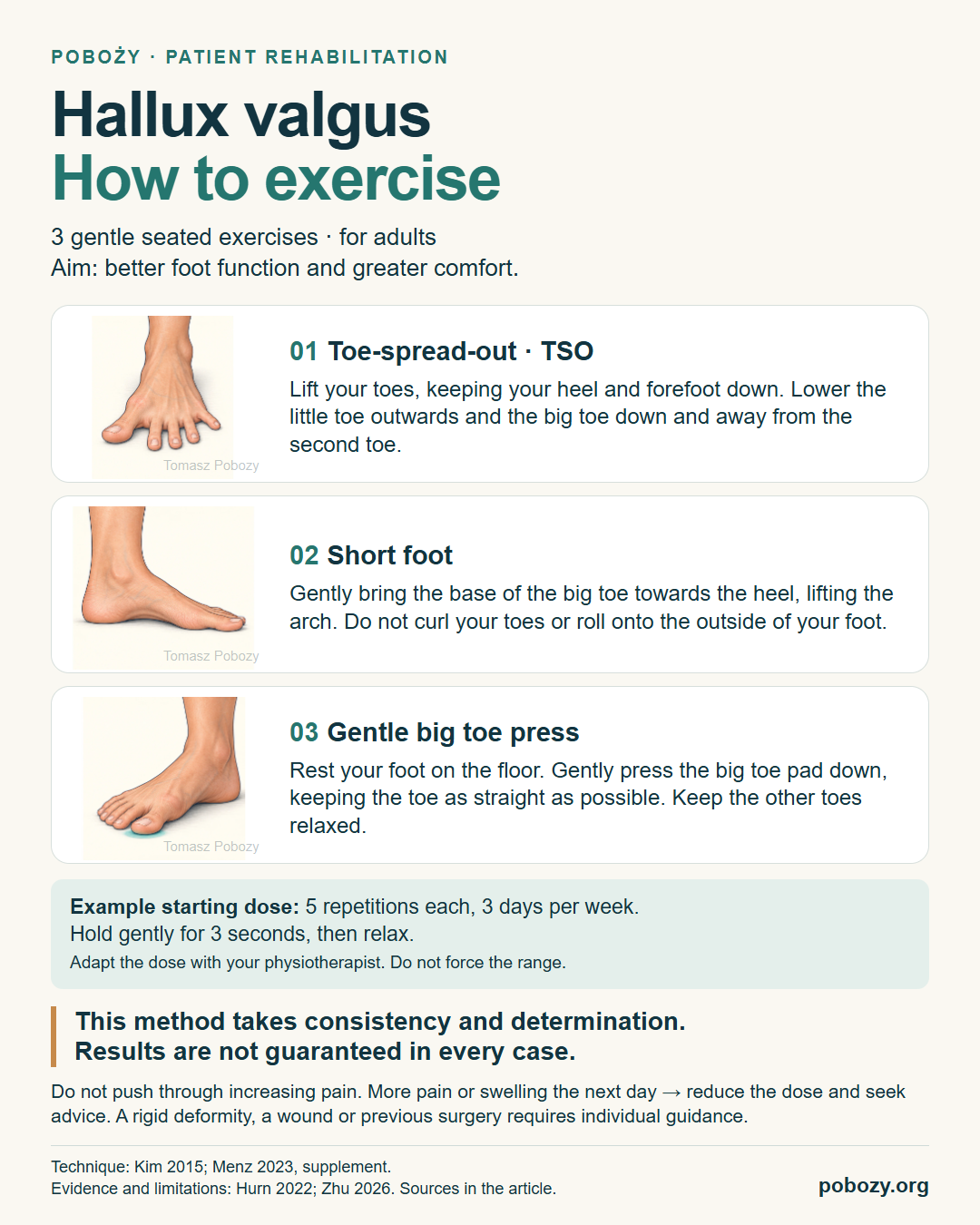
Three gentle seated exercises
The illustration shows three gentle seated exercises:
- Toe-spread-out: first lift your toes while keeping the heel and forefoot down. Then lower the little toe outwards, and the big toe away from the second toe and towards the floor. The movement may initially be very small.
- Short foot: gently lift the arch by bringing the base of the big toe towards the heel. Do not curl your toes or rotate the whole foot.
- Gentle big toe pad press: press lightly into the floor, keeping the big toe as straight as possible; do not push it towards the second toe. This is an easy stage of learning control, before any resistance selected by a physiotherapist.
How to start
An example of a gentle start: 5 repetitions of each exercise, holding for 3 seconds and then relaxing, 3 days per week. This is a suggestion to adapt individually, not a dose proven effective for every patient. If you cannot perform the movement without compensating, ask a physiotherapist to teach you. Once you have mastered the technique, loading can be progressed according to tolerance and the goal of treatment.
When to stop exercising
Consistency does not mean pushing through pain. Stop if pain is sharp or increasing. If pain or swelling is worse the next day, reduce the dose and seek advice about the plan. Do not force the big toe outwards. A wound, a hot red joint, altered sensation, a rigid deformity or previous surgery requires individual guidance; sudden severe symptoms need medical assessment.
Shoes and daily walking
Shoes with room for the toes and no pressure on the bump beside the big toe are also important. Exercises do not replace an orthopaedic assessment if pain interferes with walking or increases despite treatment.
What does research say?
What does research say? The review by Hurn and colleagues found low certainty of evidence. A newer meta-analysis by Zhu and colleagues reports more encouraging results, but larger, high-quality studies are still needed. Some trials combine exercises with other treatments, so not all improvement can be attributed to exercise alone. This short exercise set has not been tested as a separate protocol.