 Skip to content
FOOT AND ANKLE / POSTOPERATIVE PROTOCOL
Lateral malleolus fracture with distal tibiofibular syndesmotic injury
Fibular fixation with stabilisation of an unstable syndesmosis using a screw or suture-button construct. Both bone healing and distal tibiofibular stability require protection.
For clinicians, physiotherapists and patients. The individual plan based on the operative report takes precedence over the time ranges on this page.
Essential protection
- Weight-bearing
- Obtain a written loading plan after syndesmotic fixation. Initial non-weight-bearing or restricted loading is commonly used; earlier walking requires explicit surgeon clearance for the actual construct.
- Brace / immobilisation
- Splint/cast or walking boot according to stability and wound condition.
- Range of motion
- Active movement after clearance; movement permission does not imply permission for resistance or full loading.
Rehabilitation at a glance
Timings are approximate. Progression requires criteria and clearance for the relevant motion or loading level.
- 01
Protection and independence
Weeks 0–2Safe transfers, swelling control and protection of the wound and fixation.
- 02
Movement with protection
Weeks 2–6Restore gentle movement without jeopardising repaired tissues.
- 03
Walking and strength recovery
Usually weeks 6–12Gradual return to footwear and walking without a limp.
- 04
Function and return to activity
From around week 12; criteria basedRestore limb control, stair function, endurance and task-specific capacity.
Full rehabilitation board
Click to enlarge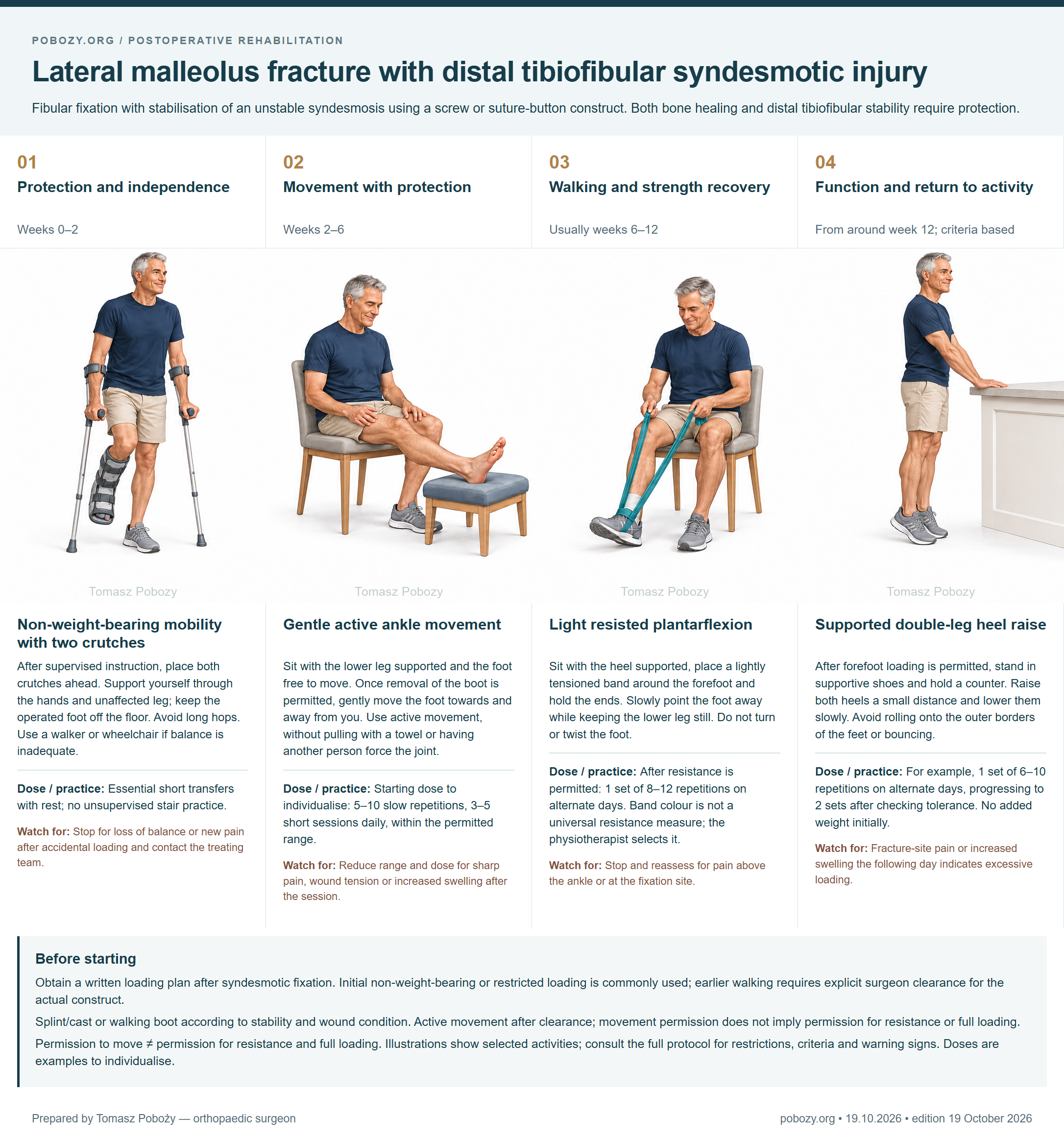
Exercises — take a closer look4 phases • technique • dosage • when to stop
Each phase has its own illustration. The descriptions below are the text equivalent of the board. Doses are starting examples to individualise with a physiotherapist and do not override surgical restrictions.
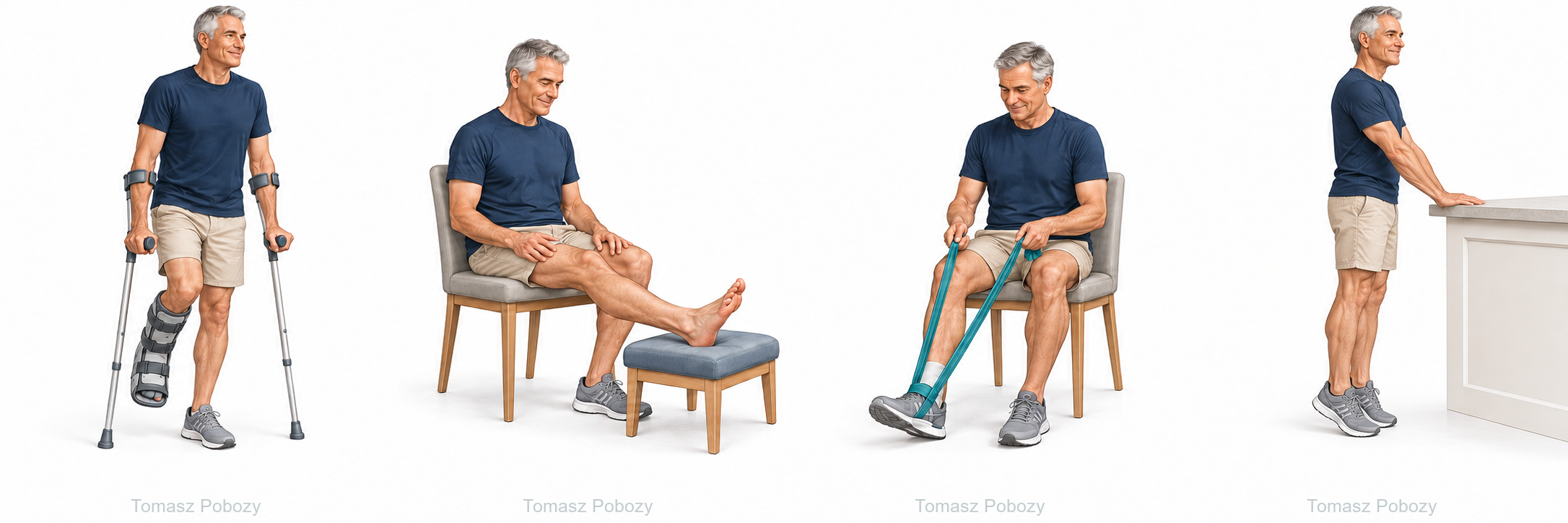
Non-weight-bearing mobility with two crutches
After supervised instruction, place both crutches ahead. Support yourself through the hands and unaffected leg; keep the operated foot off the floor. Avoid long hops. Use a walker or wheelchair if balance is inadequate.
- Dose to individualise
- Essential short transfers with rest; no unsupervised stair practice.
- When to reduce or stop
- Stop for loss of balance or new pain after accidental loading and contact the treating team.
Gentle active ankle movement
Sit with the lower leg supported and the foot free to move. Once removal of the boot is permitted, gently move the foot towards and away from you. Use active movement, without pulling with a towel or having another person force the joint.
- Dose to individualise
- Starting dose to individualise: 5–10 slow repetitions, 3–5 short sessions daily, within the permitted range.
- When to reduce or stop
- Reduce range and dose for sharp pain, wound tension or increased swelling after the session.
Light resisted plantarflexion
Sit with the heel supported, place a lightly tensioned band around the forefoot and hold the ends. Slowly point the foot away while keeping the lower leg still. Do not turn or twist the foot.
- Dose to individualise
- After resistance is permitted: 1 set of 8–12 repetitions on alternate days. Band colour is not a universal resistance measure; the physiotherapist selects it.
- When to reduce or stop
- Stop and reassess for pain above the ankle or at the fixation site.
Supported double-leg heel raise
After forefoot loading is permitted, stand in supportive shoes and hold a counter. Raise both heels a small distance and lower them slowly. Avoid rolling onto the outer borders of the feet or bouncing.
- Dose to individualise
- For example, 1 set of 6–10 repetitions on alternate days, progressing to 2 sets after checking tolerance. No added weight initially.
- When to reduce or stop
- Fracture-site pain or increased swelling the following day indicates excessive loading.
Who this protocol is for
Fibular fixation with stabilisation of an unstable syndesmosis using a screw or suture-button construct. Both bone healing and distal tibiofibular stability require protection.
Adults after fixation of a closed fracture. Open fractures, infection, neuropathy, vascular compromise, pilon injuries, cartilage repair and multiple injuries require a separate plan.
Before starting, confirm the operation date and extent, fixation, permitted loading, support-removal rules, range of motion and review date. Obtain any missing instruction from the surgeon before progressing.
Full programme by phase
01 · Protection and independenceWeeks 0–2
- Goal
- Safe transfers, swelling control and protection of the wound and fixation.
- Weight-bearing
- Follow the prescribed loading level exactly. If it is undocumented, contact the surgeon before increasing load; do not independently adopt weight-bearing as tolerated.
- Support / immobilisation
- Splint, cast or walking boot as discharged. Remove only when permitted.
- Motion
- Move the knee, hip and unrestricted toes. Move the ankle only after clearance to mobilise and remove the support; do not force it.
- Work in this phase
- Practise safe sit-to-stand transfers and short-distance mobility. Maintain thigh activation without resistance through the foot. Follow the individual thromboprophylaxis prescription.
- Progression criteria
- Wound and circulation assessed, swelling controlled, loading prescription understood and aids used safely.
02 · Movement with protectionWeeks 2–6
- Goal
- Restore gentle movement without jeopardising repaired tissues.
- Weight-bearing
- Obtain a written loading plan after syndesmotic fixation. Initial non-weight-bearing or restricted loading is commonly used; earlier walking requires explicit surgeon clearance for the actual construct.
- Support / immobilisation
- Usually a removable walking boot when the wound and stability permit. Night-time use follows the surgeon’s instructions; do not discontinue it independently.
- Motion
- Active dorsiflexion and plantarflexion within the permitted range. Avoid forced external rotation, end-range dorsiflexion and syndesmotic manipulation.
- Work in this phase
- Use short movement sessions several times daily. Continue hip and knee strengthening without foot loading. Practise gait within the prescribed load and avoid pivoting on the operated leg.
- Progression criteria
- Clinical and imaging review confirms maintained alignment, without worsening wound or increasing pain. Further resistance and loading progression have been authorised.
03 · Walking and strength recoveryUsually weeks 6–12
- Goal
- Gradual return to footwear and walking without a limp.
- Weight-bearing
- Progress only after clearance based on healing and stability. Move from two crutches to one, usually contralateral, then no aid, provided gait quality is maintained.
- Support / immobilisation
- Wean from the walking boot in stages once cleared. Choose supportive footwear; swelling may require a wider shoe.
- Motion
- Gradually expand active movement and, after healing assessment, gentle assistance. Do not force symmetrical angles at the expense of pain.
- Work in this phase
- Add light resistance and weight-bearing exercises within the loading limit. Start stationary cycling only when pedal loading and required motion are permitted. Increase one variable at a time.
- Progression criteria
- Walking in shoes without a significant limp, no marked next-day reaction, improving motion and strength, and healing adequate for further progression.
04 · Function and return to activityFrom around week 12; criteria based
- Goal
- Restore limb control, stair function, endurance and task-specific capacity.
- Weight-bearing
- Full weight-bearing after clearance. Running, jumping and direction changes require confirmed healing, adequate strength and control, and no pain or swelling response.
- Support / immobilisation
- Usually supportive footwear. Additional bracing requires a specific indication and does not replace neuromuscular recovery.
- Motion
- Range sufficient for gait and functional tasks; persistent mechanical block, joint pain or increasing stiffness requires reassessment.
- Work in this phase
- Progress calf strengthening, balance and functional tasks. Before sport, assess both limbs, movement quality and endurance; symmetry alone is insufficient if both limbs are weak.
- Progression criteria
- Treating-team clearance, no fracture-site pain, safe stairs and work- or sport-specific tasks, without deterioration after loading or the following day.
How to adjust the dose
Increase one element at a time: repetitions, distance, range or resistance. Sharp pain, limping or markedly increased swelling calls for reducing the load. Check symptoms after exercise and the following day; discuss persistent deterioration. Absence of pain does not replace union assessment.
If the surgeon prescribes a kilogram limit, record the value and duration. Do not independently convert “as tolerated” into kilograms. Do not add weights without clearance for resistance.
Everyday activities and return to function
- Walking and stairs
- Use aids while needed to respect the load restriction and maintain gait quality. Practise stairs with a physiotherapist; choose a safer alternative when support or a rail is unavailable.
- Driving
- Resume only after assessment of rapid, forceful emergency braking and without medication impairing alertness. Operated side, transmission, bracing and loading restrictions affect the decision; discuss it with the treating team and consider insurance conditions.
- Work, rest and swelling
- Seated work requires opportunities to change position and elevate the leg; standing or manual work requires loading and task tolerance. Swelling may persist, but new or rapidly increasing swelling requires assessment.
- Wound care and prevention
- Do not soak an unhealed wound, remove wires yourself or change prescribed thromboprophylaxis. Follow individual medication, dressing, compression and scar-care instructions. Swimming requires complete wound closure and clearance.
- Running and sport
- Timing follows healing and capacity; it is not a stand-alone criterion. Establish safe gait, strength, balance and task tolerance first, progressing without significant next-day worsening.
Warning signs — when to seek help
- Emergency help
- Sudden shortness of breath, chest pain, collapse or coughing up blood: call emergency services. Use 112 in the EU; elsewhere use the appropriate local emergency number.
- Urgent same-day assessment
- New one-sided calf pain and swelling; increasing pain despite rest; fever with wound redness or discharge; wound breakdown; a new injury or pain after accidental loading.
- Do not wait for a routine appointment
- A cold, pale or blue foot, rapidly increasing numbness, loss of toe movement or severe increasing pain under a cast requires immediate emergency assessment.
Variants and clinical context
- Implant type alone does not authorise early full weight-bearing. Deltoid repair, a Maisonneuve injury or a posterior malleolus fracture may alter the plan.
- The treating surgeon must establish fixation stability. No implant protects against every overload.
- The WAX trial supports considering weight-bearing from week 2 in appropriately selected adults after ankle fracture surgery. It does not establish immediate unprotected walking for every patient.
- Do not assume routine syndesmotic screw removal is required before loading. The surgeon determines indications for removal and subsequent management; RODEO supports on-demand rather than universal routine removal.
Related resources
References and evidenceVerified publications and evidence limitations
- Early versus delayed weight-bearing following operatively treated ankle fracture (WAX): a non-inferiority, multicentre, randomised controlled trial. The Lancet. 2024. DOI: 10.1016/S0140-6736(24)00710-4.
- Early Weightbearing and Range of Motion Versus Non-Weightbearing and Immobilization After Open Reduction and Internal Fixation of Unstable Ankle Fractures: A Randomized Controlled Trial. Journal of Orthopaedic Trauma. 2016. DOI: 10.1097/BOT.0000000000000572.
- Functional outcome of routine versus on-demand removal of the syndesmotic screw: a multicentre randomized controlled trial. The Bone & Joint Journal. 2021. DOI: 10.1302/0301-620X.103B11.BJJ-2021-0348.R2.
Research informs protection and progression decisions; it does not validate every illustrated exercise or example dose. Procedure details, tissue condition and the individual plan determine application.
Glossary
- ROM
- Joint range of motion. Active movement uses your own muscles; assisted movement uses additional help.
- Non-weight-bearing
- No body-weight transfer through the operated foot during standing and walking.
- As tolerated
- Once this pathway is authorised: loading limited by symptoms and movement quality within prescribed protection. It is not permission for unrestricted sport.
- Walker
- A walking boot is a protective ankle-foot support. A walking frame is a separate mobility aid.