 Skip to content
Patient knowledge / Rehabilitation
Tennis elbow: exercises and everyday tasks
With pain on the outside of the elbow, matching the load to your tolerance matters. Choose exercises according to your arm’s response and divide aggravating tasks into shorter sections. You do not need to immobilise the whole limb.
Tomasz Poboży · pobozy.org · 20.10.2026
Who this guide is for
For adults with diagnosed tennis elbow, or lateral elbow tendinopathy, in the subacute or chronic stage. This is not a programme after surgery or a recent injury. New loss of sensation, marked hand weakness or pain spreading from the neck requires assessment for another possible cause.
Your first session
Begin with unloaded movement. Initially choose resistance exercise 2 or 3; neither must be combined with the other in the same session. Support the forearm and relax the shoulder. If even light resistance clearly increases pain, the programme needs adjustment.
These doses are proposed starting examples to individualise, not a research-validated schedule for every patient. Your doctor’s or physiotherapist’s individual instructions take priority.
The full exercise board
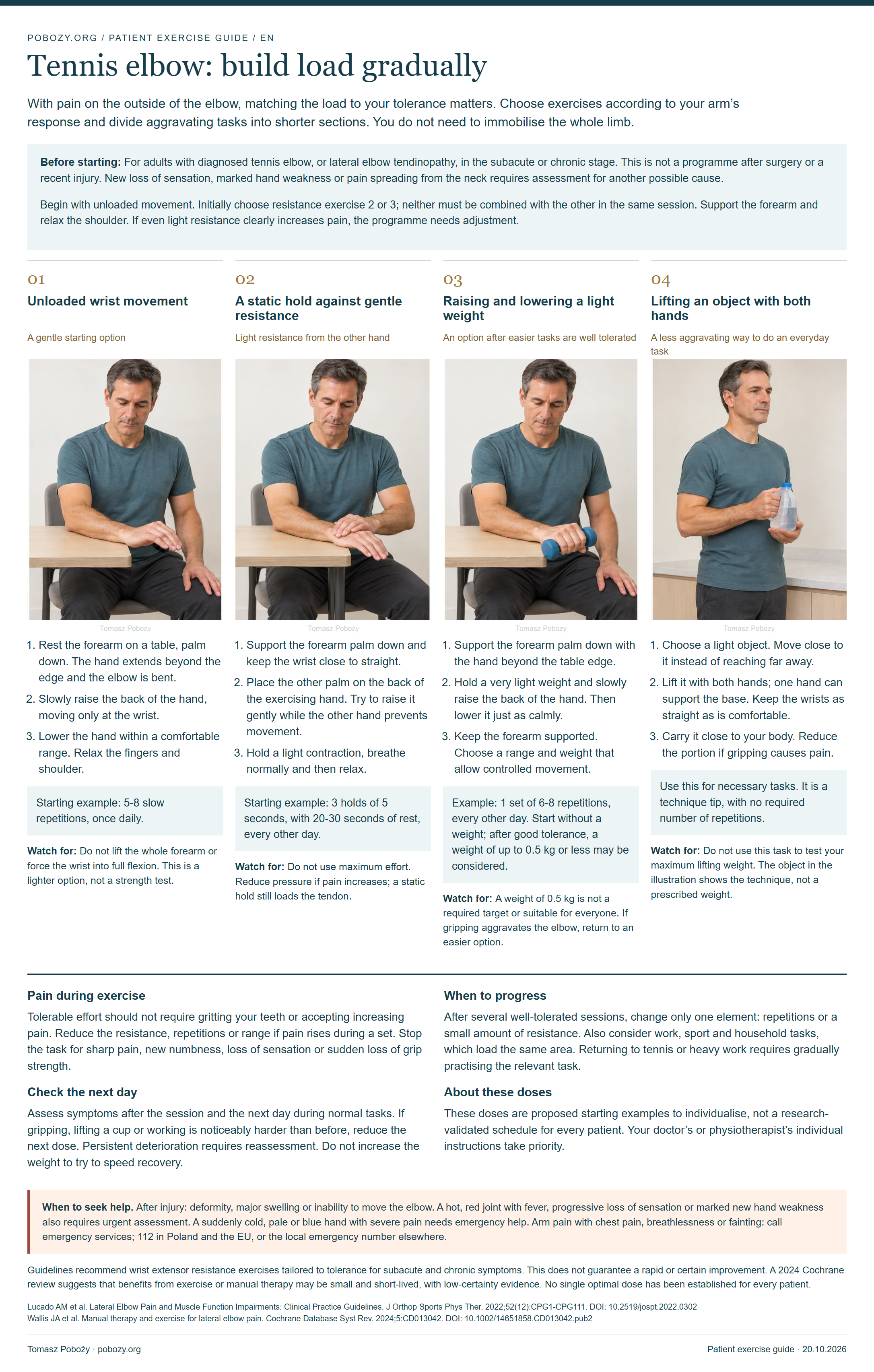
Exercises – a closer lookTechnique, starting dose and common pitfalls
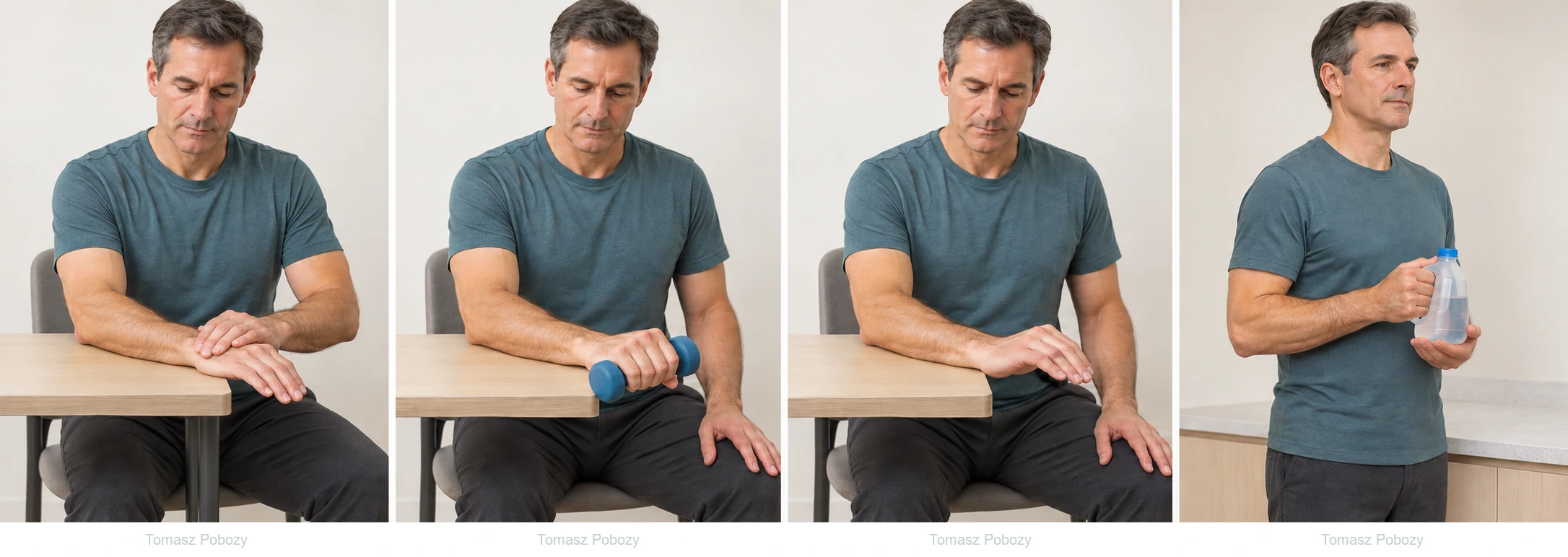
01 / A gentle starting option
Unloaded wrist movement
- Rest the forearm on a table, palm down. The hand extends beyond the edge and the elbow is bent.
- Slowly raise the back of the hand, moving only at the wrist.
- Lower the hand within a comfortable range. Relax the fingers and shoulder.
Starting example: 5-8 slow repetitions, once daily.
Watch for: Do not lift the whole forearm or force the wrist into full flexion. This is a lighter option, not a strength test.
02 / Light resistance from the other hand
A static hold against gentle resistance
- Support the forearm palm down and keep the wrist close to straight.
- Place the other palm on the back of the exercising hand. Try to raise it gently while the other hand prevents movement.
- Hold a light contraction, breathe normally and then relax.
Starting example: 3 holds of 5 seconds, with 20-30 seconds of rest, every other day.
Watch for: Do not use maximum effort. Reduce pressure if pain increases; a static hold still loads the tendon.
03 / An option after easier tasks are well tolerated
Raising and lowering a light weight
- Support the forearm palm down with the hand beyond the table edge.
- Hold a very light weight and slowly raise the back of the hand. Then lower it just as calmly.
- Keep the forearm supported. Choose a range and weight that allow controlled movement.
Example: 1 set of 6-8 repetitions, every other day. Start without a weight; after good tolerance, a weight of up to 0.5 kg or less may be considered.
Watch for: A weight of 0.5 kg is not a required target or suitable for everyone. If gripping aggravates the elbow, return to an easier option.
04 / A less aggravating way to do an everyday task
Lifting an object with both hands
- Choose a light object. Move close to it instead of reaching far away.
- Lift it with both hands; one hand can support the base. Keep the wrists as straight as is comfortable.
- Carry it close to your body. Reduce the portion if gripping causes pain.
Use this for necessary tasks. It is a technique tip, with no required number of repetitions.
Watch for: Do not use this task to test your maximum lifting weight. The object in the illustration shows the technique, not a prescribed weight.
How to respond to pain
Tolerable effort should not require gritting your teeth or accepting increasing pain. Reduce the resistance, repetitions or range if pain rises during a set. Stop the task for sharp pain, new numbness, loss of sensation or sudden loss of grip strength.
The next day
Assess symptoms after the session and the next day during normal tasks. If gripping, lifting a cup or working is noticeably harder than before, reduce the next dose. Persistent deterioration requires reassessment. Do not increase the weight to try to speed recovery.
When to progress
After several well-tolerated sessions, change only one element: repetitions or a small amount of resistance. Also consider work, sport and household tasks, which load the same area. Returning to tennis or heavy work requires gradually practising the relevant task.
Everyday tasks
Gripping and lifting
Carry lighter portions, use both hands and keep objects closer to your body. Avoid prolonged forceful gripping and lifting a load at arm’s length if these provoke pain.
Computer work and tools
Support the forearm, choose a comfortable workstation height and do not rest your body weight on the painful elbow. Vary tasks and take short breaks before symptoms build substantially.
Work and sport
Initially reduce the duration, grip force or frequency of the aggravating task. Adjust equipment and technique with your clinician. A strap or pain medicine is not permission to increase painful loading.
When to seek help
Urgent assessment
After injury: deformity, major swelling or inability to move the elbow. A hot, red joint with fever, progressive loss of sensation or marked new hand weakness also requires urgent assessment.
Emergency help
A suddenly cold, pale or blue hand with severe pain needs emergency help. Arm pain with chest pain, breathlessness or fainting: call emergency services; 112 in Poland and the EU, or the local emergency number elsewhere.
When to review the plan
If several weeks of adjusted activity bring no favourable change, or symptoms worsen, review the diagnosis and plan with a doctor or physiotherapist. Repeatedly dropping objects and altered sensation should not be treated as ordinary tendon overload.
A short record of your response
Write down what you did, your symptoms afterwards and the response the following day.
| Date / task | Dose | After exercise | The next day |
|---|---|---|---|
References and evidence
Guidelines recommend wrist extensor resistance exercises tailored to tolerance for subacute and chronic symptoms. This does not guarantee a rapid or certain improvement. A 2024 Cochrane review suggests that benefits from exercise or manual therapy may be small and short-lived, with low-certainty evidence. No single optimal dose has been established for every patient.
- Lucado AM et al. Lateral Elbow Pain and Muscle Function Impairments: Clinical Practice Guidelines. J Orthop Sports Phys Ther. 2022;52(12):CPG1-CPG111. DOI: 10.2519/jospt.2022.0302
- Wallis JA et al. Manual therapy and exercise for lateral elbow pain. Cochrane Database Syst Rev. 2024;5:CD013042. DOI: 10.1002/14651858.CD013042.pub2
These doses are proposed starting examples to individualise, not a research-validated schedule for every patient. Your doctor’s or physiotherapist’s individual instructions take priority.