 Skip to content
Patient knowledge / Rehabilitation
Flexible flatfoot in children: when and how to exercise
A low painless arch is often a developmental variation. Exercise may support function and activity tolerance in a child with symptoms; it is not a mandatory way to “build an arch” in every child.
Tomasz Poboży · pobozy.org · 22.10.2026
Who this is for
A school-age child with assessed flexible flatfoot and mild symptoms or a recommendation to work on function. Not for a rigid, progressively asymmetric or acutely painful foot, or unexplained limping. Younger children need developmentally adapted tasks.
Your first session
A parent helps with positioning and balance without forcing the foot. Start with 1-2 tasks as a short game. Pain is not necessary for useful exercise.
The doses shown are examples of a gentle start. Select tasks, range and load with your clinician according to the diagnosis and your response. You do not need every option in one session.
Foot shape and the need for treatment
Flexibility is assessed partly by arch reappearance when unloaded or on tiptoe, but a home test alone does not establish the diagnosis. Observation is usually enough without pain or limitations in play. Exercise and insoles are chosen for symptoms, not a photograph of the feet alone. Permanent bone correction or prevention of all future symptoms is not promised.
The complete board
Exercises and tasksTechnique, dose and options
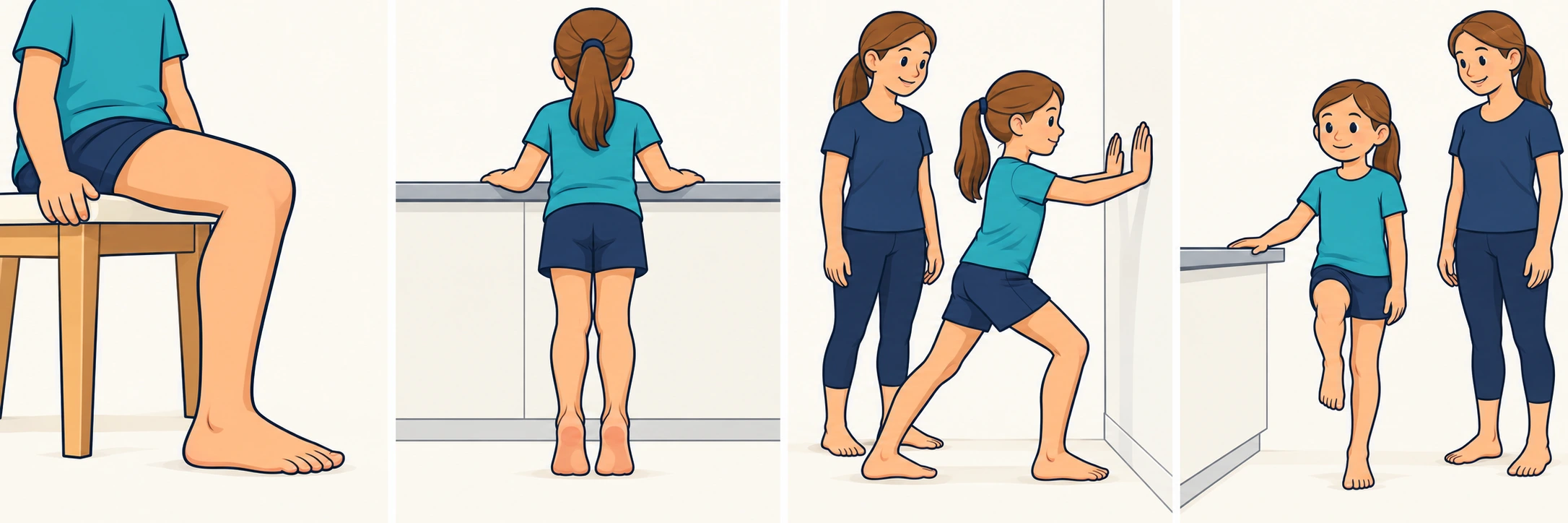
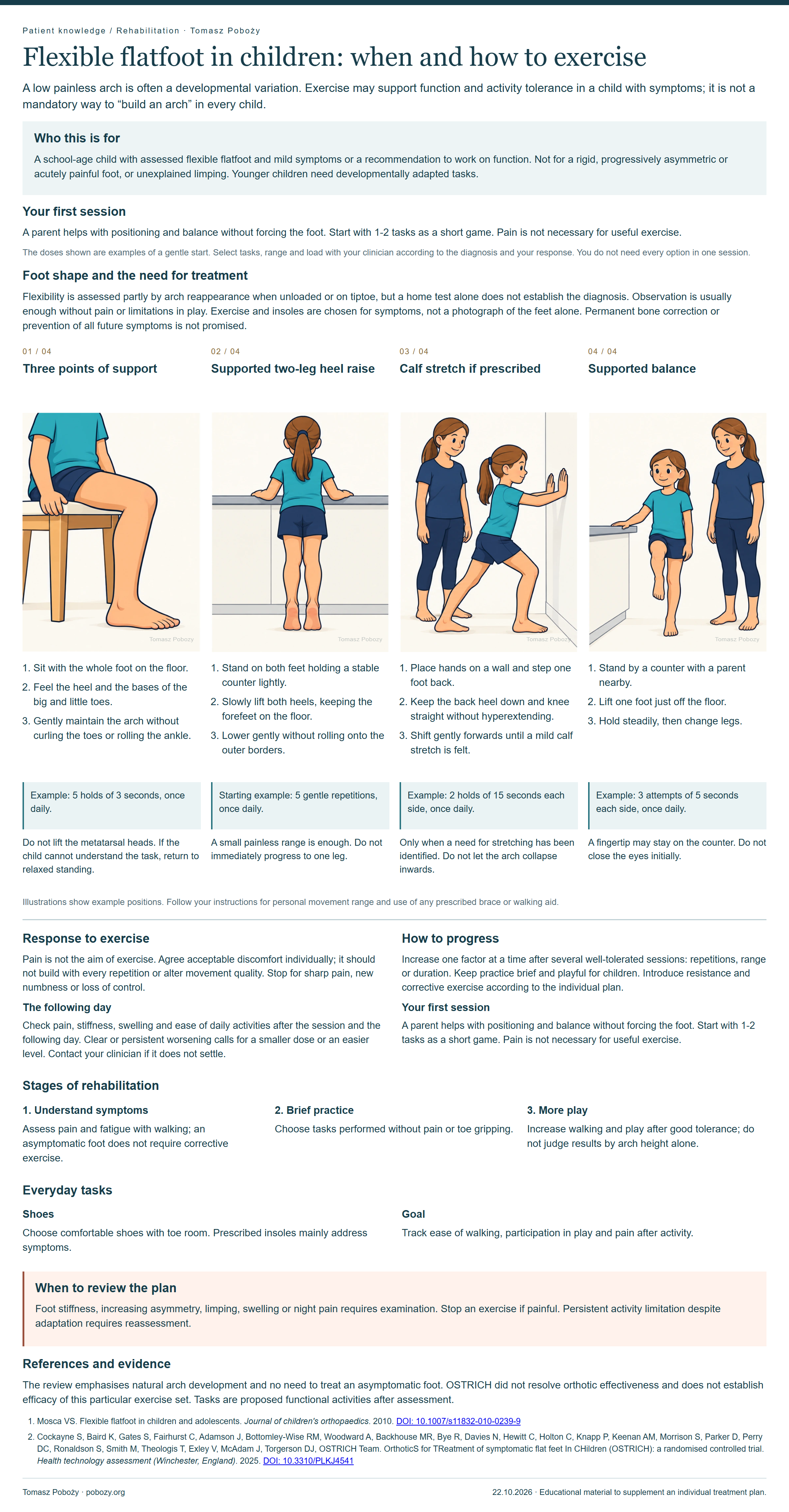
Three points of support
- Sit with the whole foot on the floor.
- Feel the heel and the bases of the big and little toes.
- Gently maintain the arch without curling the toes or rolling the ankle.
Example: 5 holds of 3 seconds, once daily.
Do not lift the metatarsal heads. If the child cannot understand the task, return to relaxed standing.
Supported two-leg heel raise
- Stand on both feet holding a stable counter lightly.
- Slowly lift both heels, keeping the forefeet on the floor.
- Lower gently without rolling onto the outer borders.
Starting example: 5 gentle repetitions, once daily.
A small painless range is enough. Do not immediately progress to one leg.
Calf stretch if prescribed
- Place hands on a wall and step one foot back.
- Keep the back heel down and knee straight without hyperextending.
- Shift gently forwards until a mild calf stretch is felt.
Example: 2 holds of 15 seconds each side, once daily.
Only when a need for stretching has been identified. Do not let the arch collapse inwards.
Supported balance
- Stand by a counter with a parent nearby.
- Lift one foot just off the floor.
- Hold steadily, then change legs.
Example: 3 attempts of 5 seconds each side, once daily.
A fingertip may stay on the counter. Do not close the eyes initially.
Illustrations show example positions. Follow your instructions for personal movement range and use of any prescribed brace or walking aid.
Response to exercise
Pain is not the aim of exercise. Agree acceptable discomfort individually; it should not build with every repetition or alter movement quality. Stop for sharp pain, new numbness or loss of control.
The following day
Check pain, stiffness, swelling and ease of daily activities after the session and the following day. Clear or persistent worsening calls for a smaller dose or an easier level. Contact your clinician if it does not settle.
How to progress
Increase one factor at a time after several well-tolerated sessions: repetitions, range or duration. Keep practice brief and playful for children. Introduce resistance and corrective exercise according to the individual plan.
1. Understand symptoms
Assess pain and fatigue with walking; an asymptomatic foot does not require corrective exercise.
2. Brief practice
Choose tasks performed without pain or toe gripping.
3. More play
Increase walking and play after good tolerance; do not judge results by arch height alone.
Everyday tasks
Shoes
Choose comfortable shoes with toe room. Prescribed insoles mainly address symptoms.
Goal
Track ease of walking, participation in play and pain after activity.
When to review the plan
Foot stiffness, increasing asymmetry, limping, swelling or night pain requires examination. Stop an exercise if painful. Persistent activity limitation despite adaptation requires reassessment.
Record your response
| Date / task | Dose | Afterwards | Next day |
|---|---|---|---|
References and evidence
The review emphasises natural arch development and no need to treat an asymptomatic foot. OSTRICH did not resolve orthotic effectiveness and does not establish efficacy of this particular exercise set. Tasks are proposed functional activities after assessment.
- Mosca VS. Flexible flatfoot in children and adolescents. Journal of children’s orthopaedics. 2010. DOI: 10.1007/s11832-010-0239-9
- Cockayne S, Baird K, Gates S, Fairhurst C, Adamson J, Bottomley-Wise RM, Woodward A, Backhouse MR, Bye R, Davies N, Hewitt C, Holton C, Knapp P, Keenan AM, Morrison S, Parker D, Perry DC, Ronaldson S, Smith M, Theologis T, Exley V, McAdam J, Torgerson DJ, OSTRICH Team. OrthoticS for TReatment of symptomatic flat feet In CHildren (OSTRICH): a randomised controlled trial. Health technology assessment (Winchester, England). 2025. DOI: 10.3310/PLKJ4541
The doses shown are examples of a gentle start. Select tasks, range and load with your clinician according to the diagnosis and your response. You do not need every option in one session.