 Skip to content
FOR CLINICIANS AND PHYSIOTHERAPISTS
Median nerve decompression for carpal tunnel syndrome — postoperative protocol
Postoperative protocol. Wound protection, early movement and a gradual return to hand function.
Using and loading the limb
Early light self-care and gentle movement; avoid forceful grip, pressure on the fresh wound and body-weight support. Progress strength with healing and tolerance.
Full guidance ↓Brace or immobilisation
Routine wrist immobilisation is not recommended after isolated uncomplicated release. Follow any separate surgical indication.
Full guidance ↓Permitted movement
Move fingers and wrist within tolerance. Nerve glides should not provoke increasing or persistent paraesthesia.
Full guidance ↓Permitted movement, loading and removal of a brace are separate decisions. Additional repairs may require a more protective programme.
Rehabilitation at a glance
Progression follows healing and functional criteria, not dates alone.
Rehabilitation boards
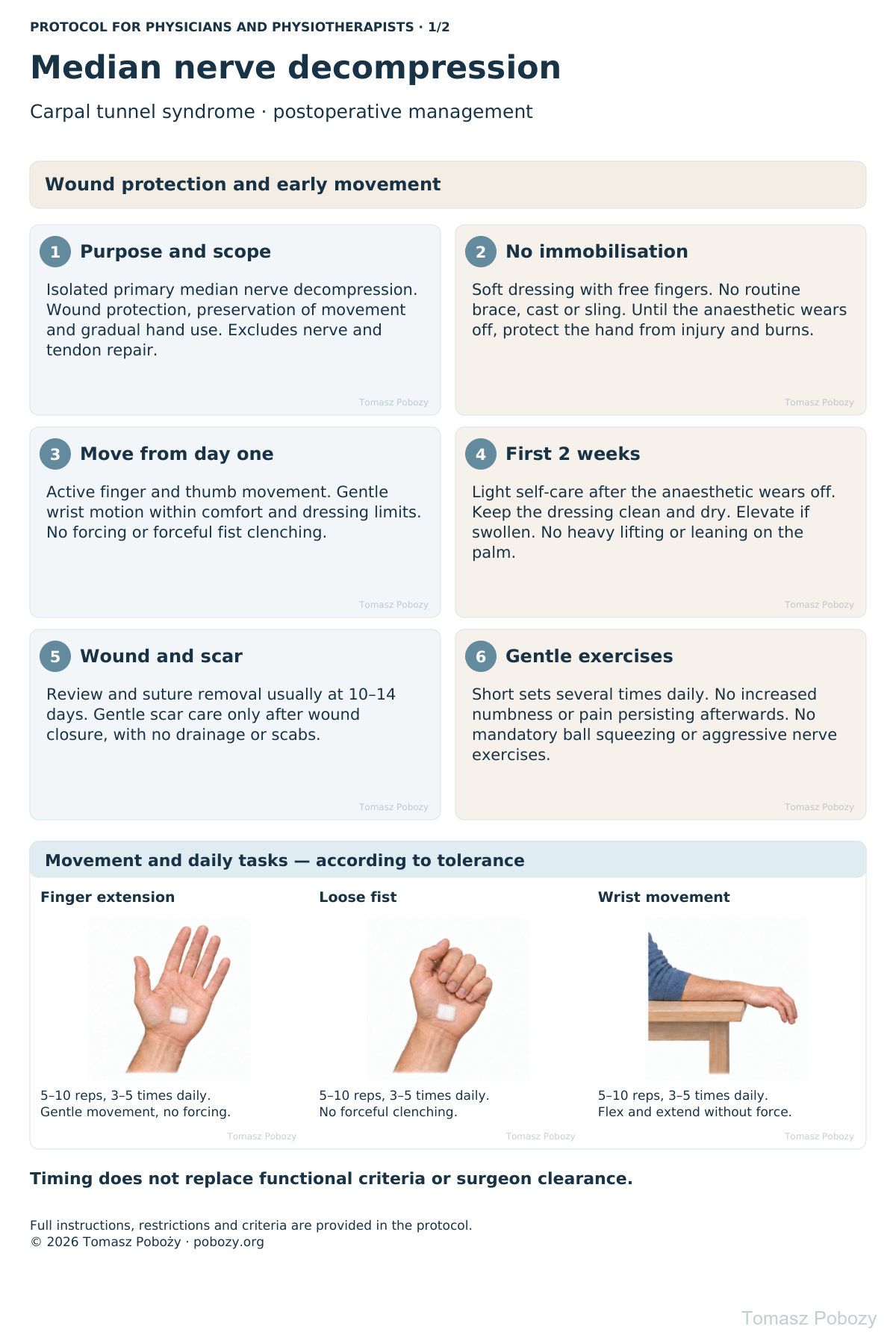
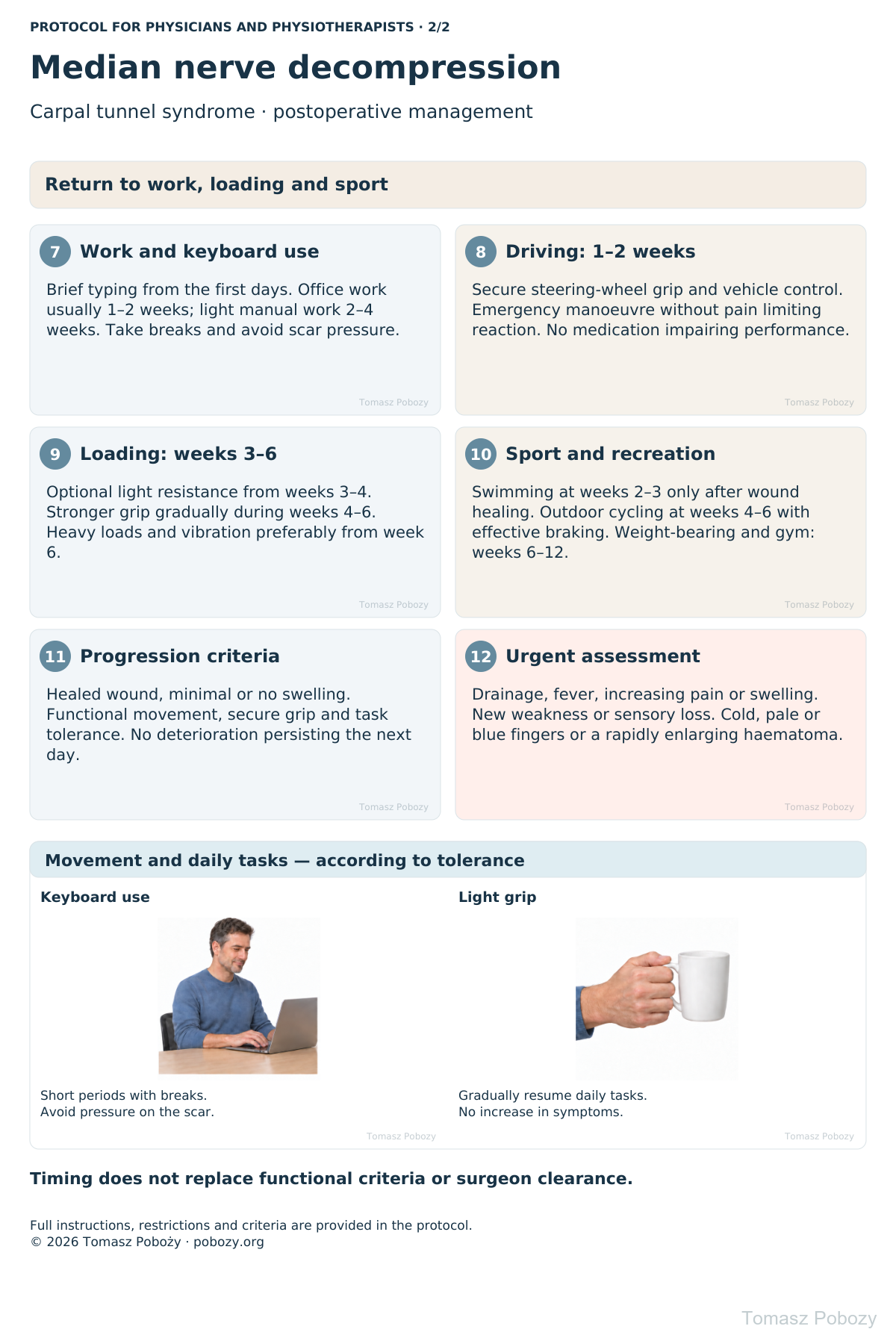
Exercises — a closer look
Use the complete boards above together with the instructions for the chosen stage. An exercise shown for a later stage is not permitted early.
Open the relevant complete board and zoom in. The viewer retains all stages and captions.
Exercise instructions and progression are contained in the stage descriptions linked above.
Scope and protection
Purpose and scope
Management after isolated primary median nerve decompression for carpal tunnel syndrome, primarily using an open or mini-open approach. The goals are wound protection, preservation of finger and wrist motion, and a gradual return to effective hand use.
This protocol excludes nerve or tendon repair, tendon transfers and complex revision surgery. Concomitant procedures and complications require an individual plan. The same function-based progression principles apply after endoscopic release; a smaller incision does not automatically permit full loading.
Core principles
No routine immobilisation. A cast, rigid wrist orthosis or sling is not routinely required. A soft dressing protects the wound and leaves the fingers free. Individual surgical instructions take precedence.
Movement from the day of surgery. Active finger and thumb movement and gentle wrist motion within comfort. Until the anaesthetic wears off, protect the hand from injury and burns and do not use it to carry objects.
Gradual loading. Initially avoid forceful gripping, heavy lifting and leaning on the operated palm. Timings are approximate; progression requires assessment of the wound, pain, swelling and grip control.
Early exercises and dosage
Fingers: gently straighten fully and bend into a loose fist. Start with 5–10 repetitions, 3–5 times daily. Do not squeeze with maximal force.
Thumb: touch each fingertip in turn and return to relaxed extension; repeat 5 times, 3–5 times daily. Do not force the end position.
Wrist: with the forearm supported, gently bend and extend actively without pushing with the other hand. Perform 5–10 repetitions, 3–5 times daily, if the dressing allows and the wound is not tensioned.
Adjust dosage to tolerance. Exercises should not increase numbness, swelling or pain that persists afterwards. Routine ball squeezing, aggressive nerve stretching and routine neurodynamic exercises are not required.
Sport and recreation
Swimming: usually around weeks 2–3, only when the wound is fully closed with no drainage or scabs. Start gently and increase effort according to tolerance.
Outdoor cycling: usually weeks 4–6. Requires tolerance of handlebar pressure, secure grip and effective braking. Delay return if there is pain at the base of the palm.
Gym exercise loading the hand, push-ups and weight-bearing: progressively during weeks 6–12, after meeting functional criteria. Racquet sports, climbing and contact sports also require tolerance of forceful gripping, rapid reactions and sport-specific loads; do not clear participation on time alone.
Progression and completion criteria
Progress to higher loads when the wound has healed, swelling is minimal or absent, movement is functional and grip is secure. A trial of the task must not cause significant pain, increasing paraesthesia or deterioration persisting the next day.
Full activity requires safe performance of the relevant work or sporting tasks. Complete resolution of pre-existing numbness is not essential if function is adequate, but sensory loss must be considered when handling hot, sharp or heavy objects.
Supervised hand therapy is not routinely necessary. Consider it for persistent stiffness, swelling, scar hypersensitivity or difficulty recovering function, after assessing the cause.
Expected recovery
Everyday function usually improves substantially within 2–4 weeks. Recovery of grip strength and tolerance of higher loads often takes 6–12 weeks, sometimes several months.
Pain at the base of the palm on either side of the scar, known as pillar pain, may limit forceful gripping and weight-bearing despite normal wound healing. It often settles within approximately 3 months but can last longer.
Night pain and tingling may improve quickly. Constant numbness and muscle weakness associated with advanced neuropathy recover more slowly, over 6–12 months or longer, and recovery may remain incomplete. Absent improvement or worsening symptoms requires reassessment; time alone does not determine the success of decompression.
Stages and progression criteria
Day of surgery to the end of week 2
Keep the dressing clean and dry. Follow the orthopaedic surgeon’s dressing instructions. Elevate the hand above heart level intermittently when swollen, especially during the first few days. Also move the elbow and shoulder.
Once the anaesthetic has worn off, use the hand for light self-care such as eating, dressing and using a phone. Start typing and writing in short periods with breaks; avoid pressing the wound against a desk.
Do not soak the wound, clench the fist forcefully or support body weight on the palm. Wound review and removal of non-absorbable sutures are usually arranged at 10–14 days, as assessed by the surgeon. Suture removal alone does not indicate readiness for heavy loading.
Weeks 2–4: wound, scar and daily function
Gradually increase use of the operated hand in light household tasks and work. Aim for comfortable finger extension, a full loose fist and functional wrist movement.
Once the wound is completely closed, with no drainage or scabs, begin gentle scar care and mobilisation if needed. For hypersensitivity, introduce graded exposure to touch. Do not massage an open wound or apply painful deep pressure.
Light grip resistance exercises may usually begin in weeks 3–4 if the wound has healed and everyday hand use is well tolerated. They are not mandatory. If needed, start with one short set of 8–10 repetitions using light resistance every other day, without maximal squeezing.
Weeks 4–6 and 6–12: increasing load
Weeks 4–6: gradually resume stronger gripping and heavier tasks. First increase the duration of light activity, then resistance. Introduce heavy loads and vibrating tools preferably from week 6, if hand function and tolerance allow.
Weeks 6–12: gradually resume gym exercise, weight-bearing through the hand and tasks involving greater palm pressure. Do not lean on the hand through pain. Introduce push-ups and heavy weights only after regaining tolerance of pressure, a secure grip and movement control.
If loading causes persistent pain, increased tingling or swelling, return to the previously tolerated level. Do not increase the load again until symptoms return to baseline.
Daily activities and follow-up
Daily activities follow the permitted joint motion, lifting, grip and arm support for your procedure. Ending immobilisation is not clearance for lifting or driving. The detailed guidance below explains the criteria and exceptions.
Work and driving
Office work: usually 1–2 weeks. Earlier return may be possible with short tasks, breaks and modified duties. Avoid pressing the scar against the desk or a wrist rest.
Light manual work: progressively during weeks 2–4, depending on repetition and grip demands. Heavy manual work: usually weeks 4–6; heavy loads, vibration or persistent soreness may require week 6 or later.
Driving: approximately 1–2 weeks. A secure steering-wheel grip, operation of all controls and the ability to perform an emergency manoeuvre without pain limiting reaction are required. The dressing must not restrict control. Do not drive while taking medication that impairs performance. After bilateral surgery, assess both hands.
Warning signs
Symptoms requiring review
Increasing redness, warmth, wound drainage, fever, wound separation, worsening pain or marked swelling require prompt contact with the treating team.
New or clearly worsening sensory loss, new thumb weakness, inability to move the fingers, cold, pale or blue fingers, or a rapidly enlarging haematoma require urgent assessment without waiting for a scheduled appointment.
Disproportionate pain, marked hypersensitivity, stiffness and changes in hand temperature or colour require early assessment for complex regional pain syndrome. Do not manage these symptoms simply by increasing exercise intensity.
For a life-threatening emergency, call your local emergency number immediately — 112 in the European Union. On the boards, 112 refers to the EU.
Additional scope notes
References
References
- American Academy of Orthopaedic Surgeons. Management of Carpal Tunnel Syndrome: Evidence-Based Clinical Practice Guideline. 2024. Source
- Newington L, Madan I, Sandford F. Driving, work, wound care and rehabilitation after carpal tunnel release: Consensus recommendations from a UK Delphi study. Hand Therapy. 2022. doi:10.1177/17589983221113870. Source
- Cambridge University Hospitals. Hand therapy advice following your carpal tunnel release surgery. Source
- Leeds Teaching Hospitals. Postoperative Advice following Carpal Tunnel Decompression. Source
- American Society for Surgery of the Hand. Pillar Pain After Carpal Tunnel Release. 2022. Source
- American Society for Surgery of the Hand. Carpal Tunnel Surgery: What to Expect. 2021. Source
- American Academy of Orthopaedic Surgeons. Carpal Tunnel Syndrome. OrthoInfo. Source
References and links checked on 18 October 2026. Existence of a publication does not validate every dose or timetable. Institutional protocols and examples require individualisation.
Use of this protocol
Educational material for physicians and physiotherapists. Use requires assessment of the patient, operative records and postoperative instructions. It does not replace an individual treatment plan. Restrictions and progression should be documented and updated according to healing.
© 2026 Tomasz Poboży – orthopaedic surgeon · pobozy.org