 Skip to content
Patient knowledge / Rehabilitation
Knee osteoarthritis: how to start exercising
Start with movement you can repeat calmly. The aim is to make walking, standing up and everyday tasks easier. You do not need to complete every exercise straight away.
Tomasz Poboży · pobozy.org · 20.10.2026
Who this guide is for
For adults with diagnosed knee osteoarthritis whose symptoms are stable. A recent injury, surgery or swelling of uncertain cause requires a separate plan. If you cannot stand up safely or feel very unsteady when walking, start after a physiotherapy assessment.
Your first session
Choose gentle movement from exercise 1, one of exercises 2-3 and a short walk if tolerated. If symptoms are easily aggravated, start with one task and fewer repetitions. Place a stable chair against a wall; do not use a chair with wheels.
These doses are proposed starting examples to individualise, not a research-validated schedule for every patient. Your doctor’s or physiotherapist’s individual instructions take priority.
The full exercise board
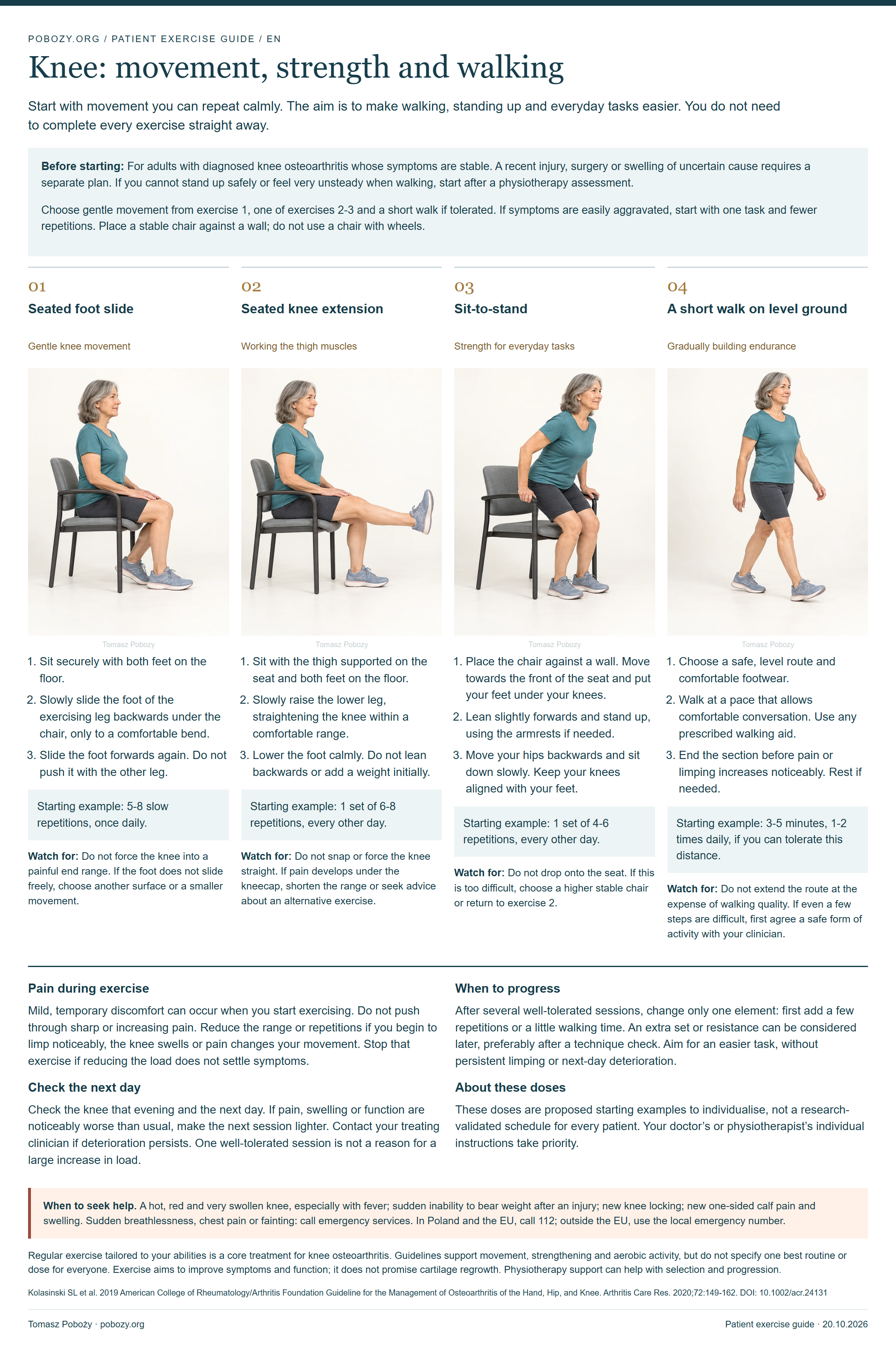
Exercises – a closer lookTechnique, starting dose and common pitfalls
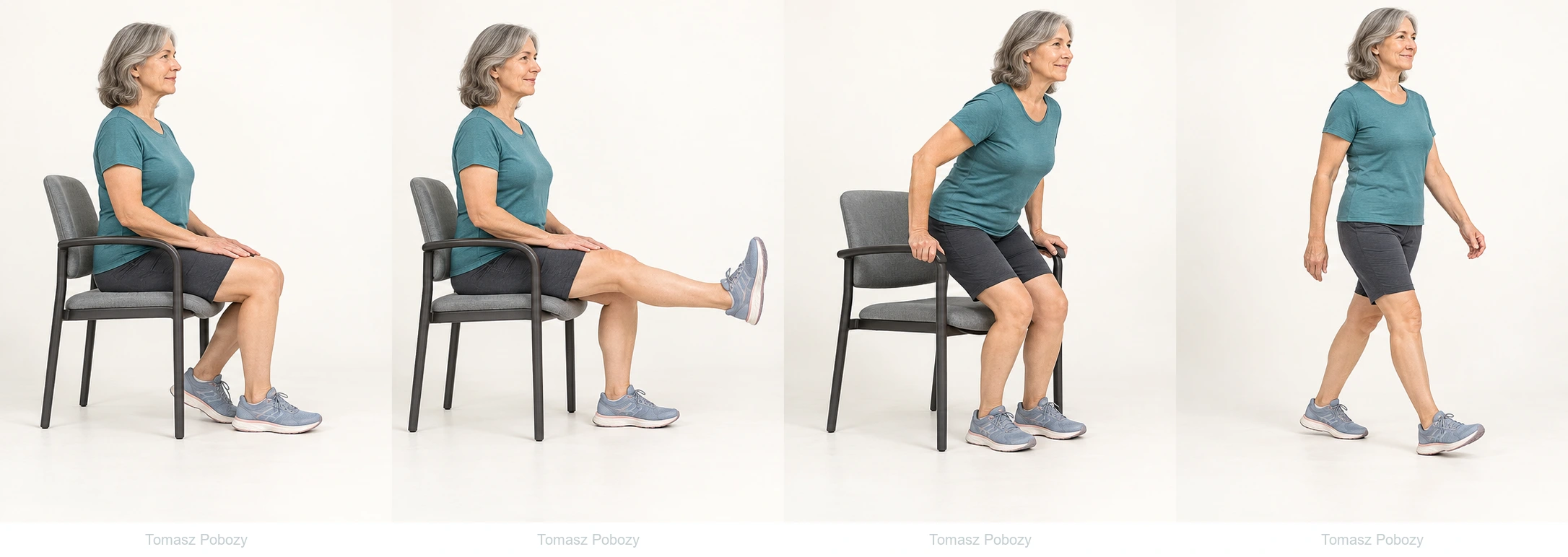
01 / Gentle knee movement
Seated foot slide
- Sit securely with both feet on the floor.
- Slowly slide the foot of the exercising leg backwards under the chair, only to a comfortable bend.
- Slide the foot forwards again. Do not push it with the other leg.
Starting example: 5-8 slow repetitions, once daily.
Watch for: Do not force the knee into a painful end range. If the foot does not slide freely, choose another surface or a smaller movement.
02 / Working the thigh muscles
Seated knee extension
- Sit with the thigh supported on the seat and both feet on the floor.
- Slowly raise the lower leg, straightening the knee within a comfortable range.
- Lower the foot calmly. Do not lean backwards or add a weight initially.
Starting example: 1 set of 6-8 repetitions, every other day.
Watch for: Do not snap or force the knee straight. If pain develops under the kneecap, shorten the range or seek advice about an alternative exercise.
03 / Strength for everyday tasks
Sit-to-stand
- Place the chair against a wall. Move towards the front of the seat and put your feet under your knees.
- Lean slightly forwards and stand up, using the armrests if needed.
- Move your hips backwards and sit down slowly. Keep your knees aligned with your feet.
Starting example: 1 set of 4-6 repetitions, every other day.
Watch for: Do not drop onto the seat. If this is too difficult, choose a higher stable chair or return to exercise 2.
04 / Gradually building endurance
A short walk on level ground
- Choose a safe, level route and comfortable footwear.
- Walk at a pace that allows comfortable conversation. Use any prescribed walking aid.
- End the section before pain or limping increases noticeably. Rest if needed.
Starting example: 3-5 minutes, 1-2 times daily, if you can tolerate this distance.
Watch for: Do not extend the route at the expense of walking quality. If even a few steps are difficult, first agree a safe form of activity with your clinician.
How to respond to pain
Mild, temporary discomfort can occur when you start exercising. Do not push through sharp or increasing pain. Reduce the range or repetitions if you begin to limp noticeably, the knee swells or pain changes your movement. Stop that exercise if reducing the load does not settle symptoms.
The next day
Check the knee that evening and the next day. If pain, swelling or function are noticeably worse than usual, make the next session lighter. Contact your treating clinician if deterioration persists. One well-tolerated session is not a reason for a large increase in load.
When to progress
After several well-tolerated sessions, change only one element: first add a few repetitions or a little walking time. An extra set or resistance can be considered later, preferably after a technique check. Aim for an easier task, without persistent limping or next-day deterioration.
Everyday tasks
Standing up and sitting down
Initially choose a higher seat with armrests. Approach the chair, plant both feet and sit down slowly. Using your arms for assistance is allowed.
Walking and stairs
Break longer journeys into shorter sections. Use a handrail on stairs; if unsteady, practise stair technique with a physiotherapist. A walking stick needs a height and technique check.
A more painful day
Reduce the load, but avoid staying still for hours if gentle changes of position are possible. Swelling and loss of the ability to bear weight require assessment, not a harder workout.
When to seek help
Urgent same-day assessment
A hot, red and very swollen knee, especially with fever; sudden inability to bear weight after an injury; new knee locking; new one-sided calf pain and swelling.
Emergency help
Sudden breathlessness, chest pain or fainting: call emergency services. In Poland and the EU, call 112; outside the EU, use the local emergency number.
When to review the plan
Arrange a review if deterioration persists despite adjusting the programme, substantial swelling recurs or everyday tasks are not improving. Record which task causes a problem and how the knee responds the next day.
A short record of your response
Write down what you did, your symptoms afterwards and the response the following day.
| Date / task | Dose | After exercise | The next day |
|---|---|---|---|
References and evidence
Regular exercise tailored to your abilities is a core treatment for knee osteoarthritis. Guidelines support movement, strengthening and aerobic activity, but do not specify one best routine or dose for everyone. Exercise aims to improve symptoms and function; it does not promise cartilage regrowth. Physiotherapy support can help with selection and progression.
- Kolasinski SL et al. 2019 American College of Rheumatology/Arthritis Foundation Guideline for the Management of Osteoarthritis of the Hand, Hip, and Knee. Arthritis Care Res. 2020;72:149-162. DOI: 10.1002/acr.24131
These doses are proposed starting examples to individualise, not a research-validated schedule for every patient. Your doctor’s or physiotherapist’s individual instructions take priority.