 Skip to content
FOR CLINICIANS AND PHYSIOTHERAPISTS
Gluteal tendon repair — gluteus medius ± minimus — rehabilitation protocol
Protection, movement and a gradual return to daily activity. Select the stage appropriate to the actual procedure and current clearance.
Using and loading the limb
Selected small repairs: crutches usually 2–4 weeks; larger repairs: partial loading usually 4–6 weeks or longer. Select A/B from the actual repair.
Full guidance ↓Brace or immobilisation
In the described A/B technique, the brace is discontinued after a full week off crutches. Crutch and brace durations are not identical.
Full guidance ↓Permitted movement
In the described A/B technique, avoid active abduction and passive adduction across the midline for 8 weeks. A different plan requires explicit instructions.
Full guidance ↓Permitted movement, loading and removal of a brace are separate decisions. Additional repairs may require a more protective programme.
Rehabilitation at a glance
Progression follows healing and functional criteria, not dates alone.
Rehabilitation boards
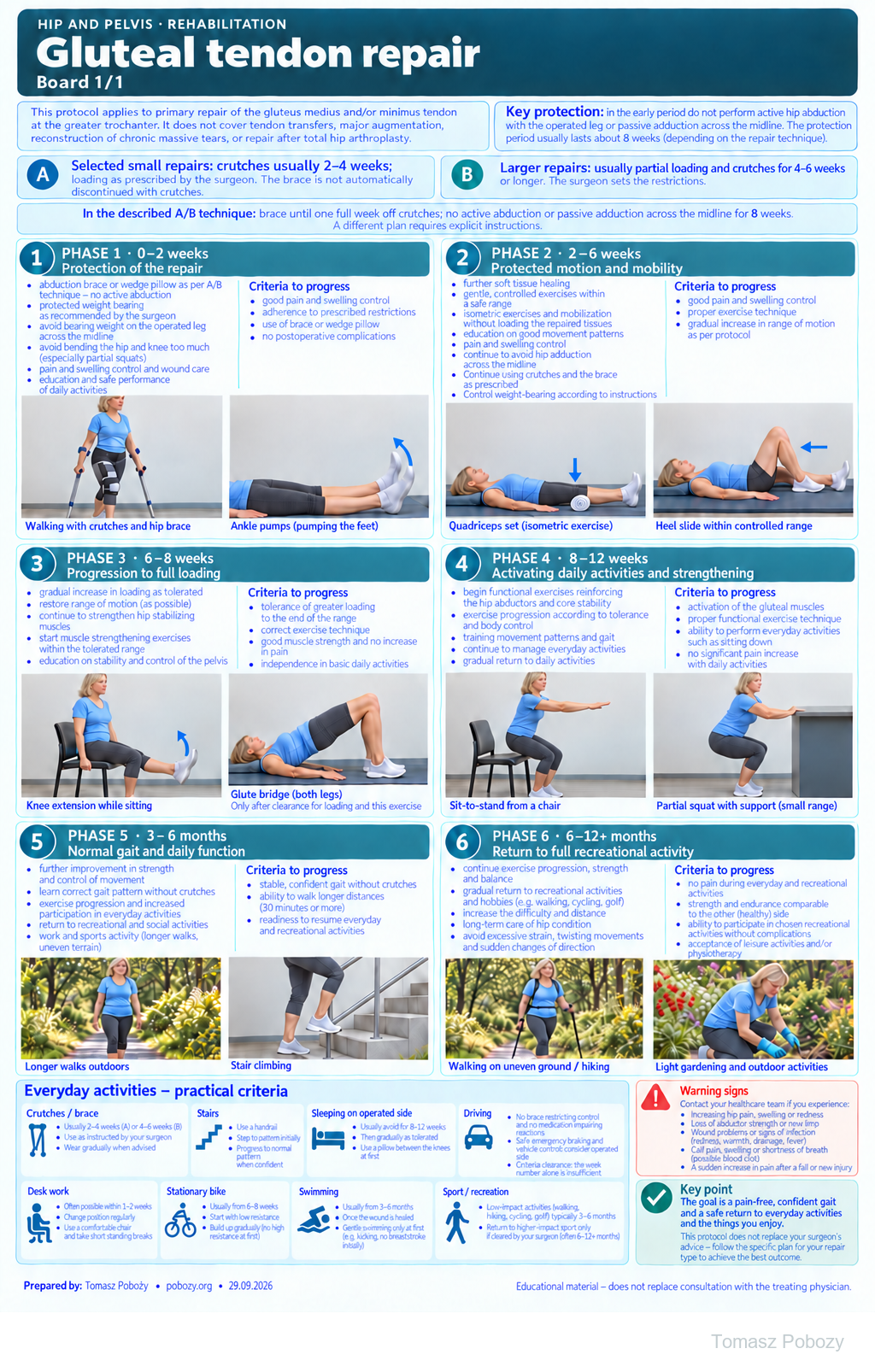
Exercises — a closer look
Use the complete boards above together with the instructions for the chosen stage. An exercise shown for a later stage is not permitted early.
Open the relevant complete board and zoom in. The viewer retains all stages and captions.
Exercise instructions and progression are contained in the stage descriptions linked above.
Scope and protection
Stages and progression criteria
Phase 1 · weeks 0–2 — protect the repair
Hip abduction brace and crutches according to pathway A/B. Control pain and swelling. Maintain ankle and knee movement. No active hip abduction and no passive adduction across the midline. Progress when the wound is healing appropriately, symptoms are controlled and transfers are safe.
Phase 2 · weeks 2–6 — protected motion and mobility
Maintain prescribed loading protection. Introduce gentle controlled motion within the permitted range, isometrics and trunk exercise without stressing the repair. Continue to avoid active abduction. Increase range only according to the orthopaedic surgeon-defined plan.
Phase 3 · weeks 6–8 — transition toward fuller loading
Gradually increase weight bearing and wean crutches only with stable gait and no limp. Continue restoring motion. Abduction and adduction restrictions are lifted only according to the repair and surgeon instructions.
Phase 4 · weeks 8–12 — activate abductors and strengthen
When cleared, begin targeted active abduction and progressive strengthening. Add sit-to-stand, supported shallow squats, pelvic-control and gait exercises. Do not increase load when lateral hip pain flares the following day.
Phase 5 · months 3–6 — efficient walking and daily function
The main goals are longer comfortable walking distances, normal gait without crutches, stair climbing, stable single-leg pelvic control and return to most household and social activities. Build strength and endurance without provoking reactive pain.
Phase 6 · months 6–12+ — full recreational activity
Return to confident walking on uneven ground, longer walks, hiking, light gardening and other activities that match the patient’s goals. Sport is not a mandatory endpoint of this protocol; for active patients it is introduced individually after strength and control are restored.
Daily activities and follow-up
Daily activities — practical criteria
- Crutches: pathway A commonly 2–4 weeks; pathway B 4–6 weeks or longer. Brace: do not stop automatically with crutches; in the described technique, continue for a full week after stopping crutches.
- Stairs: from the start with assistance and within weight-bearing restrictions; initially step-to pattern.
- Sleeping on the operated side: avoid early; resume only after healing and pain-free tolerance, commonly around 8–12 weeks or later.
- Driving: after brace and crutches are no longer required, sedating medication has stopped, entry/exit is safe and emergency braking can be performed confidently; right-sided surgery is usually later.
- Desk work: when transfers and sitting are comfortable and safe; timing is individualized.
- Stationary bike: once safe ROM and loading status permit.
- Swimming: after wound healing; strong kicking only after active abduction is permitted.
- Recreation: walking, Nordic walking, hiking, cycling and gardening — gradual, criteria-based progression.
Warning signs
Warning signs
Sudden increase in lateral hip pain, new loss of abduction strength, a new or worsening Trendelenburg gait, increasing limp, wound problems or thromboembolic symptoms require reassessment.
Further guidance
HIP AND PELVIS · FOR DOCTORS AND PHYSIOTHERAPISTS
From protecting the greater-trochanter repair to restoring comfortable, confident walking, pelvic control and everyday activity.
Prepared by: Tomasz Poboży, MD, PhD · Updated: 29 September 2026
Protocol scope
This protocol applies to primary repair of the gluteus medius and/or minimus tendon at the greater trochanter. Progression depends on tear size, tissue quality and repair construct. It does not cover tendon transfers, major augmentation, reconstruction of chronic massive tears, or repair after total hip arthroplasty.
Key protection: early rehabilitation avoids active hip abduction and passive adduction across the midline. This protection commonly lasts about 6–8 weeks depending on the repair.
Two protection pathways
A · Small / less extensive tear
For selected small stable repairs, crutches are commonly used for 2–4 weeks. The brace follows a separate rule: in this endoscopic technique, discontinue only after one full week off crutches.
B · Larger full-thickness / extensive tear
Partial or very limited weight bearing with crutches and a hip abduction brace is commonly maintained for about 4–6 weeks; many protocols use 6 weeks or longer according to the surgeon.
Key point: the goal is comfortable, confident walking and a safe return to everyday activity. Do not accelerate active abduction simply because pain is low — the tendon repair is still healing.
The shorter A/B pathway refers to selected repairs, not every abductor reconstruction. In the published endoscopic technique, small repairs use crutches for 2–4 weeks and larger repairs use partial loading for 4–6 weeks; the brace is discontinued only after a full week off crutches. Do not interpret the crutch duration as automatic permission to remove the brace. The technique protects against active abduction and passive adduction across the midline for 8 weeks; any different plan must be explicit. Endoscopic Gluteus Medius Repair (2022).
References
References
- Ilizaliturri VM Jr, Zepeda Mora R, Rodríguez Vega LP. Rehabilitation After Gluteus Medius and Minimus Treatment. Arthrosc Sports Med Rehabil. 2022;4:e41–e50. doi:10.1016/j.asmr.2021.10.024.
- Meghpara MB, Yelton MJ, Glein RM, et al. Isolated Endoscopic Gluteus Medius Repair Can Achieve Successful Clinical Outcomes at Minimum 2-Year Follow-up. Arthrosc Sports Med Rehabil. 2021;3:e1697–e1704. doi:10.1016/j.asmr.2021.07.026.
- Larson JH, Brusalis CM, Allahabadi S, et al. Outcomes of Isolated Endoscopic Gluteal Tendon Repair Compared With Concomitant Endoscopic Gluteal Tendon Repair and Arthroscopic Hip Labral Repair. Orthop J Sports Med. 2024;12:23259671231215340. doi:10.1177/23259671231215340.