 Skip to content
FOR CLINICIANS AND PHYSIOTHERAPISTS
Hip arthroscopy for FAIS with cam morphology — femoroplasty ± labral repair — rehabilitation protocol
Protection, movement and a gradual return to daily activity. Select the stage appropriate to the actual procedure and current clearance.
Using and loading the limb
Distinguish femoroplasty without labral repair, labral refixation and cartilage procedures. Each may change loading; use crutches according to plan and gait quality.
Full guidance ↓Brace or immobilisation
Brace use depends on associated procedures and surgeon. This protocol does not prescribe one bracing duration for all arthroscopies.
Full guidance ↓Permitted movement
Use repair-specific protected motion without forcing end range. Straight-leg raising and hip-flexor resistance are not permitted by the week number alone.
Full guidance ↓Permitted movement, loading and removal of a brace are separate decisions. Additional repairs may require a more protective programme.
Rehabilitation at a glance
Progression follows healing and functional criteria, not dates alone.
Rehabilitation boards
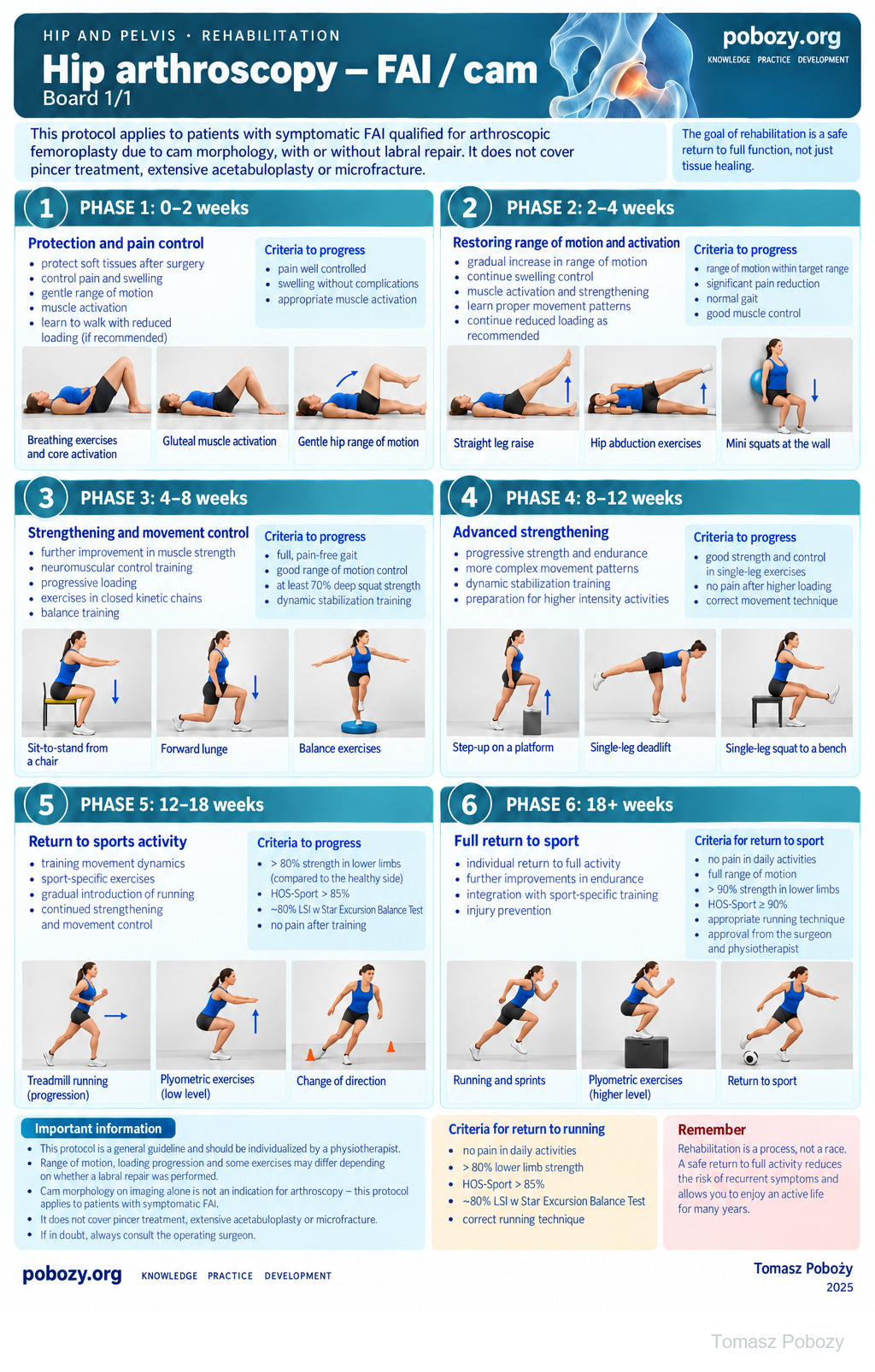
The English guide uses the same sharp exercise imagery without enlarging the individual exercise photographs. The complete accessible text follows below.
Exercises — a closer look
Use the complete boards above together with the instructions for the chosen stage. An exercise shown for a later stage is not permitted early.
Open the relevant complete board and zoom in. The viewer retains all stages and captions.
Exercise instructions and progression are contained in the stage descriptions linked above.
Scope and protection — decisions for the orthopaedic surgeon
Baseline assessment and operative details
Confirm whether femoroplasty alone was performed or whether the labrum was repaired or selectively debrided, and whether the capsule was treated. Microfracture, other cartilage-restoration procedures, labral reconstruction, osteotomy, tendon repair and revision surgery require a separate pathway. Before progression assess pain, swelling, gait, range of motion, gluteal activation and lumbopelvic control.
Stages and progression criteria
Phase 1 — weeks 0–2: protection and gait normalization
Control pain and swelling, maintain protected motion and normalize gait with crutches as instructed. Gentle circumduction, an upright stationary bike without resistance and submaximal isometrics can be introduced. After labral repair do not force end-range motion. There is no single mandatory restriction set for every repair; the operative record and surgeon instructions take priority.2 5
Phase 2 — weeks 2–4: progression of weight bearing
Reference goals: about 90° pain-free flexion and about 10° extension. Wean crutches only when gait is symmetrical and there is no clear next-day flare. Add weight shifting, shallow mini-squats, heel raises and bridge progression.
Phase 3 — weeks 4–8: strengthening
Work toward normalized gait and range of motion. Progress stationary cycling, walking, bridges, hip abduction, trunk stabilization, squats to about 90°, single-leg balance and bilateral-to-single-leg strengthening.
Phase 4 — weeks 8–12: early functional restoration
Emphasize dynamic pelvic and lower-limb control during single-leg tasks. Progress bike resistance, elliptical training, loaded squats, deadlifts, lunges, step-downs and dynamic balance. Progression depends on movement quality and joint response, not time alone.
Phase 5 — weeks 12–18: running and low-level impact
The ISHA agreement supports straight-line running when single-leg control is appropriate, strength is >80% of the uninvolved side, Hip Outcome Score–Sport is >85%, and Star Excursion Balance Test performance is about 80% Limb Symmetry Index. Then add low-level plyometrics and light agility work.2
Phase 6 — about week 18 onward: return to sport
Progress sprinting, change of direction, advanced plyometrics and sport-specific tasks. Readiness requires good load tolerance, adequate strength and range of motion, and excellent pelvic and lower-extremity control.
Warning signs
Warning signs and reasons for reassessment
Increasing groin pain, loss of previously achieved motion, increasingly painful catching or clicking, gait deterioration, fever or wound problems, new marked calf pain/swelling or shortness of breath require reassessment; possible thromboembolic symptoms require urgent evaluation.
Further guidance
HIP AND PELVIS · FOR DOCTORS AND PHYSIOTHERAPISTS
This protocol applies to adults after primary arthroscopic femoroplasty for symptomatic femoroacetabular impingement syndrome (FAIS) associated with cam morphology. Labral repair is not automatic; it depends on lesion pattern, stability and tissue quality.
Prepared by: Tomasz Poboży, MD, PhD
Sources reviewed: 29 September 2026
Two postoperative pathways
A. Femoroplasty without labral repair
The labrum is stable or the identified lesion does not require refixation. Loading and motion can progress according to tolerance, gait quality and the next-day response.
B. Femoroplasty + labral repair
This pathway applies to an unstable, repairable lesion with tissue quality sufficient for durable fixation. The early phase is more protective and depends on the actual repair performed.
References
References
- Dijkstra HP, Mc Auliffe S, Ardern CL, et al. Oxford consensus on primary cam morphology and femoroacetabular impingement syndrome: part 1—definitions, terminology, taxonomy and imaging outcomes. Br J Sports Med. 2023;57(6):325–341. doi:10.1136/bjsports-2022-106085.
- Disantis A, Martin RL, Campbell A, et al. The 2024 International Society for Hip Preservation physiotherapy agreement on post-operative rehabilitation following hip arthroscopy for femoroacetabular impingement syndrome. J Hip Preserv Surg. 2025. doi:10.1093/jhps/hnaf055.
- Takla A, O’Donnell J, Voight M, et al. The 2019 International Society of Hip Preservation (ISHA) physiotherapy agreement on assessment and treatment of femoroacetabular impingement syndrome (FAIS). J Hip Preserv Surg. 2020;7(4):631–642. doi:10.1093/jhps/hnaa043.
- Monselli C, Bianco Prevot L, Accetta R, et al. State of the Art in Rehabilitation Strategies After Hip Arthroscopy for Femoroacetabular Impingement Syndrome: A Systematic Review. J Clin Med. 2024;13(23):7302. doi:10.3390/jcm13237302.
- Matache BA, Belzile EL, Ayeni OR, et al. Management of Labral Tears in the Hip: A Consensus Statement. Orthop J Sports Med. 2025;13(1):23259671241305409. doi:10.1177/23259671241305409.
- Bohn DS, Bigarella LG, Gusmão PDF, Fritsch CG, Lima DJL. Arthroscopic Labral Repair Versus Debridement for Femoroacetabular Impingement: A Systematic Review and Meta-analysis of 2730 Hips. Am J Sports Med. 2026. doi:10.1177/03635465261465092.