 Skip to content
For Doctors and Physiotherapists / Outpatient and Ultrasound-Guided Procedures
ORTHOBIOLOGICS · PROFESSIONAL EDUCATION · PART 2
PRP: what is in the plasma?
Beyond platelet count: transport proteins, a provisional matrix, immune responses and cellular communication. An English presentation and reading guide by Tomasz Poboży, MD, PhD.
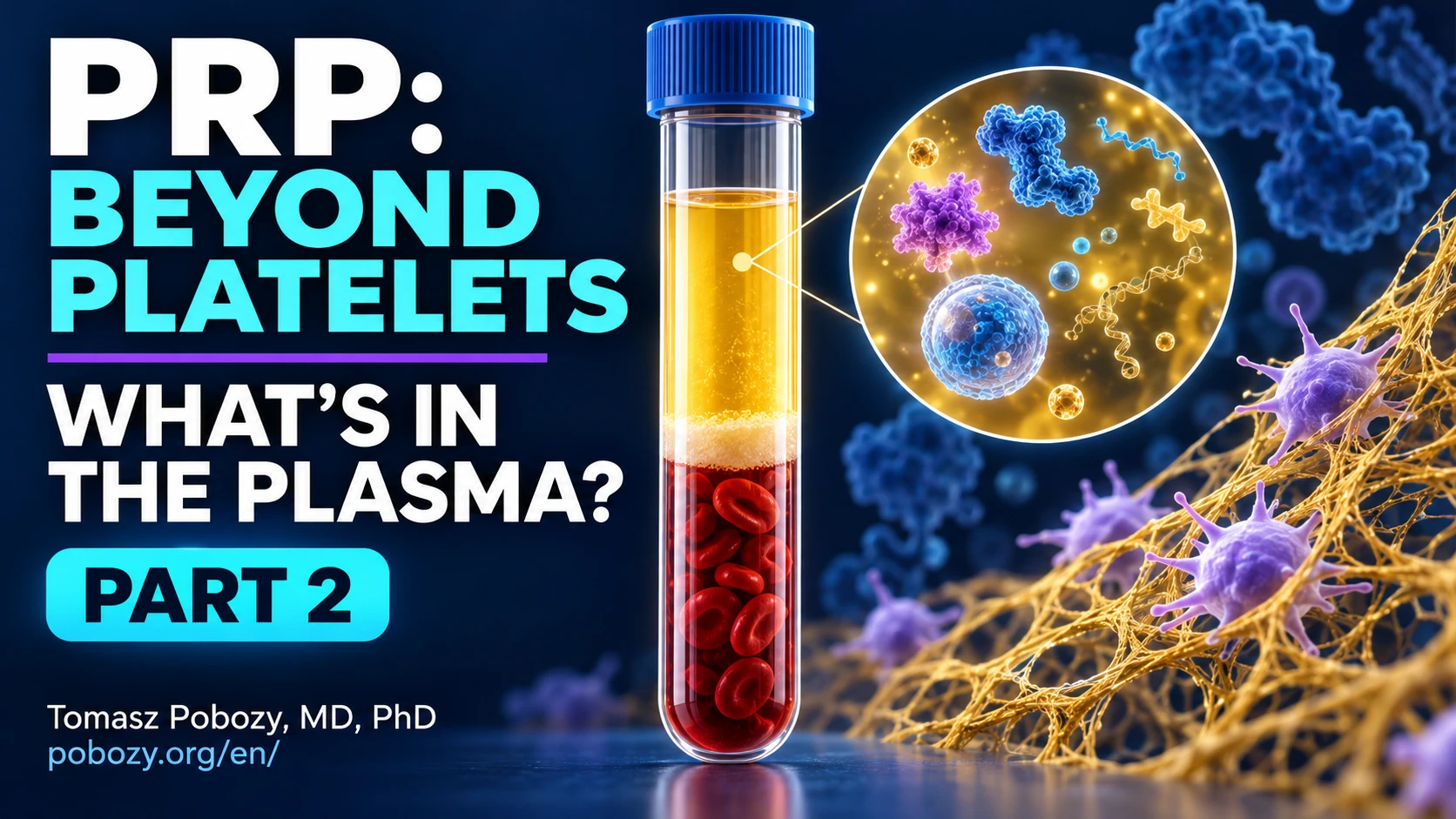
Watch the full presentation
Open Part 2 on YouTube · English audio · Approximately 10 minutes
New to the series? Start with Part 1: PRP Growth Factors Explained. The two episodes examine complementary aspects of the same biological environment.
Plasma and platelet interactions: what an orthopaedic surgeon should know
The distinction between plasma components and platelet-derived mediators is useful, but not absolute. Some proteins are found in circulating plasma and in platelet granules. Platelets contribute to coagulation, while plasma proteins influence the matrix and its interactions with cells. Platelet-poor plasma is biologically active, but this does not establish clinical equivalence to PRP.
Six aspects of the plasma environment
Albumin — transport and redox homeostasis
Albumin contributes to fluid distribution within the circulation, binds many molecules and participates in antioxidant defence. In a plasma preparation, these are features of the biochemical environment; they do not establish that locally injected albumin regenerates cartilage or tendon.
Fibrinogen and fibrin — a provisional matrix
Thrombin converts soluble fibrinogen into fibrin, and factor XIII contributes to cross-linking. Anticoagulants, calcium, activation and tissue contact influence clot formation. A fibrin network can provide a provisional structure for cells and molecules, but is not equivalent to restored native tissue.
Fibronectin and vitronectin — cell–matrix interactions
Adhesive proteins interact with receptors such as integrins. Cell attachment influences migration, survival and responsiveness to signals. Functional repair also requires matrix organisation and an appropriate mechanical environment.
Complement — context-dependent immune activity
Complement participates in recognition, clearance and inflammatory signalling. The extent, duration and regulation of activation matter. Its presence does not prove that a plasma injection is anti-inflammatory, antimicrobial or regenerative.
Immunoglobulins — recognition and immune coordination
Antibodies recognise antigens and can interact with complement and immune cells. Autologous plasma still requires aseptic preparation and administration; its immune components do not protect against contamination.
Cytokines and chemokines — a wider signalling environment
These signals coordinate cellular activity and migration. They can originate from plasma, platelets, leukocytes and local tissue cells. Their effects depend on concentration, receptor expression and timing; persistent inflammation can interfere with repair.
From biological rationale to clinical evidence
A mechanism explains why a treatment might be investigated. Clinical benefit must still be demonstrated for the specified preparation, indication and outcome. Symptom improvement, structural healing and regeneration are different endpoints. The figures are educational illustrations, not evidence that every depicted effect occurs after every injection.
For clinical interpretation, consider platelet dose, plasma volume, leukocyte content, activation, handling and the condition of the target tissue. Preparation and patient factors influence the biological product that is actually delivered.
Continue exploring
Part 1 — six growth factors and their complementary functions · More presentations on YouTube · The professional resource library
Further reading
Platelet Rich Plasma: a short overview of certain bioactive components — PRP constituents and biological functions.
Blood plasma derivatives for tissue engineering and regenerative medicine therapies — plasma proteins, fibrin-based materials and translational considerations.
A practical checklist for reading a PRP study
The plasma components in the film explain a biological environment. To evaluate a clinical claim, use a separate worksheet. These questions help identify what a paper can and cannot tell you.
- Population: does the study include patients with the same diagnosis, disease stage and previous treatment?
- Product: are platelet dose, delivered volume, leukocytes, red-cell contamination and activation described sufficiently to understand what was injected?
- Comparison: was PRP compared with a credible control, another injection, exercise or usual care? Was co-treatment similar?
- Outcome: was the difference meaningful to patients, or only a laboratory or imaging measurement? Were harms also recorded?
- Timing: was follow-up long enough for the claimed benefit? A short-term symptom change does not establish durable tissue restoration.
- Uncertainty: how precise are the estimates, how many participants were lost and were additional treatments needed?
Use a two-column note
In one column, write what the authors measured. In the other, write the claim you are considering making to a patient. If the trial measured pain but the claim is “regrows cartilage”, the two do not match. If the trial used one preparation for one condition, avoid turning the result into a promise for every PRP product and diagnosis.
Record a decision, not just a procedure
Document the treatment goal, alternatives discussed, uncertainties, aftercare and review plan. At review, compare the patient’s function with the baseline and reconsider the diagnosis if the course is unexpected. The presence of fibrin, albumin or immune proteins alone does not determine the next injection.
Background: AAOS — PRP and the importance of the condition and preparation.
Medical author: Tomasz Poboży - orthopaedic surgeon, MD, PhD. For doctors, physiotherapists and other healthcare professionals. Educational material does not replace clinical judgement or individual patient assessment. Publication: 12 October 2026.