 Skip to content
FOR CLINICIANS AND PHYSIOTHERAPISTS
Coonrad–Morrey total elbow arthroplasty — rehabilitation protocol
Protection, movement and a gradual return to daily activity. Select the stage appropriate to the actual procedure and current clearance.
Using and loading the limb
Manufacturer’s ceiling: approximately 0.45 kg for 3 months; thereafter this protocol rounds conservatively to 2 kg. These are ceilings, not training targets; no routine strengthening or support.
Full guidance ↓Brace or immobilisation
Sling for support; splint and settings depend on tissues, wound and surgeon. Implant name alone does not define triceps precautions.
Full guidance ↓Permitted movement
After triceps reattachment, initially use passive/assisted extension; active extension requires clearance. Flex within repair and skin tolerance.
Full guidance ↓Permitted movement, loading and removal of a brace are separate decisions. Additional repairs may require a more protective programme.
Rehabilitation at a glance
Progression follows healing and functional criteria, not dates alone.
Rehabilitation boards
Limits in this project are conservatively converted from the manufacturer: maximum 0.45 kg for the first 3 months and 2 kg thereafter. These are ceilings, not training targets; stricter instructions prevail. Do not round up to 0.5 or 2.5 kg.
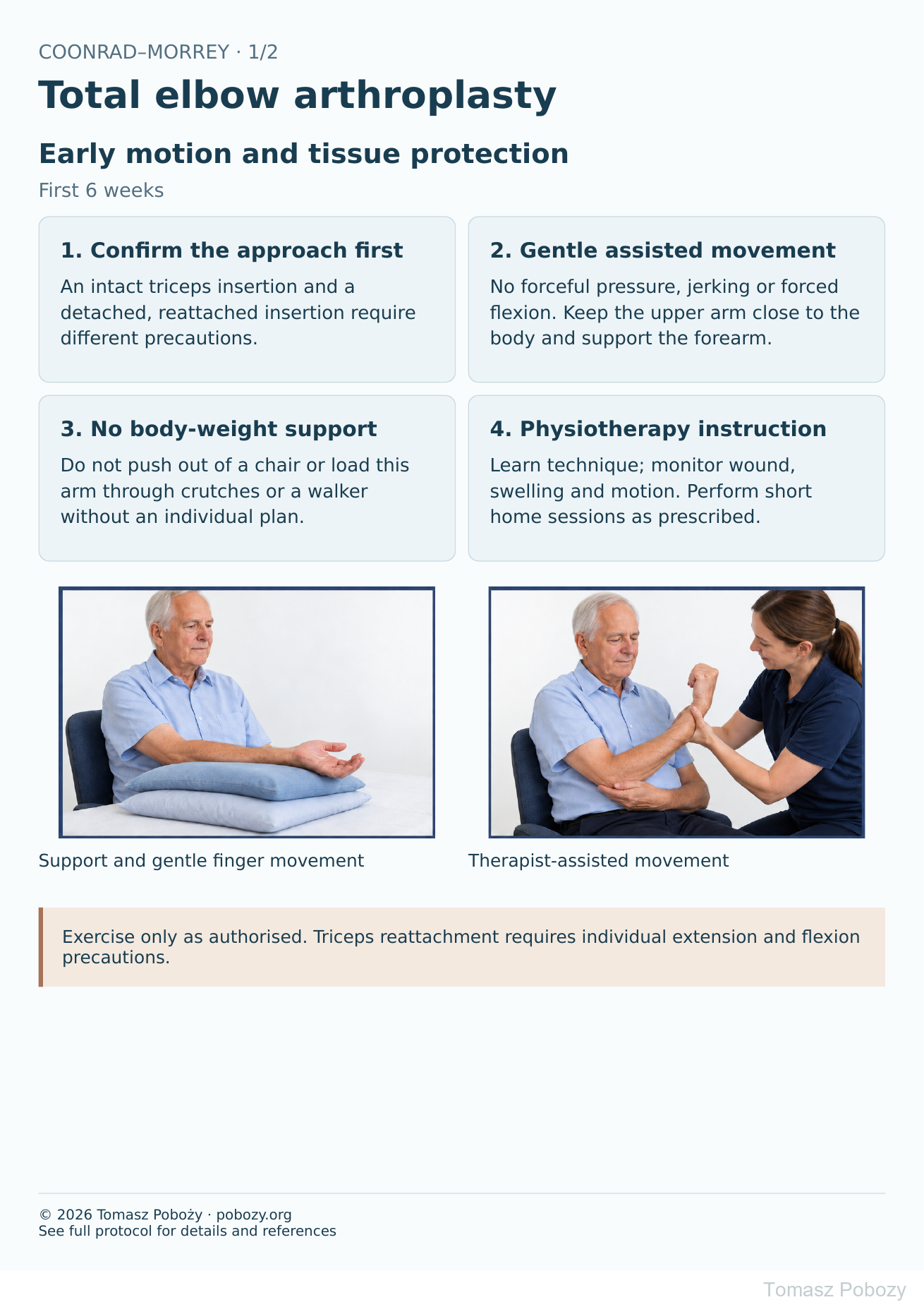
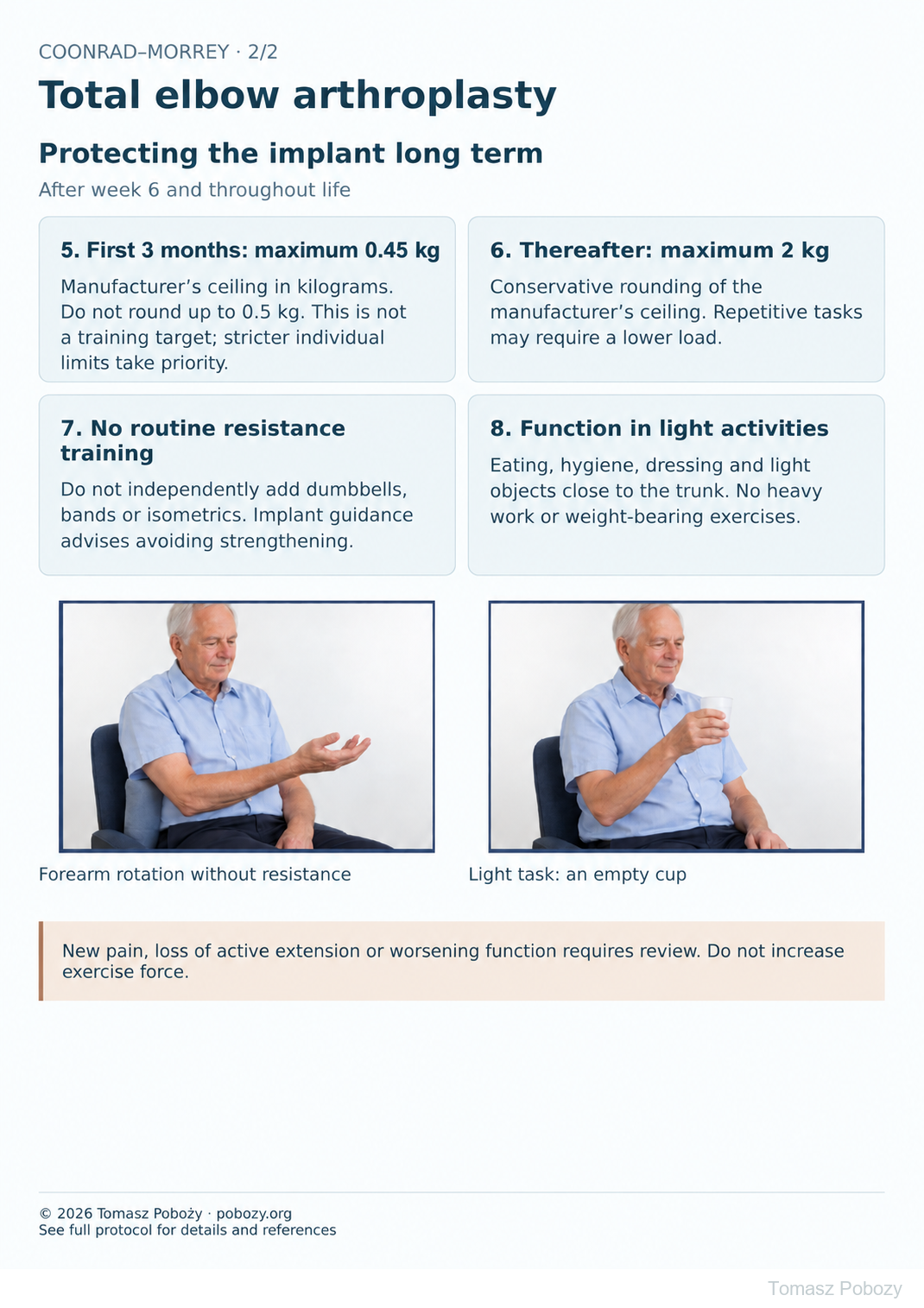
Exercises — a closer look
Use the complete boards above together with the instructions for the chosen stage. An exercise shown for a later stage is not permitted early.
Open the relevant complete board and zoom in. The viewer retains all stages and captions.
Exercise instructions and progression are contained in the stage descriptions linked above.
Scope and protection
1. Information needed by the physiotherapist
Before exercises start, confirm the implant, primary or revision procedure, triceps management, bone and implant stability, any fracture or fixation, ulnar nerve procedure and wound condition. Discharge instructions should specify permitted movements, flexion limits, splint use and review arrangements.
A posterior approach does not necessarily mean an intact triceps insertion. If the operative details are incomplete, agree the programme with the orthopaedic surgeon before introducing active extension or increasing flexion. Early motion is determined by tissue status, not the implant name alone. [2]
2. Triceps: two rehabilitation pathways
Intact insertion — triceps-on / preserving approach
With the surgeon’s approval, early active and assisted movement may be possible within wound and pain tolerance. Preserving the insertion does not remove implant loading restrictions. [2]
Detached and reattached insertion — triceps-off
Protective option for individual approval: approximately the first 6 weeks, passive or assisted extension without triceps contraction; no independent active extension against the weight of the forearm unless specifically authorised by the surgeon. Flexion remains within the range safe for the repair and skin, without a universal angle target. Avoid triceps isometrics, band extension and weight-bearing.
At approximately 6 weeks, the surgeon assesses healing and decides whether active extension without additional resistance can begin. Poor tissue quality may require longer protection. This timing is a proposed clinical framework, not automatic clearance. Permission for active movement is not permission for strength training.
Stages and progression criteria
3. Phase I — first days to week 2
Goals: protect the wound, manage pain and swelling and learn safe daily tasks. A sling provides support and comfort; a prescribed splint protects the tissues according to the surgeon’s instructions. Do not independently change its angle or discontinue it.
Support the forearm and hand on a soft surface without pressure over the posterior or medial elbow. Gently move the fingers and wrist without forceful ball squeezing. Support the operated limb during shoulder movements. Begin elbow exercises when authorised by the surgical team. Do not exercise independently while a nerve block remains active.
Proposed initial dose: 5–10 gentle repetitions of permitted movements in 3–5 short sessions daily, adjusted by the physiotherapist to the joint response. Instruction before discharge or in the first days afterwards; subsequent visits according to independence and progress. Wound review follows the discharge plan, often around days 10–14.
Progression criteria: uncomplicated wound healing, decreasing swelling, controlled pain and correct technique. Bleeding, discharge or wound separation warrants contact with the team.
4. Phase II — weeks 2–6
Continue permitted flexion, the type of extension appropriate to the approach, and forearm rotation. Do not force full extension or maximum flexion. The priority is function while tissues heal, without a mandatory angle at a particular week.
Rotate the forearm with the elbow near the trunk, without weight or resisted twisting. Introduce light self-care only within the prescribed limits. Do not force open jars, carry shopping, lift a kettle or push heavy doors with the operated arm.
The physiotherapist records motion, pain, swelling, hand function and sensation. Progressive motion loss requires reassessment, not stronger stretching. Splints intended to improve motion may be considered only after surgical review.
5. Phase III — weeks 6–12 and after 3 months
Following clinical and imaging review as planned by the surgeon, progress active movement and light tasks. After triceps reattachment, begin movement without added resistance under conditions selected by the physiotherapist. Increasing active extension lag or sudden weakness requires stopping progression and contacting the surgeon.
The lifting restriction below applies throughout the first 3 months. Do not routinely introduce dumbbells, resistance bands or exercises against the other hand. Thereafter, comfortable motion and light daily function remain the goals.
Return to work depends on actual duties. Desk work requires arm support and breaks. Heavy manual work may remain unsuitable permanently. Driving requires discontinuation of immobilisation and impairing medicines, the ability to perform an emergency manoeuvre safely, and agreement with the treating clinician.
Daily activities and follow-up
Daily activities follow the permitted joint motion, lifting, grip and arm support for your procedure. Ending immobilisation is not clearance for lifting or driving. The detailed guidance below explains the criteria and exceptions.
6. Loading limits and daily life
The manufacturer’s early lifting ceiling converts to approximately 0.45 kg for the first 3 months. Do not round this ceiling up to 0.5 kg. For the later ceiling, this protocol uses a conservative rounded value of 2 kg, rather than 2.5 kg. These are maximum permitted loads, not training targets. Follow any stricter individual instruction and avoid strengthening exercises as specified in the manufacturer’s technique. Zimmer Biomet — Coonrad/Morrey, p. 11.
The limit is not a recommended training weight. Repetition, distance from the trunk, speed and twisting forces also matter. Keep light objects close to the body. The surgeon may prescribe lower limits.
Avoid push-ups, planks, hanging, pull-ups, pushing out of a chair, transferring body weight through the arm, impacts and sudden pulls. This includes hammering, heavy tools, contact sports and activities carrying substantial fall risk. [3],[4] If crutches or a walker are required, discuss this before surgery and arrange an individual mobility plan.
Warning signs
7. Warning signs and follow-up
Urgent same-day assessment: fever with wound redness or drainage, increasing swelling and pain despite treatment, new little- or ring-finger numbness, hand weakness, sudden loss of active extension, painful clunking or new deformity. After a fall with new pain, do not test the arm’s strength.
Emergency care: a cold, pale or blue hand, rapidly increasing pain with tense swelling, breathlessness or chest pain — call emergency services.
Take medicines as prescribed. Cooling through a cloth may help if skin sensation is normal; keep the dressing dry. Do not independently start antibiotics or heterotopic ossification prophylaxis. Maintain periodic implant reviews according to the surgeon’s plan even when pain-free. New pain after a period of good function requires investigation.
For a life-threatening emergency, call your local emergency number immediately — 112 in the European Union. On the boards, 112 refers to the EU.
Additional scope notes
The goals are comfortable functional motion and independence in light daily tasks while protecting the soft tissues and implant. Exercises begin after physiotherapy instruction and in accordance with the operative report. Triceps precautions depend on the surgical approach.
References
References
- Zimmer Biomet. Coonrad/Morrey Total Elbow. Surgical Technique. 2021.
- Verstuyft L, Caekebeke P, van Riet R. Postoperative rehabilitation in elbow surgery. J Clin Orthop Trauma. 2021;20:101479. doi:10.1016/j.jcot.2021.101479.
- American Academy of Orthopaedic Surgeons. Total Elbow Replacement. OrthoInfo.
- University of Washington Orthopaedics. Total elbow joint replacement for elbow arthritis.
References and links checked on 18 October 2026. Existence of a publication does not validate every dose or timetable. Institutional protocols and examples require individualisation.
Clinical commentary and terms of use
8. Clinical commentary
The aim is a useful, more comfortable arm for daily life. Loading progressions designed for arthroscopic contracture release should not be transferred to elbow replacement.
General elbow arthroplasty sources provide differing loading limits and strengthening schedules. [2],[3],[4] These are not automatically appropriate for Coonrad–Morrey. The limits in this programme follow the specific implant documentation. No single regimen is established for every indication and approach.
The manufacturer’s guide does not require routine formal physiotherapy for every patient. [1] In this programme the physiotherapist provides instruction and technique review, with visits tailored to need. Repetition counts, visit arrangements and the protective pathway after triceps reattachment are proposed clinical choices for individual approval.