 Skip to content
FOR CLINICIANS AND PHYSIOTHERAPISTS
Anterior subcutaneous ulnar nerve transposition — postoperative protocol
Protection, movement and a gradual return to daily activity. Select the stage appropriate to the actual procedure and current clearance.
Using and loading the limb
Initially avoid heavy lifting, forceful grip and wound pressure. Light resistance generally starts around week 6 after assessment.
Full guidance ↓Brace or immobilisation
Subcutaneous transposition usually uses a soft dressing and short-term comfort sling. Do not automatically apply submuscular-transposition precautions.
Full guidance ↓Permitted movement
Gentle elbow movement from the first days when wound and instructions permit. Avoid forceful stretching and provocation of nerve symptoms.
Full guidance ↓Permitted movement, loading and removal of a brace are separate decisions. Additional repairs may require a more protective programme.
Rehabilitation at a glance
Progression follows healing and functional criteria, not dates alone.
Rehabilitation boards
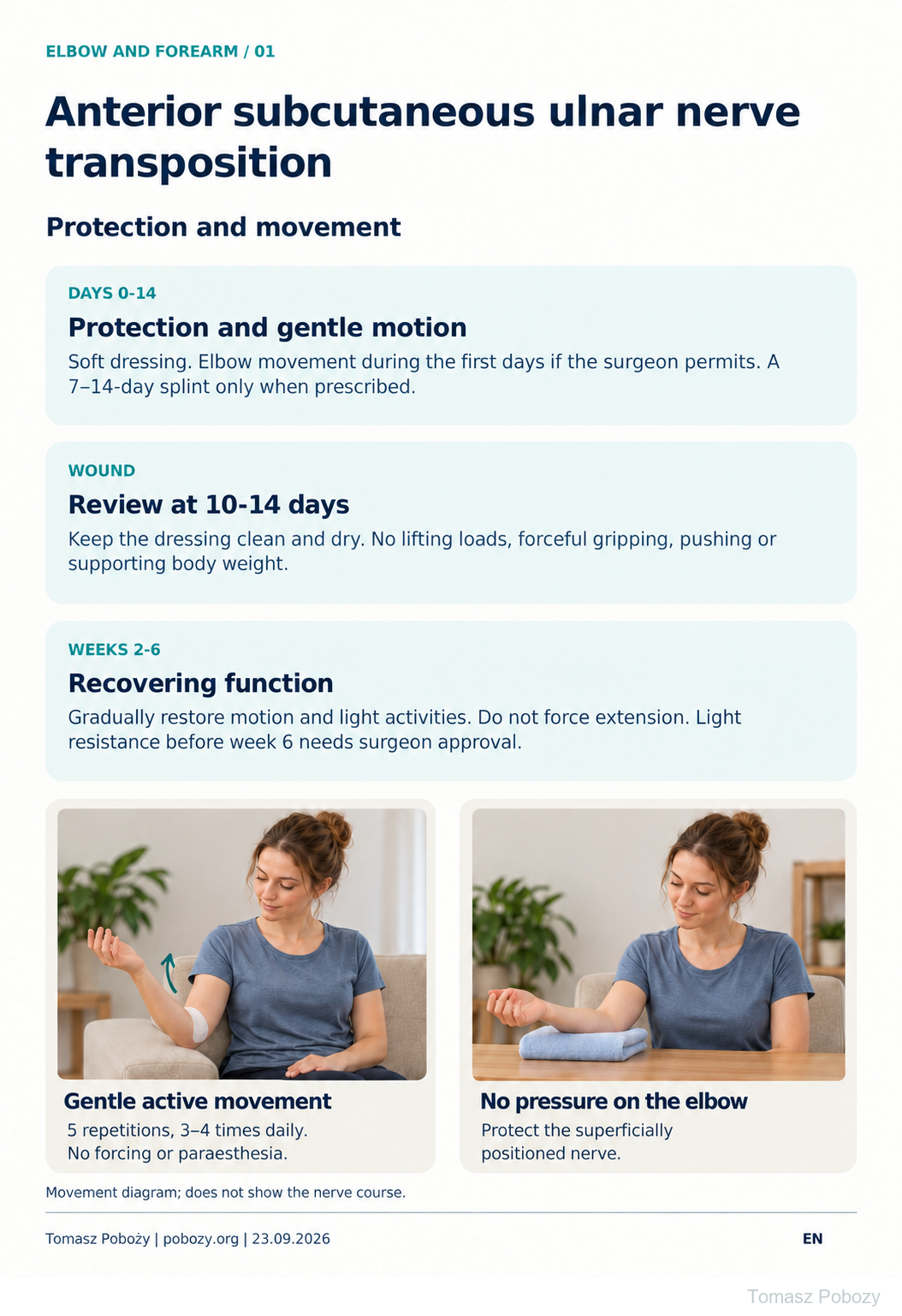
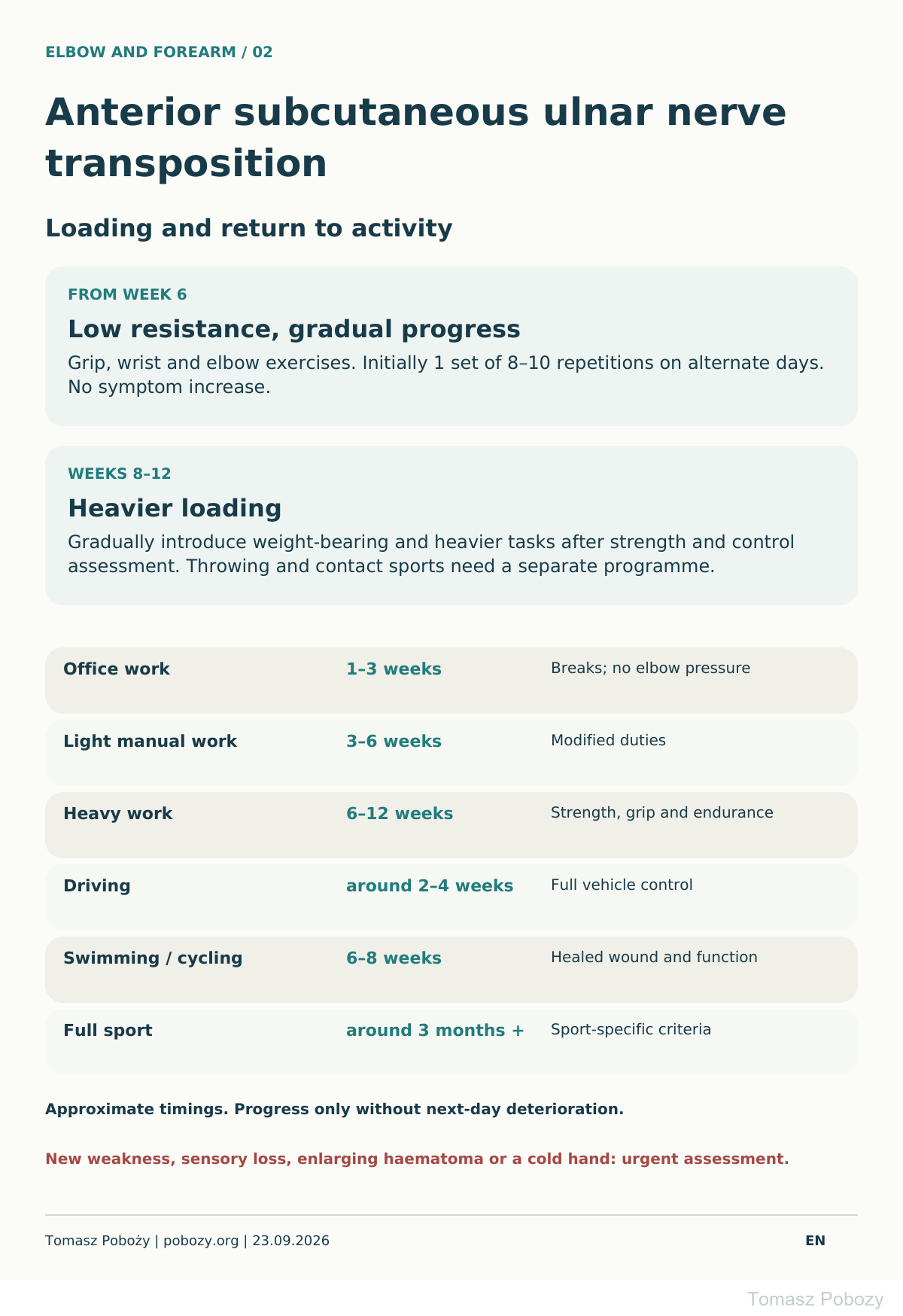
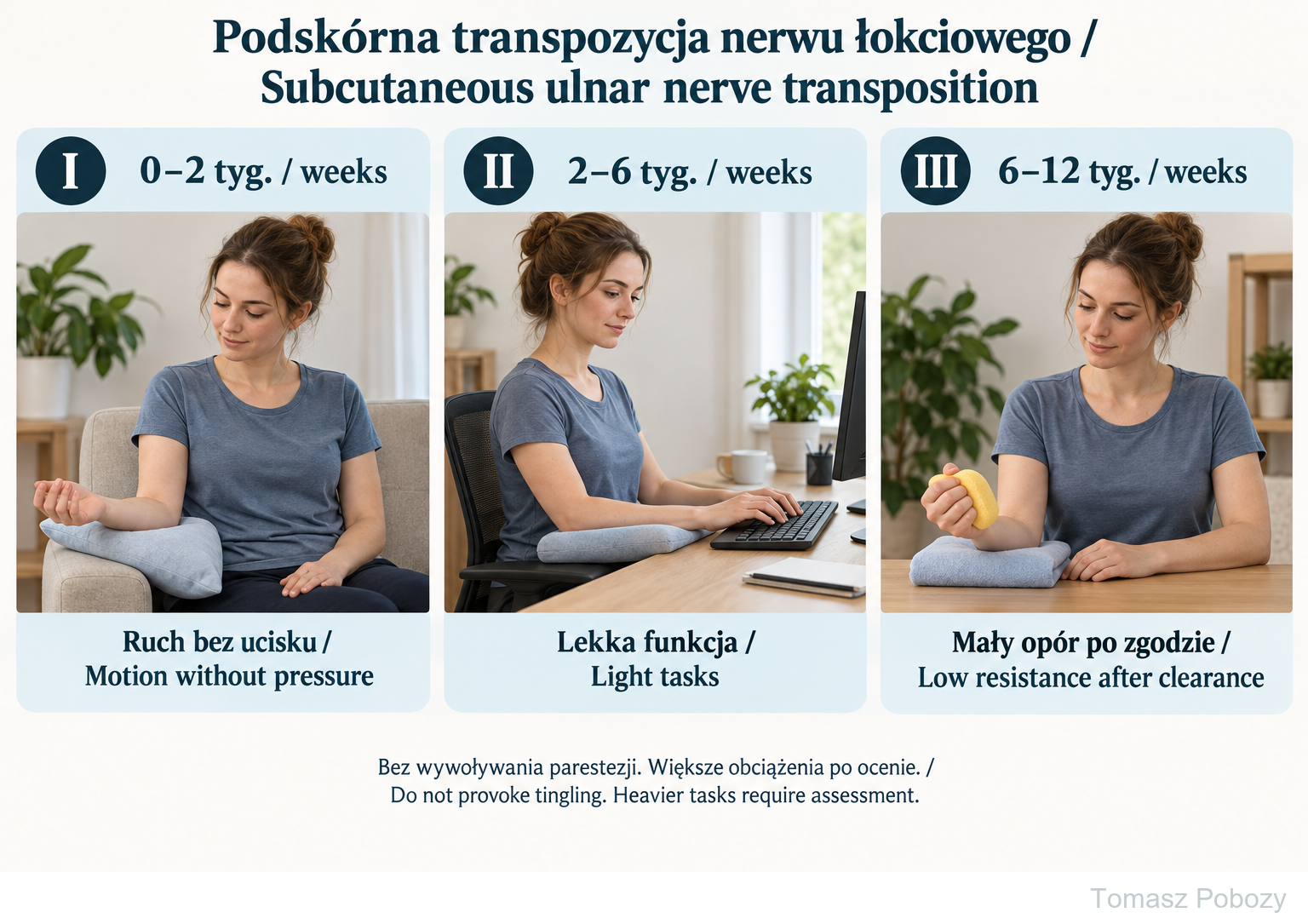
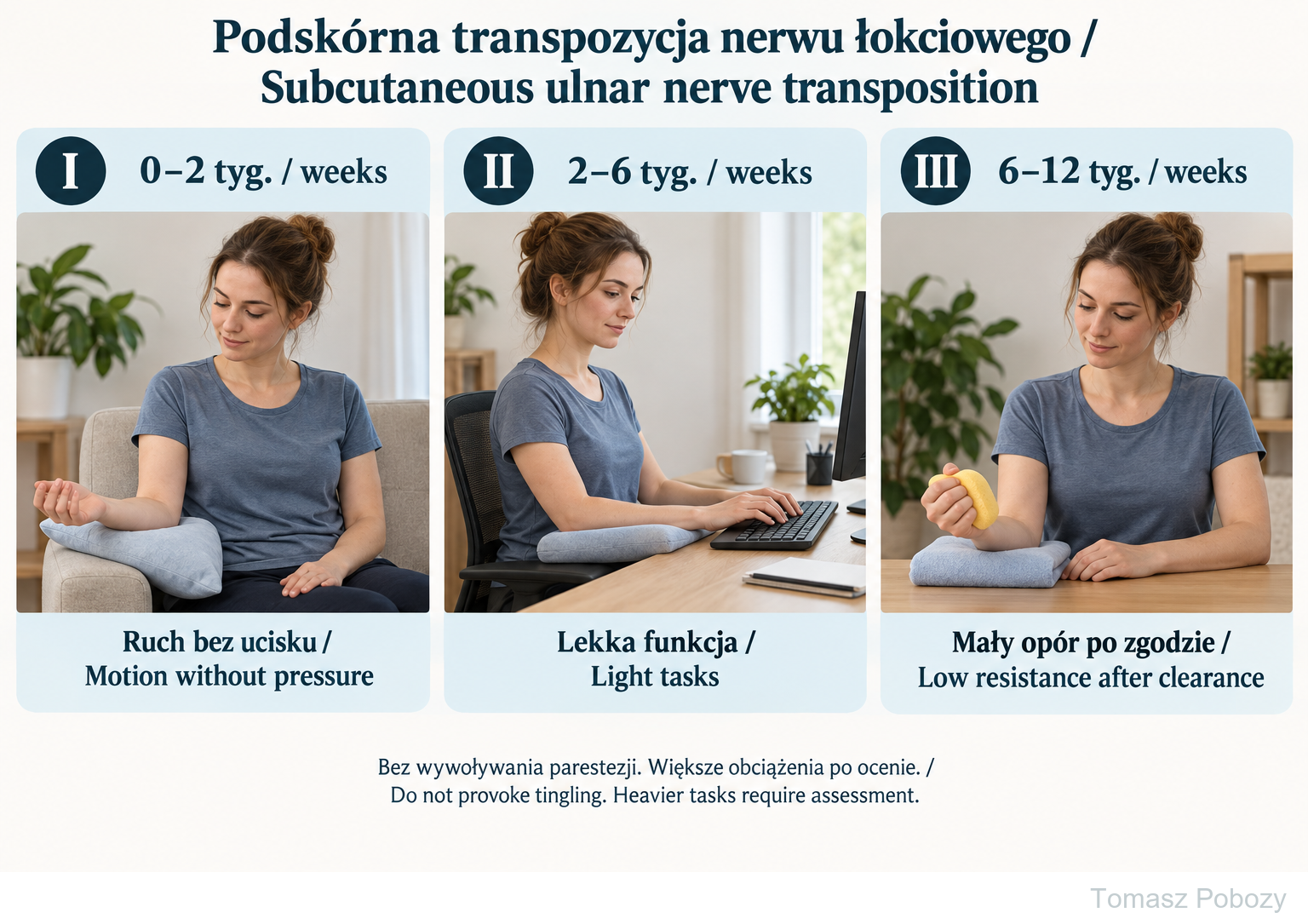
Weeks 0–2: gentle motion without nerve pressure. Weeks 2–6: brief light tasks with support. Weeks 6–12: low-resistance grip after clearance. Body-weight support and heavier loads require separate assessment.
Exercises — a closer look
Use the complete boards above together with the instructions for the chosen stage. An exercise shown for a later stage is not permitted early.
Open the relevant complete board and zoom in. The viewer retains all stages and captions.
Exercise instructions and progression are contained in the stage descriptions linked above.
Weeks 0–2: gentle motion without nerve pressure. Weeks 2–6: brief light tasks with support. Weeks 6–12: low-resistance grip after clearance. Body-weight support and heavier loads require separate assessment.
Scope and protection
Scope and prerequisites
Isolated primary anterior subcutaneous transposition of the ulnar nerve at the elbow, with nerve stability confirmed during surgery. This protocol excludes submuscular transposition, nerve repair or grafting, revision surgery and associated ligament, tendon or fracture procedures.
Review the operative report before rehabilitation: nerve stabilisation, any fascial sling and prescribed restrictions. Record baseline sensation in the little finger and ulnar half of the ring finger, intrinsic hand strength and elbow range of motion.
Dressing, splint and initiation of movement
Default pathway: a soft dressing and gentle active elbow movement during the first days, as permitted by pain, the wound and surgeon instructions. Prolonged immobilisation is not automatic. A sling may be used briefly for comfort or until the anaesthetic block resolves; remove it for permitted exercises.
If the orthopaedic surgeon prescribes a splint to protect the wound or stabilised tissues, follow those instructions, usually for 7–14 days. Do not independently remove it for elbow exercises without permission. Move the fingers, wrist and shoulder within dressing restrictions. The surgeon sets the splint angle and permitted movement.
Early exercises
Elbow: once movement is permitted, slowly bend and straighten actively with the upper arm near the trunk and the hand relaxed. Start with 5 comfortable repetitions, 3–4 times daily. Increase the arc gradually without pushing with the other hand or painful stretching.
Forearm and hand: with the elbow near the trunk, rotate the palm up and down. Bend and straighten the wrist and fingers; gently spread and bring the fingers together, 5–10 repetitions. Move the shoulder without tension at the surgical site.
Short sessions should not increase paraesthesia or cause persistent pain or swelling. Reduce the arc and dosage if symptoms increase. Avoid aggressive nerve tension testing. Individually prescribed nerve sliders must remain symptom-free; they are not mandatory home exercises.
Sport and recreation
Walking from the first days as tolerated. Stationary cycling without loading the operated arm is possible once anaesthetic effects resolve and balance is safe.
Swimming and outdoor cycling usually from weeks 6–8: a completely closed wound, comfortable movement and exercise tolerance are required; cycling also requires reliable steering and braking. Gradually introduce heavier gym training and weight-bearing in weeks 8–12.
Racquet sports, throwing and contact sports: sport-specific progression usually during weeks 8–12 or later. Full return is generally considered from around month 3 and may take longer. Competitive athletes need a separate programme; starting a throwing programme is not clearance for competition.
Progression criteria and therapy
A healed wound, minimal or no swelling, functional elbow and forearm motion, stable sensation and controlled grip. Task trials must not cause increasing paraesthesia or deterioration persisting the following day. Assess task-specific strength and endurance before heavy occupational or sporting loads.
Hand therapy is indicated for stiffness, intrinsic weakness, impaired dexterity, scar sensitivity or delayed improvement. Uncomplicated cases may follow an instructed home programme with progress reviews.
Expected recovery
Wound healing and recovery of movement precede nerve recovery. Tingling may improve during the first weeks; sensory and strength recovery takes months, and final results may be assessed at 12–18 months. Longstanding denervation and muscle wasting may limit recovery.
A persistent preoperative deficit does not automatically mean surgical failure. New deterioration must not be attributed simply to slow nerve recovery. Clinical reviews are usually at 10–14 days, around week 6 and month 3; further follow-up depends on residual deficits.
Stages and progression criteria
First 2 weeks: protection
Keep the dressing clean and dry. Support the limb and elevate the hand for swelling. Protect the anaesthetised arm from injury and temperature extremes. Wound review is usually at 10–14 days; remove non-absorbable sutures according to healing.
Avoid resting the medial elbow on desks, armrests or firm cushions. Avoid tight sleeves, prolonged deep elbow flexion and movements causing tingling. The transposed nerve is superficial and requires protection from pressure and impact.
Light self-care is permitted. Avoid lifting loads, forceful gripping, pushing, pulling and supporting body weight through the operated arm. Do not exercise with weights.
Weeks 2–6: movement and daily function
Following wound review, gradually recover preoperative motion. Comfortable motion is often possible by weeks 3–4 with early mobilisation, but may take longer with stiffness or prolonged protection. Lack of improvement by weeks 4–6 needs assessment, not more forceful stretching.
Increase light activity duration and practise dexterity. Start gentle scar care and mobilisation only after complete wound closure. Avoid deep massage over the transposed nerve. A soft elbow protector may prevent accidental contact, provided it does not compress the area.
Avoid heavy exertion and strength training. Light resistance in weeks 4–6 requires explicit surgeon approval, a healed wound, comfortable motion and no symptom increase.
Weeks 6–12: strength and loading
Generally start low resistance for grip, intrinsic hand muscles, wrist and elbow from week 6. Initially use one set of 8–10 repetitions on alternate days, adjusted to strength and tolerance. Increase easy repetitions before increasing load.
Progress from light activities to occupational tasks. Introduce weight-bearing and heavier loads gradually in weeks 8–12 after functional assessment. Recurrent tingling, pain or swelling requires stepping back to the previous tolerated level.
Daily activities and follow-up
Daily activities follow the permitted joint motion, lifting, grip and arm support for your procedure. Ending immobilisation is not clearance for lifting or driving. The detailed guidance below explains the criteria and exceptions.
Work and driving
Office work: approximately 1–3 weeks, sometimes later. Use short tasks, breaks and forearm support without elbow pressure. Light manual work: usually 3–6 weeks with modified duties. Heavy work: usually 6–12 weeks; heavy loads, vibration and repeated strong gripping require restored endurance.
Driving: usually consider at weeks 2–4. Requirements include no splint or sling restricting control, secure grip, operation of vehicle controls and an emergency manoeuvre without limiting pain. Do not drive while taking medication that impairs performance. Elapsed time alone is insufficient.
Warning signs
Symptoms requiring review
Urgent assessment: new or increasing hand weakness, worsening sensation after the anaesthetic wears off, a rapidly enlarging haematoma, severe pain or substantial swelling. A cold, pale or blue hand requires immediate care.
Contact the surgical team for drainage, wound separation, fever or spreading redness. Painful snapping at the medial elbow, persistent nerve irritation or disproportionate pain with hand colour or temperature changes require early assessment.
For a life-threatening emergency, call your local emergency number immediately — 112 in the European Union. On the boards, 112 refers to the EU.
Additional scope notes
Early movement after stable transposition. Protection from pressure. Resistance exercise generally from week 6.
For physicians and physiotherapists. Restrictions and progression require patient assessment, the operative report and surgeon instructions. Timings are approximate and do not replace functional assessment.
References
References
- Weirich SD, Gelberman RH, Best SA, Abrahamsson SO, Furcolo DC, Lins RE. Rehabilitation after subcutaneous transposition of the ulnar nerve: immediate versus delayed mobilization. J Shoulder Elbow Surg. 1998;7(3):244–249. doi:10.1016/S1058-2746(98)90052-0. Source
- Black BT, Barron OA, Townsend PF, Glickel SZ, Eaton RG. Stabilized subcutaneous ulnar nerve transposition with immediate range of motion. Long-term follow-up. J Bone Joint Surg Am. 2000;82(11):1544–1551. Source DOI
- Jurgensmeier K, et al. Ulnar Nerve Decompression With Subcutaneous Transposition. Video J Sports Med. 2024;4(1):26350254231186438. doi:10.1177/26350254231186438. Source
- University of Virginia, Department of Orthopaedic Surgery. Cubital Tunnel Release Anterior Subcutaneous Transposition: Rehabilitation Guidelines. Source
- Allina Health, Sports & Orthopaedic Specialists. Ulnar Nerve Transposition Protocol. Source
- American Academy of Orthopaedic Surgeons. Cubital Tunnel Release. OrthoInfo. Source
- Gateshead Health NHS Foundation Trust. Cubital Tunnel Release Surgery. 2024. Source
- Royal Berkshire NHS Foundation Trust. Ulnar nerve decompression. April 2025. Source
References and links checked on 18 October 2026. Existence of a publication does not validate every dose or timetable. Institutional protocols and examples require individualisation.
Use of this protocol
© 2026 Tomasz Poboży – orthopaedic surgeon · pobozy.org