 Skip to content
CONDITIONS AND SYMPTOMS
Shoulder Conditions
Shoulder pain, stiffness, weakness or instability may have different causes. Choose the problem closest to your symptoms and go to the detailed guide.
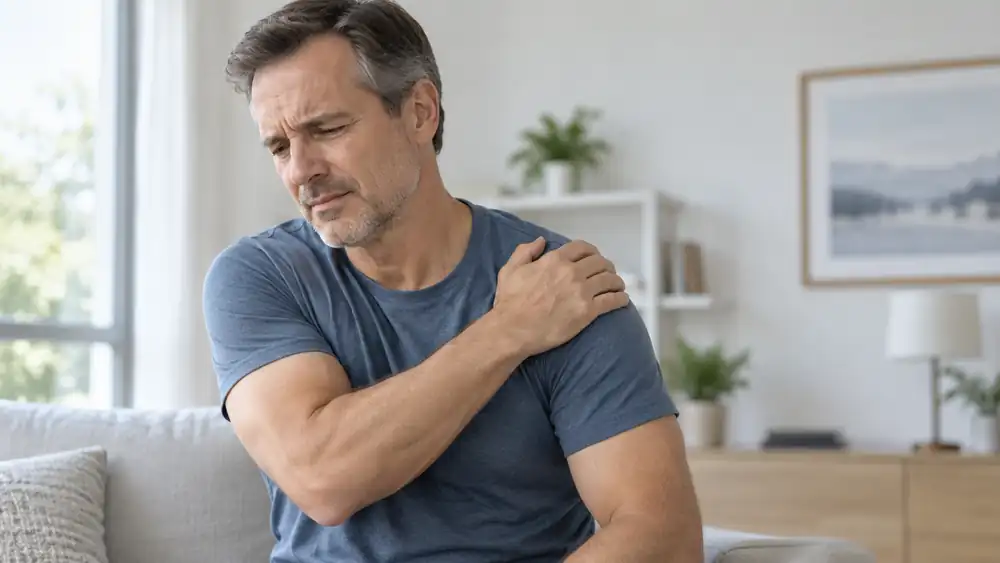
Shoulder problems an orthopaedic surgeon assesses
Shoulder Pain — Possible Causes
Shoulder pain is a symptom, not a single diagnosis. Similar symptoms may arise from tendons, a bursa, the glenohumeral or acromioclavicular joint, the biceps tendon, instability or injury, and sometimes from the cervical spine or nerve irritation.
Podcast in English: Shoulder Pain — Possible Causes and Where to Start
Expand: what may cause shoulder pain and where should you start?
The way pain began matters as well as its location. Pain after injury is assessed differently from gradually developing pain, night pain, stiffness, weakness or a feeling of instability. Pointing to the painful spot is usually insufficient to identify its cause.
Diagnosis begins with a conversation and clinical examination. Imaging is then selected for a specific question: X-rays primarily assess bone and alignment, ultrasound dynamically examines many tendons and bursae, and MRI gives a broader view of soft tissue and deeper structures. Not every painful shoulder needs immediate MRI.
- Pain when raising the arm may relate to the rotator cuff or a bursa.
- Pain with increasing stiffness suggests a different group of problems from isolated weakness.
- Pain after dislocation or a feeling of instability requires assessment of the labrum and possible bone loss.
- Pain radiating below the elbow or numbness may direct assessment beyond the shoulder itself.
PODCAST · DOCTOR POBOŻY ON HEALTH
Subacromial impingement — when does rehabilitation help, and when is other treatment needed?
An English episode about pain when raising the arm, subacromial impingement, assessment and the role of rehabilitation. Nonsurgical care and rehabilitation after surgery are separate treatment pathways.
Shoulder conditions and injuries
Subacromial impingement
Pain during arm elevation related to the subacromial region. Structural factors and functional shoulder control may both contribute.
Rotator cuff
Pain when raising the arm, weakness and principles of selection for non-operative care or tendon repair.
Podcast on Spotify ↗Frozen shoulder (in Polish)
Pain and increasing stiffness that make raising the arm and reaching behind the back difficult.
Rotator cuff calcification (in Polish)
Calcific tendinopathy, the role of ultrasound and targeted treatment, including barbotage.
Long head of biceps tendon (in Polish)
Anterior shoulder pain may arise from the biceps tendon or coexist with other joint problems.
Shoulder instability (in Polish)
Dislocations, subluxations, a feeling that the shoulder is slipping out and the importance of possible bone loss.
Symptoms, tests and injuries
Shoulder pain at night (in Polish)
Night symptoms do not indicate a single diagnosis, but their pattern helps guide further assessment.
Shoulder ultrasound and MRI (in Polish)
Ultrasound, X-rays and MRI answer different questions. Find out when each is most useful.
Shoulder injuries
A recent dislocation, fracture or sudden loss of strength or function requires a separate diagnostic pathway.
How to use this section
Start with the problem that most resembles your symptoms. Individual guides explain typical symptoms, diagnosis, treatment options and when surgery is considered.
Symptoms requiring quicker assessment
A recent injury with deformity, sudden inability to raise the arm, worsening sensory disturbance or signs of impaired circulation requires urgent assessment.
SLAP findings: what do they mean for a patient?
A SLAP lesion concerns the upper shoulder labrum near the attachment of the long head of the biceps. A scan finding must be interpreted alongside symptoms, the injury history and examination. Clicking or the word “SLAP” in a report is not, by itself, a reason for surgery.
Prepare the clinical story
Record whether symptoms followed an injury, which movement brings on pain and whether the shoulder feels unstable or weak. Bring the images as well as the report. Ask whether the labral finding explains your symptoms or whether the rotator cuff, biceps or neck also needs assessment.
Understand the investigation and treatment plan
X-rays assess bone rather than the labrum. MRI, sometimes MR arthrography, can clarify a suspected tear. Ultrasound cannot exclude every labral injury. Initial treatment is often nonsurgical, with activity modification and rehabilitation; the next step depends on the type of lesion, symptoms and response to treatment.
If surgery is proposed
Ask what will actually be done: labral repair, removal of unstable tissue or a procedure on the biceps tendon. Why is this option suitable for you? How will it affect using the arm, work and sport? Request a written follow-up and rehabilitation plan matched to the procedure performed.
A recent injury with deformity, worsening numbness or signs of impaired circulation needs urgent assessment rather than self-directed exercises.
Further reading: AAOS — SLAP tears.
Calcific tendinopathy and barbotage: beyond the demonstration
Calcific tendinopathy involves deposits within a rotator cuff tendon. Seeing a deposit does not, on its own, establish why a shoulder hurts or which treatment will help. The assessment should also consider movement, strength, the bursa, other tendon changes and the effect on daily activities.
What does barbotage do?
Barbotage uses a needle under ultrasound guidance to puncture and wash a deposit. The technical ability to remove material is different from proving a durable improvement in pain and function. A video showing the procedure cannot predict the result for an individual patient.
What does the evidence add?
A sham-controlled trial of 220 adults with persistent calcific shoulder tendinopathy found no superiority of lavage plus steroid, or sham lavage plus steroid, over sham treatment at four months; none of the procedures was superior at 24 months. This is an important reason to discuss uncertainty rather than promise relief from removing calcium. Individual assessment and the wider evidence remain relevant.
Prepare a decision worksheet
- Which finding best explains my pain, and are other causes being considered?
- What activities have become difficult: sleeping, dressing, reaching or work?
- What has already been tried, for how long and with what effect?
- What are the reasonable alternatives, including exercise-based care and symptom management?
- If a procedure is proposed, what benefit, risk, cost and aftercare should I expect?
- When will we assess whether treatment has helped, and what happens if it has not?
Bring previous images and reports. Use a short record of sleep and function to discuss change over time. Do not judge success solely by whether a deposit looks smaller on the next scan.
Reference: Moosmayer and colleagues, BMJ 2023 — randomised sham-controlled trial. A detailed Polish guide to calcific tendinopathy is also available.