 Skip to content
FOR PATIENTS
Diagnostic Tests
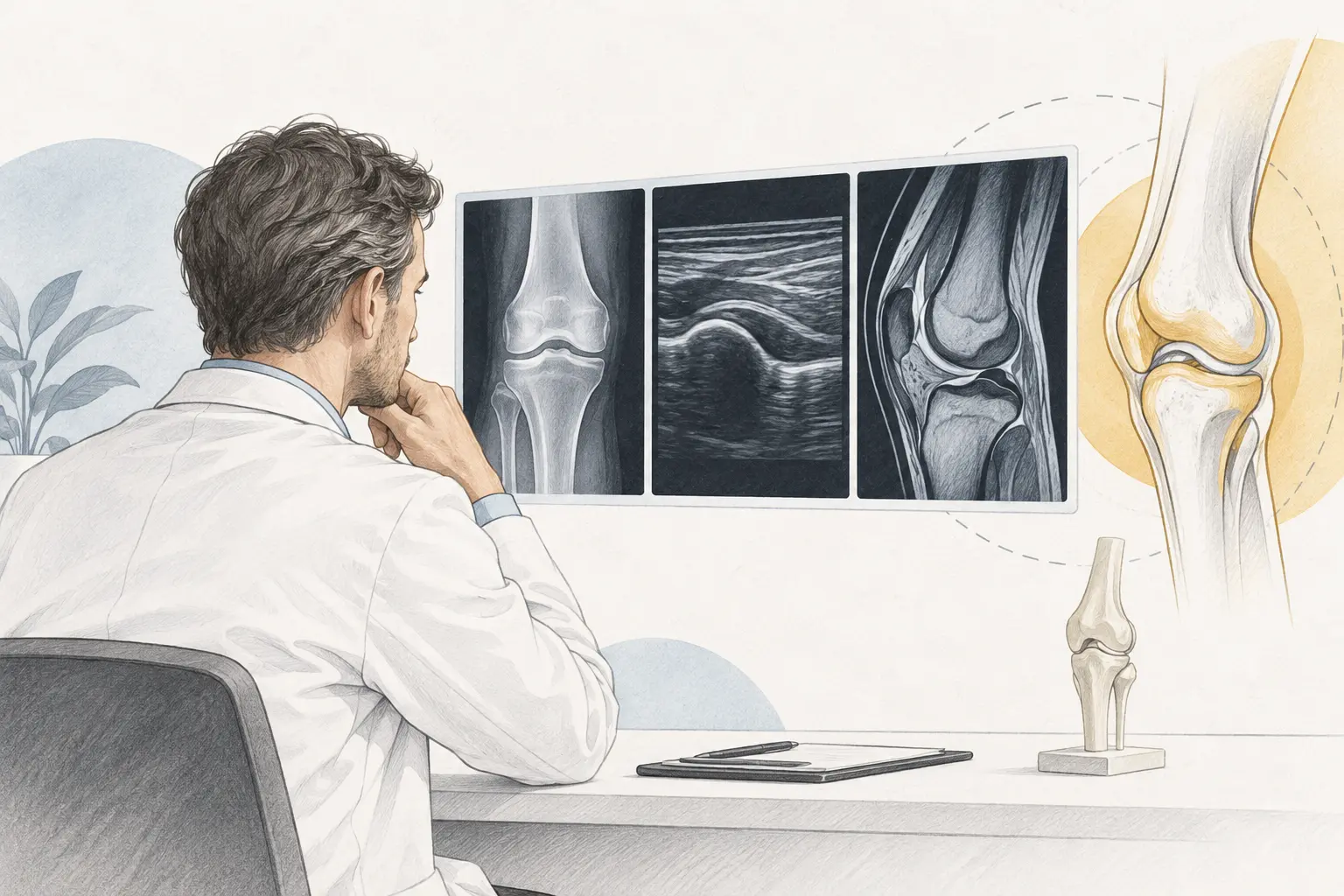
How are orthopaedic tests selected? Clinical examination, X-rays, ultrasound, MRI, CT and EMG answer different questions and should not be ordered automatically in every case.
Where does diagnosis begin?
With a conversation and clinical examination. The location, onset and duration of pain, injury, swelling, stiffness, numbness, weakness and movements that worsen symptoms all matter. Together, these determine whether imaging or a nerve function test is needed. Helpful explanations include Why Does an Orthopaedic Surgeon Examine More Than the Painful Area? (in Polish), Active and Passive Movement — Why Are Both Assessed? (in Polish) and What Does a Positive Orthopaedic Test Mean? (in Polish).
Assessment of function and movement is also explained in Why Does an Orthopaedic Surgeon Measure Muscle Strength? (in Polish), Why Does an Orthopaedic Surgeon Watch You Walk? (in Polish) and Why Does an Orthopaedic Surgeon Ask Whether Pain Wakes You at Night? (in Polish).
X-rays — primarily bones and joint alignment
X-rays are often the first investigation for a suspected fracture, osteoarthritis, deformity or joint alignment problem. Appropriate views, sometimes under weight-bearing, often provide information that MRI alone cannot replace. Read Why Do Weight-Bearing X-rays Show More? (in Polish).
Ultrasound — dynamic soft-tissue assessment
Ultrasound can assess tendons, some ligaments, bursae, joint fluid, selected muscle abnormalities and peripheral nerves. An important advantage is examination during movement and comparison of both sides. Read Why Is Ultrasound Performed During Movement? (in Polish) and Why Compare Both Sides on Ultrasound? (in Polish). Ultrasound can also guide a needle precisely during selected procedures.
However, not every structure is accessible to ultrasound. It does not automatically replace X-rays, MRI or CT. A separate ankle guide is available: Ankle Ultrasound — When Is It Useful and What Can It Miss?. The general patient guide remains at its existing public address: Sono-orthopaedics — Musculoskeletal Ultrasound and Ultrasound-Guided Procedures (in Polish); professional resources are available in the Musculoskeletal Ultrasound section.
MRI — when a broader view of tissues is needed
MRI is particularly useful for deeper structures, cartilage, bone marrow, labra, menisci, ligaments and the extent of soft-tissue abnormalities. An MRI report alone is not a diagnosis. Abnormalities may also occur in people without pain, so findings must be related to symptoms and examination. This is also why an MRI finding alone is not an indication for surgery (in Polish).
CT — bone detail and planning
CT provides detailed images of bone. It may be needed for complex fractures, bone loss, certain deformities, implant positioning or surgical planning. Three-dimensional reconstructions are also used for selected problems.
EMG and nerve conduction studies
Electrodiagnostic tests may help when numbness, tingling, weakness or suspected neuropathy predominates. They assess nerve and muscle function rather than appearance. EMG can therefore complement clinical examination and nerve ultrasound, but these are different investigations.
Is MRI always necessary?
No. In many common problems, a careful history, examination and simpler imaging are enough to plan management. MRI is most valuable when its result may change the diagnosis, treatment or preparation for surgery.
How should you prepare for a diagnostic consultation?
- bring previous images and reports, if available;
- access to the X-ray, MRI or CT images themselves is useful, not just the report;
- recall when symptoms started and whether an injury preceded them;
- note previous treatments, injections, operations and their effects;
- prepare a list of medications and important medical conditions.
Choose a Body Area → · Orthopaedic Conditions and Symptoms →
Medical author
Tomasz Poboży - orthopaedic surgeon, MD, PhD — specialist in orthopaedics and musculoskeletal traumatology.
This educational material does not replace an individual consultation or medical examination. Last updated: 12 September 2026.