 Skip to content
FOR CLINICIANS AND PHYSIOTHERAPISTS
Unicompartmental knee arthroplasty — rehabilitation protocol
A professional time- and criterion-based pathway for uncomplicated primary medial or lateral unicompartmental knee arthroplasty. Typical timings are presented as ranges; the operative report, surgeon’s instructions, healing and function take precedence.
Using and loading the limb
Follow prescribed loading and progress walking with aids after uncomplicated UKA. Wean aids according to knee control and gait, not the date alone.
Full guidance ↓Brace or immobilisation
A brace and CPM are not routine after uncomplicated UKA. Follow any additional individual protection plan.
Full guidance ↓Permitted movement
Prioritise extension and functional flexion. Stage targets are approximate; do not force range at the expense of pain and swelling.
Full guidance ↓Permitted movement, loading and removal of a brace are separate decisions. Additional repairs may require a more protective programme.
Rehabilitation at a glance
Progression follows healing and functional criteria, not dates alone.
Rehabilitation boards
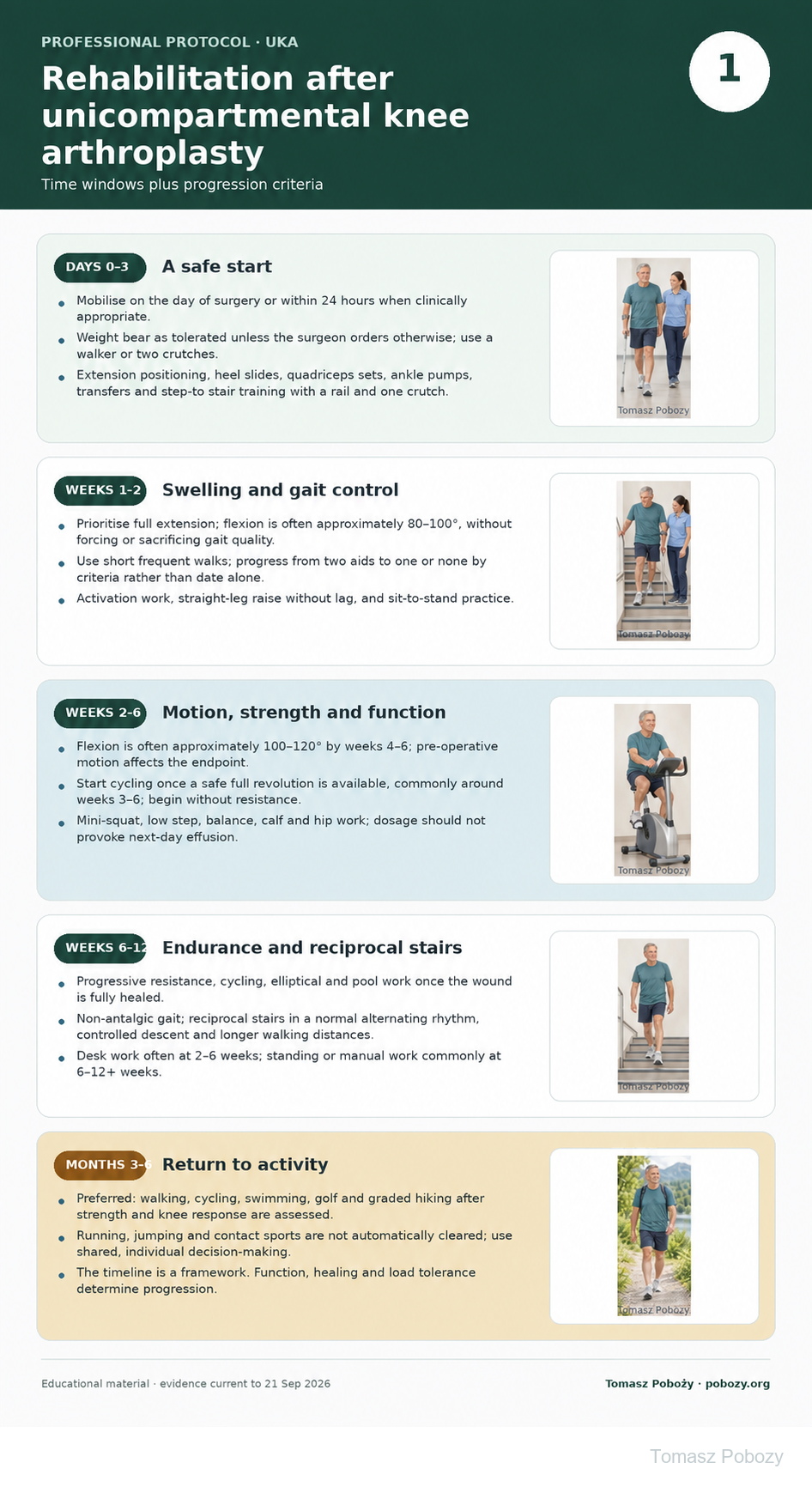
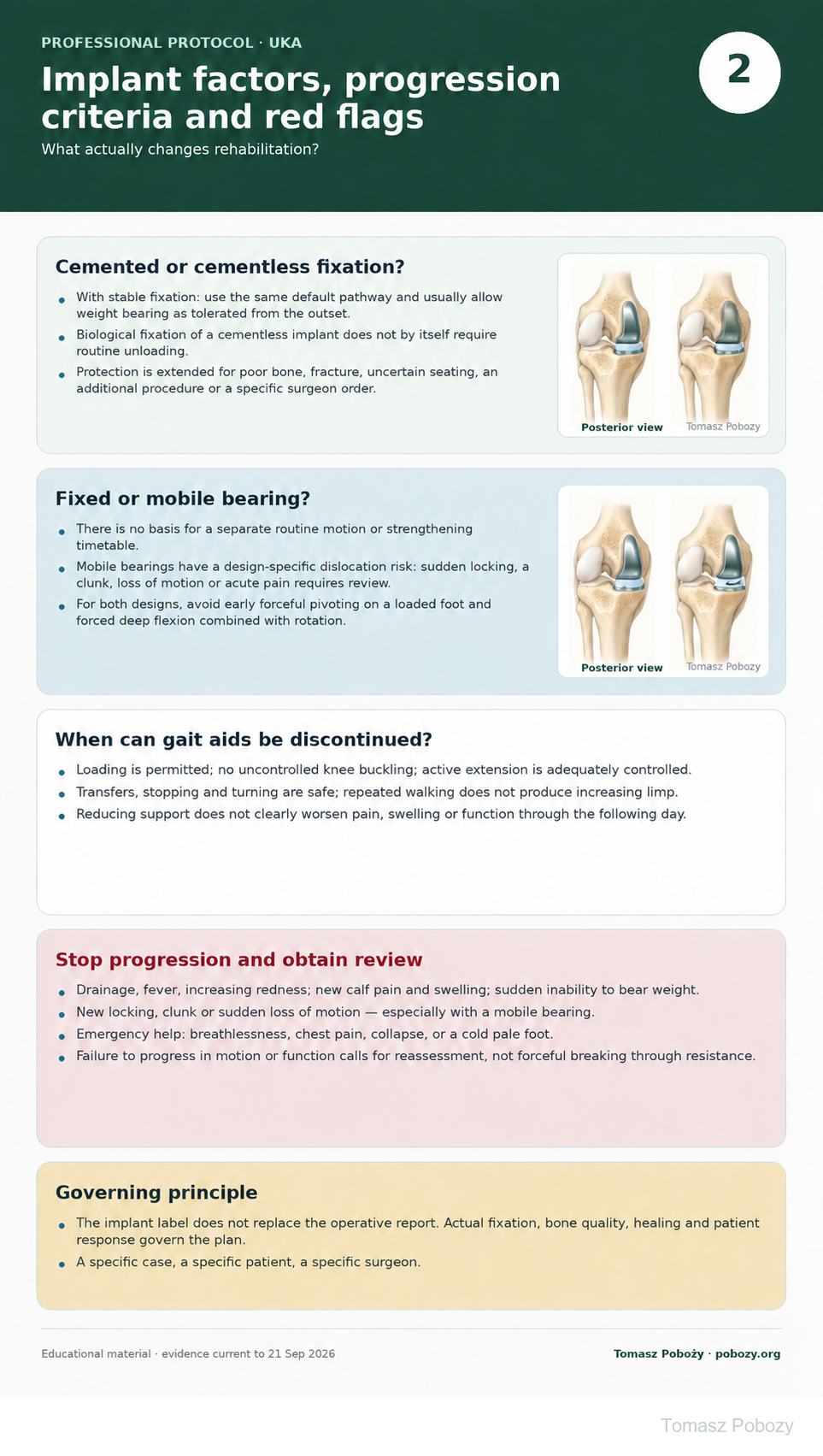
Exercises — a closer look
Use the complete boards above together with the instructions for the chosen stage. An exercise shown for a later stage is not permitted early.
Open the relevant complete board and zoom in. The viewer retains all stages and captions.
Exercise instructions and progression are contained in the stage descriptions linked above.
Scope and protection
Fixation and bearing design
Key conclusion
For a stable, uncomplicated UKA, four separate rehabilitation calendars are not justified. Cemented and cementless fixation can usually use the same weight-bearing-as-tolerated and motion-strength pathway. Fixed and mobile bearings also do not routinely require different exercise timing. The actual operative findings, not the implant label alone, determine modification.2–5
| Variant | Default pathway | Reasons to modify |
|---|---|---|
| Cemented | Early mobilisation and weight bearing as tolerated. | Fracture, poor bone, additional procedure, instability or a specific order. |
| Cementless | The same when initial fixation is stable. Osseointegration alone is not a routine reason to unload. | Uncertain press-fit, intra-operative fracture, poor bone quality or surgeon concern. |
| Fixed bearing | Standard progression of motion, strength and gait. | Restrictions arise from tissues, healing and fixation rather than the bearing label. |
| Mobile bearing | The same standard timetable; early avoidance of forceful pivoting on a loaded foot and forced deep flexion with rotation. | Acute clunk, locking, loss of motion or sharp pain — assess for bearing dislocation. |
Safety check: before rehabilitation, confirm side, compartment, implant, weight-bearing order, any bone injury and any additional procedure.
Gait aids, walking and stairs
There is no mandatory date for stopping gait aids. Progress from two aids to one on the opposite side, then to no aid, when:
- loading is permitted and the knee does not buckle;
- active extension and quadriceps control are adequate;
- transfers, stopping, turning and the required distance are safe;
- limp or trunk lean does not increase after repeated walking;
- less support does not clearly worsen pain, swelling or function through the following day.
Many institutional pathways report unaided walking within 1–3 weeks, but some patients need support for longer. Safety takes priority over the calendar.
Progress review and adjuncts
At each review record wound status, rest and movement pain, swelling or effusion, active and passive motion, active extension lag, strength, gait quality, transfers, stairs and next-day response. Later testing may include Timed Up and Go, 30-second chair stand and a patient-appropriate walk test.
Approximate motion windows are not an instruction to force through resistance. If motion or function stops improving across visits, deteriorates, or a meaningful extension deficit persists, assess pain, effusion, wound, exercise technique and possible mechanical causes, and contact the orthopaedic surgeon early.
NMES may be considered for marked quadriceps inhibition or active extension lag; this is extrapolated from TKA guidance rather than a strong UKA-specific recommendation. CPM and bracing are not routine after uncomplicated UKA.1
Stages and progression criteria
Rehabilitation phases
Phase I · days 0–3
Mobilise on the day of surgery or within 24 hours when medically appropriate. Usually weight bear as tolerated with a walker or two crutches. Use extension positioning, heel slides, quadriceps sets, ankle pumps and transfers. On postoperative day 1–2, teach safe stair negotiation in a step-to pattern, usually with a handrail and one crutch. Walking does not replace prescribed pharmacological thromboprophylaxis.
Progress when: transfers and the required walking distance are safe, there is no uncontrolled knee buckling, and a pain, swelling and wound plan is in place.
Phase II · weeks 1–2
Full extension is the priority. Flexion is often approximately 80–100° during this period but is not a pass/fail test. Use short frequent walks, quadriceps activation, straight-leg raise without lag, sit-to-stand and gait retraining.
Phase III · weeks 2–6
Flexion often reaches approximately 100–120° by weeks 4–6; pre-operative motion and swelling influence the endpoint. Start cycling when a full revolution is available without compensation, commonly around weeks 3–6. Add mini-squat, low step, balance, hip and calf work.
Phase IV · weeks 6–12
Progress resistance, endurance and patient-specific tasks. Targets include non-antalgic gait, reciprocal ascent and descent of stairs in a normal alternating rhythm, and increasing distance without reactive effusion. Pool work starts only after complete wound healing.
Phase V · months 3–6 and beyond
Prefer low-impact activity. Return to more demanding sport depends on previous skill, strength, function, clinical course and shared risk assessment.6–7
24-hour response rule: if effusion, pain or limp clearly increases or motion falls the following day, reduce dosage and investigate the cause.
Daily activities and follow-up
Progress in everyday activities follows the permitted loading and motion for your procedure. Walking without aids requires a controlled gait; returning to driving requires safe vehicle control and no impairing medication. The detailed recommendations below explain the criteria and exceptions.
Stairs, endurance, work and strengthening.
Driving, work and sport
| Task | Typical range | Conditions |
|---|---|---|
| Driving | 2–6 weeks | No opioids or other impairing medication; confident pedal transfer and effective emergency braking. The right knee usually takes longer. |
| Desk work | 2–6 weeks | Position changes, safe travel and tolerable swelling. |
| Standing or manual work | 6–12+ weeks | Depends on lifting, terrain, stairs and shift length. |
| Recreational sport | 3–6 months | Low-impact first; demanding sports after individual assessment and shared decision-making. |
The ranges reflect variation across studies and institutional pathways. They are neither an outcome guarantee nor a substitute for clinical assessment.6–7
Warning signs
Red flags
Urgent same-day assessment: wound drainage, fever or chills, increasing redness, new calf pain and swelling, sudden inability to bear weight, loss of active extension after trauma, or new motor or sensory change.
Mobile bearing: acute locking, a distinct clunk, sharp pain and sudden loss of motion require stopping exercise and assessment for bearing dislocation.
Emergency help: breathlessness, chest pain, collapse, or a suddenly pale cold foot.
Additional scope notes
mobilise
Weight bear as tolerated unless the surgeon orders otherwise.
control
Extension, swelling, quadriceps activation and safe gait.
progress
Motion, cycling, basic strength and graded reduction of aids.
function
activity
Return to agreed recreation by testing and tolerance.
Select a board to open it at full size. The two boards form one protocol.
Watch or listen
Is knee replacement always necessary? (Polish)
Tomasz Poboży discusses when knee replacement is considered. This material concerns treatment selection; use the protocol above for postoperative rehabilitation.
References
References
This is a synthesis, not a copy of one protocol. UKA literature does not answer every rehabilitation question in equal detail; TKA extrapolations are explicitly identified.
- Bove AM et al. Clinical practice guideline for physical therapist management of total knee arthroplasty: revision 2026. Phys Ther. 2026;106(7):pzag058. DOI: 10.1093/ptj/pzag058. Principles applied to UKA only where explicitly identified as extrapolation.
- Campi S et al. Five-year results of a randomised controlled trial comparing cemented and cementless Oxford unicompartmental knee replacement using radiostereometric analysis. Knee. 2021;28:383–390. DOI: 10.1016/j.knee.2020.09.003.
- Mohammad HR et al. Cementless unicompartmental knee replacement achieves better ten-year clinical outcomes than cemented: a systematic review. Knee Surg Sports Traumatol Arthrosc. 2021;29(10):3229–3245. DOI: 10.1007/s00167-020-06091-5.
- Abu Al-Rub Z et al. Survivorship of fixed vs mobile bearing unicompartmental knee replacement: A systematic review and meta-analysis of sixty-four studies and National Joint Registries. Knee. 2020;27(5):1635–1644. DOI: 10.1016/j.knee.2020.09.004.
- Albishi W et al. Unicompartmental knee replacement: controversies and technical considerations. Arthroplasty. 2024;6:21. DOI: 10.1186/s42836-024-00242-6.
- Radhakrishnan GT et al. Return to Sport After Unicompartmental Knee Arthroplasty: A Systematic Review and Meta-analysis. Orthop J Sports Med. 2022;10(3):23259671221079285. DOI: 10.1177/23259671221079285.
- Cerasoli T et al. Sport participation after unicompartmental knee arthroplasty: High return rates independent of implant design or technique, a systematic review and meta-analysis. J Exp Orthop. 2026;13(1):e70514. DOI: 10.1002/jeo2.70514.
Clinical commentary and terms of use
Clinical commentary
UKA often allows faster early recovery than TKA, but it is not a minor operation without risk. A useful pathway does not chase one flexion number; it integrates extension, quadriceps function, gait quality, effusion response and the goals of the individual patient.
I would not prolong unloading solely because an implant is cementless when fixation is stable and the surgeon has no concern. Equally, I would not ignore acute locking with a mobile bearing. A specific case, a specific patient, a specific surgeon.