 Przejdź do treści
FOR CLINICIANS AND PHYSIOTHERAPISTS
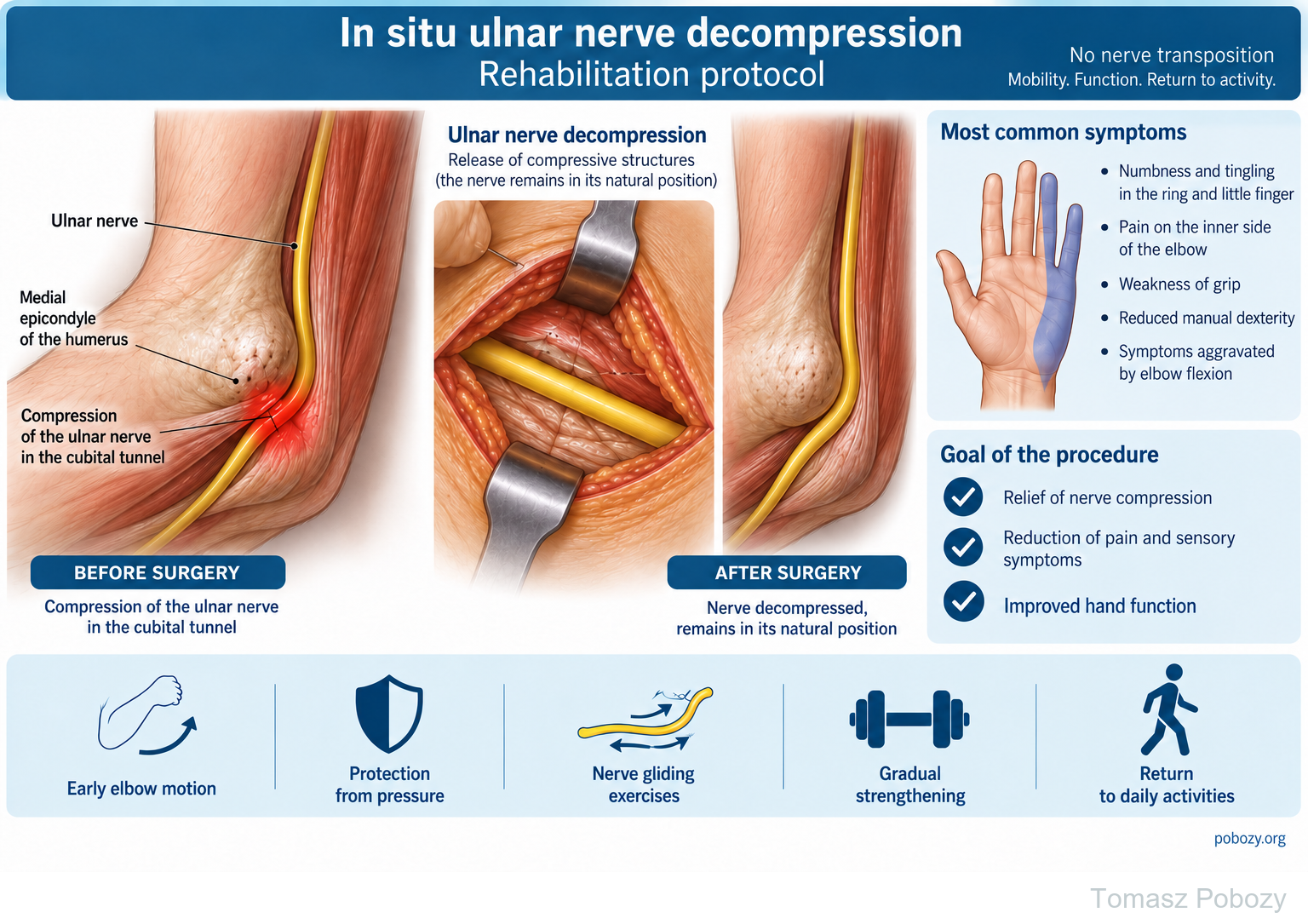
In situ ulnar nerve decompression — rehabilitation protocol
Protection, movement and a gradual return to daily activity. Select the stage appropriate to the actual procedure and current clearance.
Using and loading the limb
Initially light self-care without nerve pressure or heavy loads. Light resistance is considered around weeks 4–6 in this pathway after assessment.
Full guidance ↓Brace or immobilisation
After uncomplicated in-situ release, use a soft dressing; prolonged splinting is not routine. Do not automatically apply transposition precautions.
Full guidance ↓Permitted movement
Gentle elbow movement from the first days as tolerated. No routine 90° limit unless prescribed; glides should not provoke symptoms.
Full guidance ↓Permitted movement, loading and removal of a brace are separate decisions. Additional repairs may require a more protective programme.
Rehabilitation at a glance
Progression follows healing and functional criteria, not dates alone.
Rehabilitation boards
Neural sliders are optional and require individual instruction. New weakness, deteriorating sensation or painful snapping require assessment, not stronger stretching.
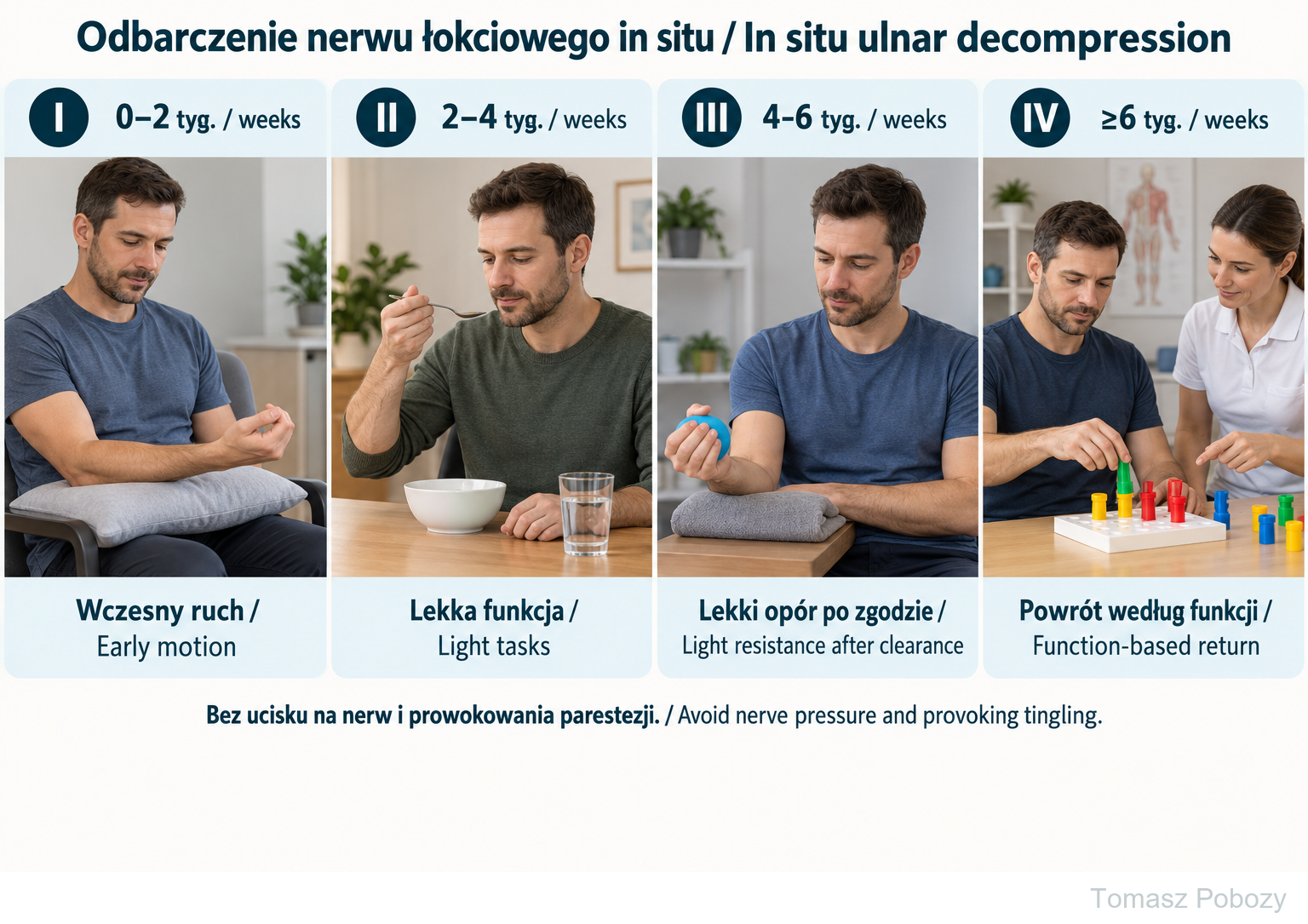
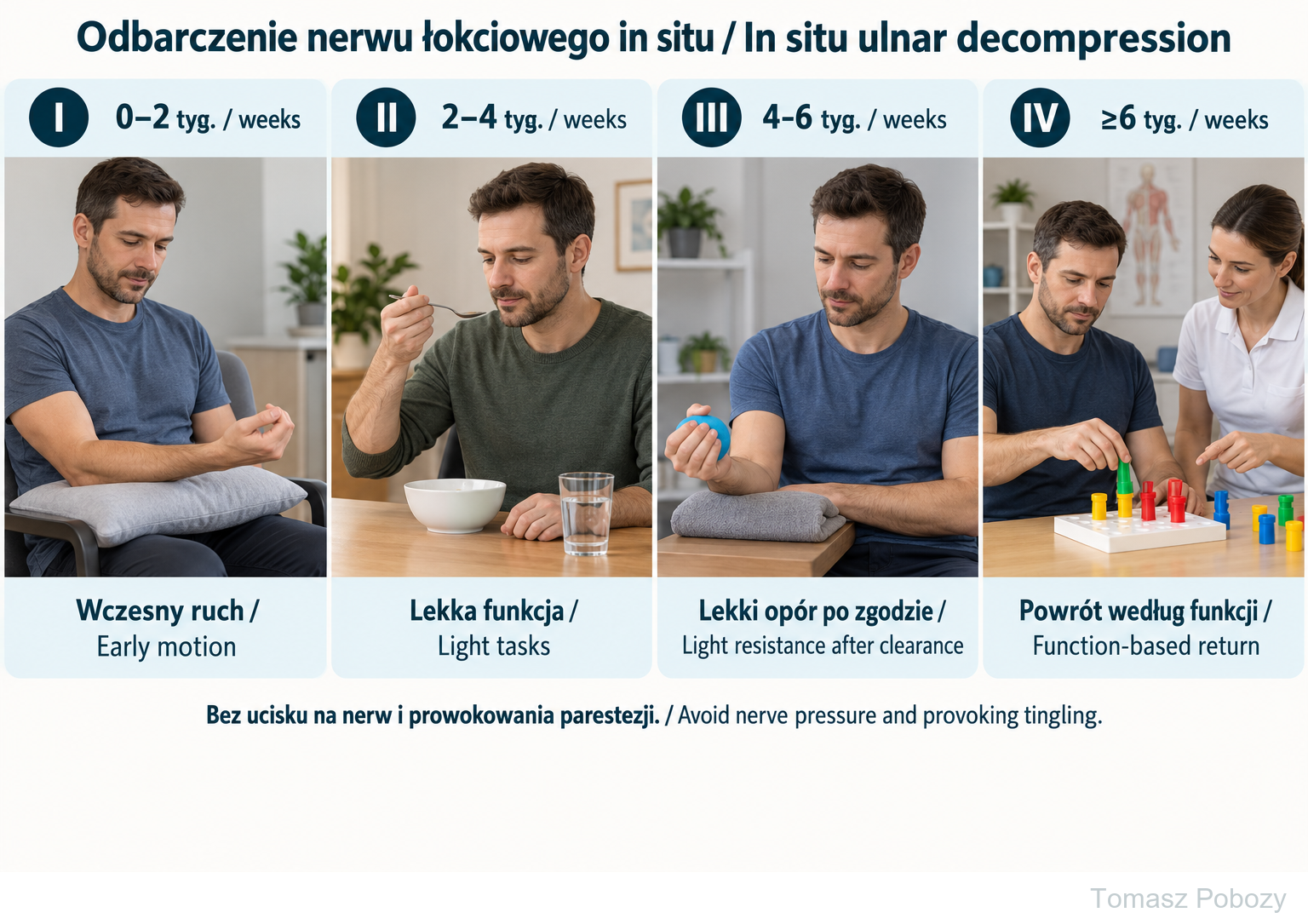
Weeks 0–2: early motion without pressure. Weeks 2–4: light tasks. Weeks 4–6: low resistance after clearance. From around week 6: task-based dexterity assessment and gradual return. The illustrated manual assessment does not mean early maximal grip testing.
Exercises — a closer look
Use the complete boards above together with the instructions for the chosen stage. An exercise shown for a later stage is not permitted early.
Open the relevant complete board and zoom in. The viewer retains all stages and captions.
Home exercises
Elbow: 5–10 comfortable flexion and extension repetitions several times daily. Forearm: with the elbow near the trunk, turn the palm up and down. Hand and wrist: full finger and wrist movement with gentle finger spreading. Nerve gliding: only gentle individually selected sliders; stop if they cause persistent tingling, numbness or pain.
Weeks 0–2: early motion without pressure. Weeks 2–4: light tasks. Weeks 4–6: low resistance after clearance. From around week 6: task-based dexterity assessment and gradual return. The illustrated manual assessment does not mean early maximal grip testing.
Scope and protection
Scope
Isolated primary in situ decompression of the ulnar nerve at the cubital tunnel, without anterior transposition, epicondylectomy, nerve repair or grafting, ligament reconstruction or fracture treatment. The nerve remains in its anatomical groove. If it subluxates or is unstable after release, this simple in situ protocol may not apply.
Expected recovery
Wound healing and recovery of elbow motion occur faster than nerve recovery. Paraesthesia may improve during the first weeks, while sensation and intrinsic hand strength may continue to improve for many months. Longstanding preoperative denervation and muscle wasting may limit final recovery; persistent preoperative deficits do not by themselves indicate surgical failure.
Stages and progression criteria
Weeks 0–2 — wound care and early motion
Use a soft dressing as directed by the orthopaedic surgeon; prolonged routine splinting is not required after uncomplicated decompression. Begin finger, wrist, forearm, elbow and shoulder motion during the first days. Flex and extend the elbow gently within tolerance. There is no routine need to restrict flexion to 90° unless the surgeon specifically requests this.
Avoid resting the medial elbow on a hard surface. Avoid heavy lifting, forceful gripping, pushing, pulling and supporting body weight through the operated arm. Light self-care is permitted if it does not increase pain or neurological symptoms. Avoid prolonged deep elbow flexion and positions that reproduce numbness.
Weeks 2–4 — full motion and light function
Progress towards full comfortable elbow motion and forearm rotation. Once the wound has fully healed, gentle scar mobilisation and desensitisation may begin. Ulnar nerve gliding can be added as gentle sliders without provoking paraesthesia; aggressive nerve tension tests are not rehabilitation exercises.
Increase light activities of daily living. Formal physiotherapy is not mandatory in an uncomplicated course, but is useful for stiffness, scar problems, hand weakness or delayed functional improvement.
Weeks 4–6 — strengthening
With a healed wound, functional range of motion and no increase in neurological symptoms, introduce light resistance for grip, wrist and elbow. Increase load gradually. Continue to avoid prolonged direct pressure over the nerve and an abrupt return to heavy loads, repeated forceful gripping or prolonged deep elbow flexion.
From approximately week 6 — return to full activity
Progressively resume heavier loads, manual work and sport when healing and function permit. There is no single date for every patient: hand strength, tolerance of pressure, occupational demands and the severity and duration of preoperative nerve dysfunction all matter. In uncomplicated cases, restrictions can generally be lifted earlier than after nerve transposition.
Warning signs
Symptoms requiring review
Urgent assessment is required for new or increasing hand weakness, worsening sensation after the anaesthetic has resolved, a rapidly enlarging haematoma, severe pain or substantial swelling. Contact the surgical team for wound drainage, wound separation, fever or spreading redness. Painful snapping of the nerve behind the medial epicondyle after surgery requires assessment of nerve stability.
For a life-threatening emergency, call your local emergency number immediately — 112 in the European Union. On the boards, 112 refers to the EU.
Additional scope notes
ELBOW AND FOREARM · FOR DOCTORS AND PHYSIOTHERAPISTS
Protocol after simple cubital tunnel decompression without ulnar nerve transposition. The nerve remains in its anatomical groove, so an uncomplicated release does not require protection of a new nerve position and elbow motion can begin early.
Prepared by Tomasz Poboży, MD, PhD — orthopaedic surgeon
Updated and sources reviewed: 26 September 2026
References
References
- Verstuyft L, Caekebeke P, van Riet R. Postoperative rehabilitation in elbow surgery. J Clin Orthop Trauma. 2021;20:101479. doi:10.1016/j.jcot.2021.101479.
- Warwick L, Seradge H. Early versus late range of motion following cubital tunnel surgery. J Hand Ther. 1995;8(4):245–248. DOI
- Adkinson JM, Chung KC. Minimal-Incision In Situ Ulnar Nerve Decompression at the Elbow. Hand Clin. 2014;30(1):63–70. doi:10.1016/j.hcl.2013.08.019. DOI · Full text
- University of Virginia, Department of Orthopaedic Surgery. Cubital Tunnel Release In Situ Rehabilitation Guidelines. 2024.
Warwick and Seradge studied release with medial epicondylectomy, not isolated in situ decompression. This is indirect evidence about mobilisation, not validation of this entire timetable.
References and links checked on 18 October 2026. Existence of a publication does not validate every dose or timetable. Institutional protocols and examples require individualisation.