 Przejdź do treści
Polski — ćwiczenia i rehabilitacja
FOR PATIENTS · NONSURGICAL REHABILITATION
Frozen shoulder, also known as adhesive capsulitis, involves inflammation, thickening and tightening of the joint capsule. This causes pain and restricted movement. Exercises should match your shoulder’s current level of pain and stiffness.
Tomasz Poboży, MD, PhD
More about the condition, diagnosis and treatment (in Polish) →
Exercise is part of treatment
Home exercises alone are not always enough, particularly when pain is severe or stiffness is established. A physiotherapist can help select movements, joint mobilisations and gentle progressive stretching suited to how irritable your shoulder is. Your orthopaedic surgeon may recommend painkillers or anti-inflammatory medicines and, in selected cases, an intra-articular corticosteroid injection or hydrodilatation — stretching the capsule with fluid under ultrasound guidance. Less often, if nonsurgical treatment has not helped, manipulation under anaesthesia or arthroscopic capsular release may be considered. After surgery, follow the separate postoperative rehabilitation protocol →.
Programme principles
- Do not try to force your shoulder through severe pain. When pain is prominent, keep movements gentle and brief; build up stretching as pain settles.
- Choose 2–3 well-tolerated exercises with your physiotherapist. Do not do all eight from day one.
- A mild pulling sensation may be acceptable. Symptoms should settle quickly, roughly within 30 minutes. Worse sleep or clearly increased pain the following day means you should reduce the dose.
- The suggested numbers are a cautious starting point, not the same prescription for everyone. Increase only one element at a time: range, repetitions, hold time or resistance.
- Stages depend on your shoulder’s response, not a particular week of the condition. More complete improvement may take many months.
STAGE A · WHEN PAIN DOMINATES
Relaxation and assisted movement
Use short sessions, initially 1–2 times a day. Start with the smallest dose your shoulder tolerates without a flare-up. If even a small movement is very painful, your treatment needs reviewing.
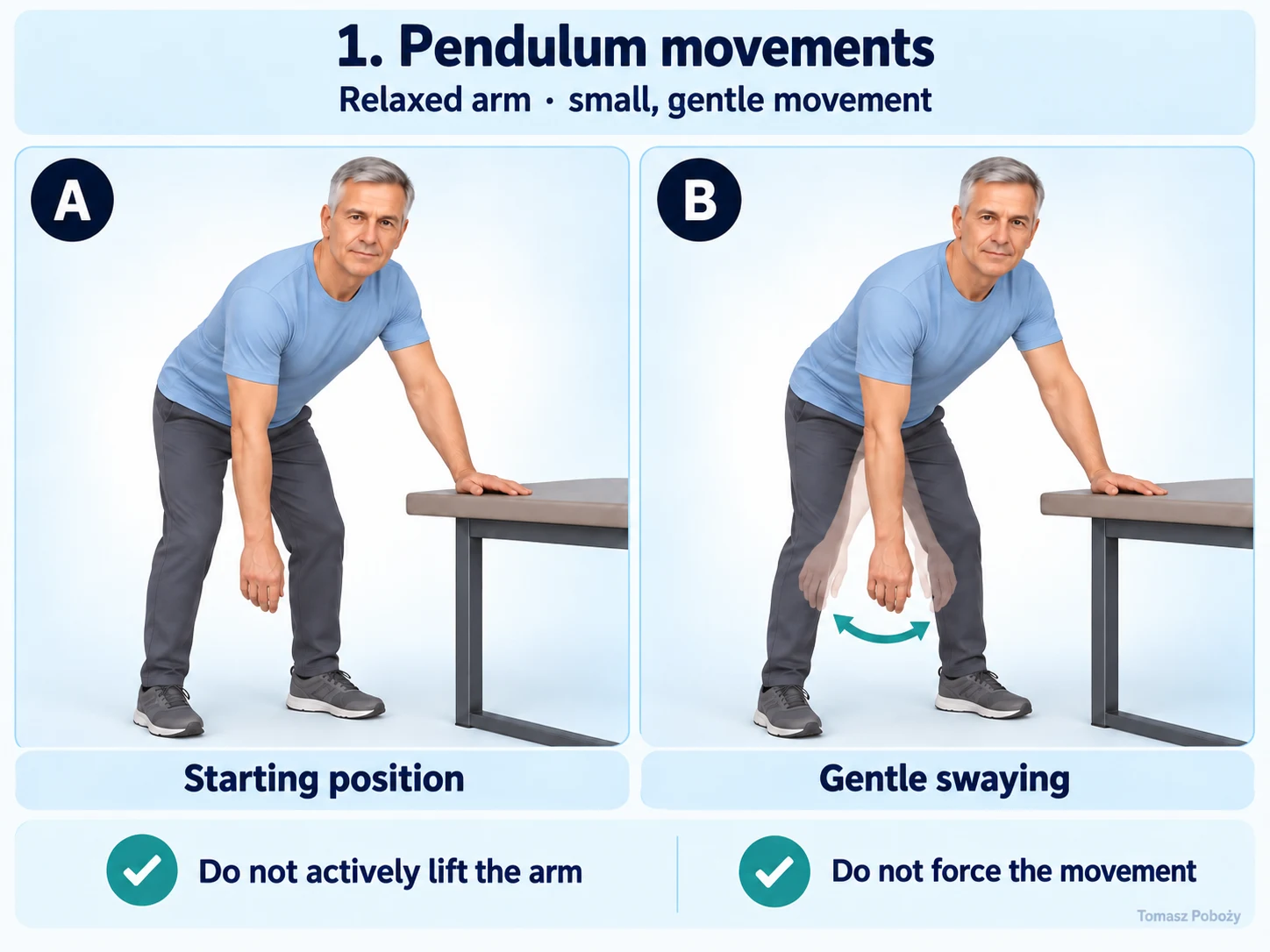
1. Pendulum movements
Support your unaffected hand on a stable table and lean forwards. Let the other arm hang loosely. Gently sway your body to create a small, relaxed movement of the arm. Do not drive the movement with your shoulder muscles or hold a weight.
To start: 20–30 seconds, repeated 1–2 times with a break. This is a supporting exercise; it does not replace work on range of movement.
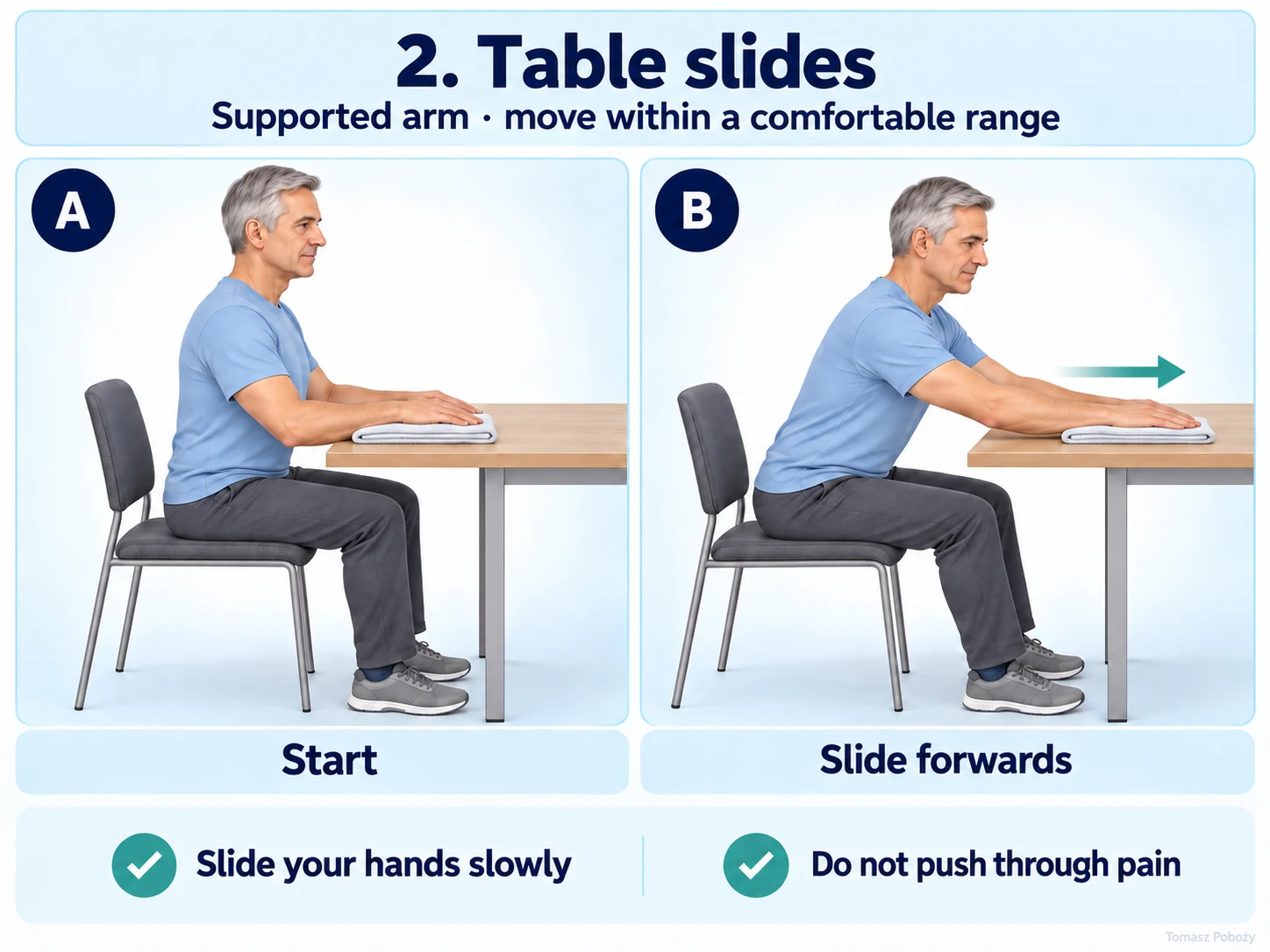
2. Table slides
Sit at a table with your hands and forearms resting on a towel. Slide them forwards while leaning your trunk slightly forwards. Stop before significant pain and return calmly. The table height should allow comfortable support.
To start: 5 slow repetitions, without a prolonged hold.
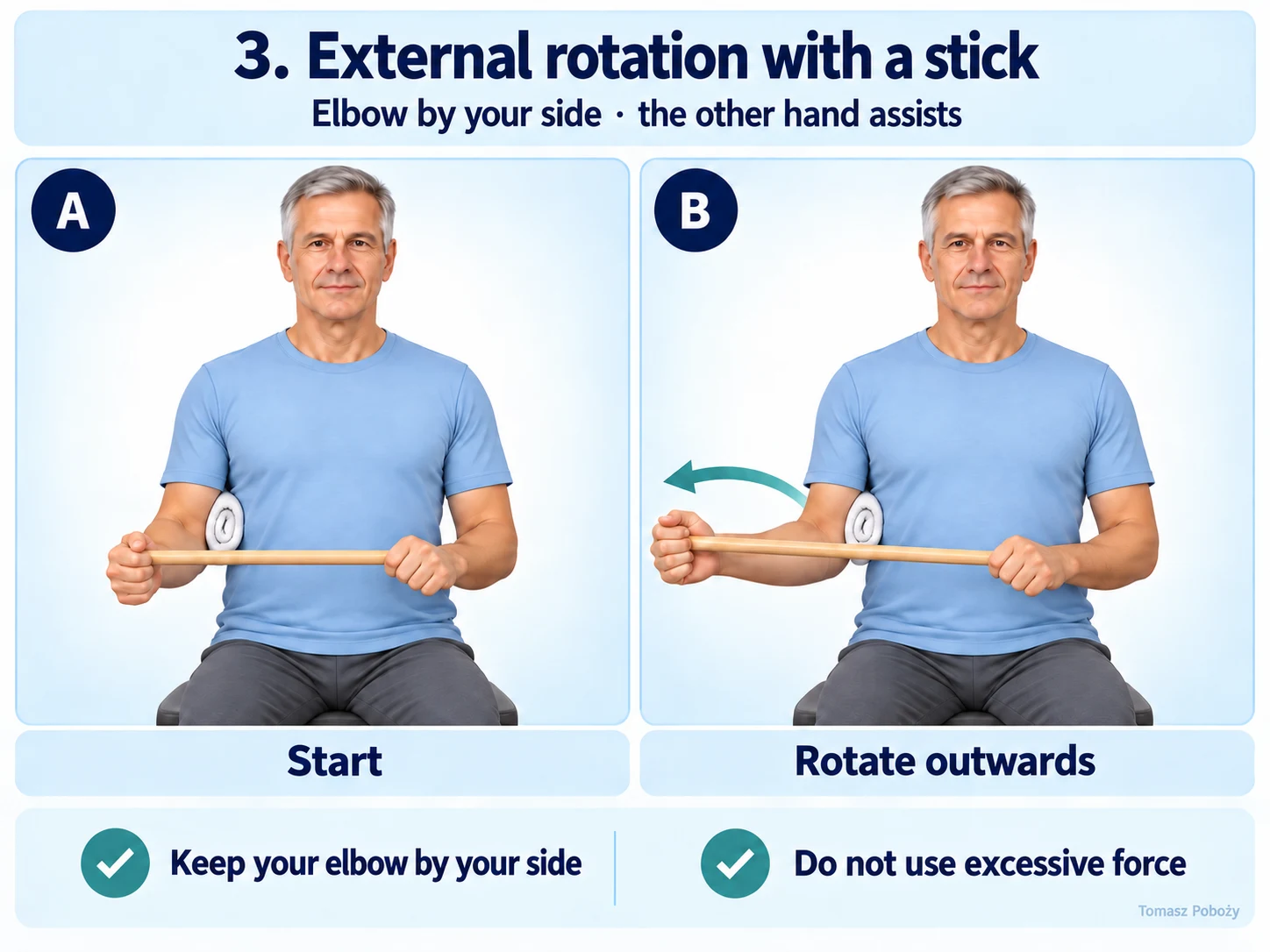
3. External rotation with a stick
Hold a stick in both hands. Bend the elbow of the affected arm to about a right angle and keep it by your side; a small towel may help with positioning. Gently move the stick with your unaffected hand so the affected forearm rotates outwards. Keep the elbow by your side and avoid twisting your trunk.
To start: 5 repetitions; if well tolerated, hold for 2–3 seconds. If you feel pain rather than a gentle stretch, reduce the range.
STAGE B · LESS PAIN, MORE STIFFNESS
Gradually regaining movement
When your current exercises do not worsen sleep or next-day symptoms, you can increase the range and introduce new directions. Choose one elevation exercise; exercises 2, 4 and 5 do not all need to be performed in the same session.
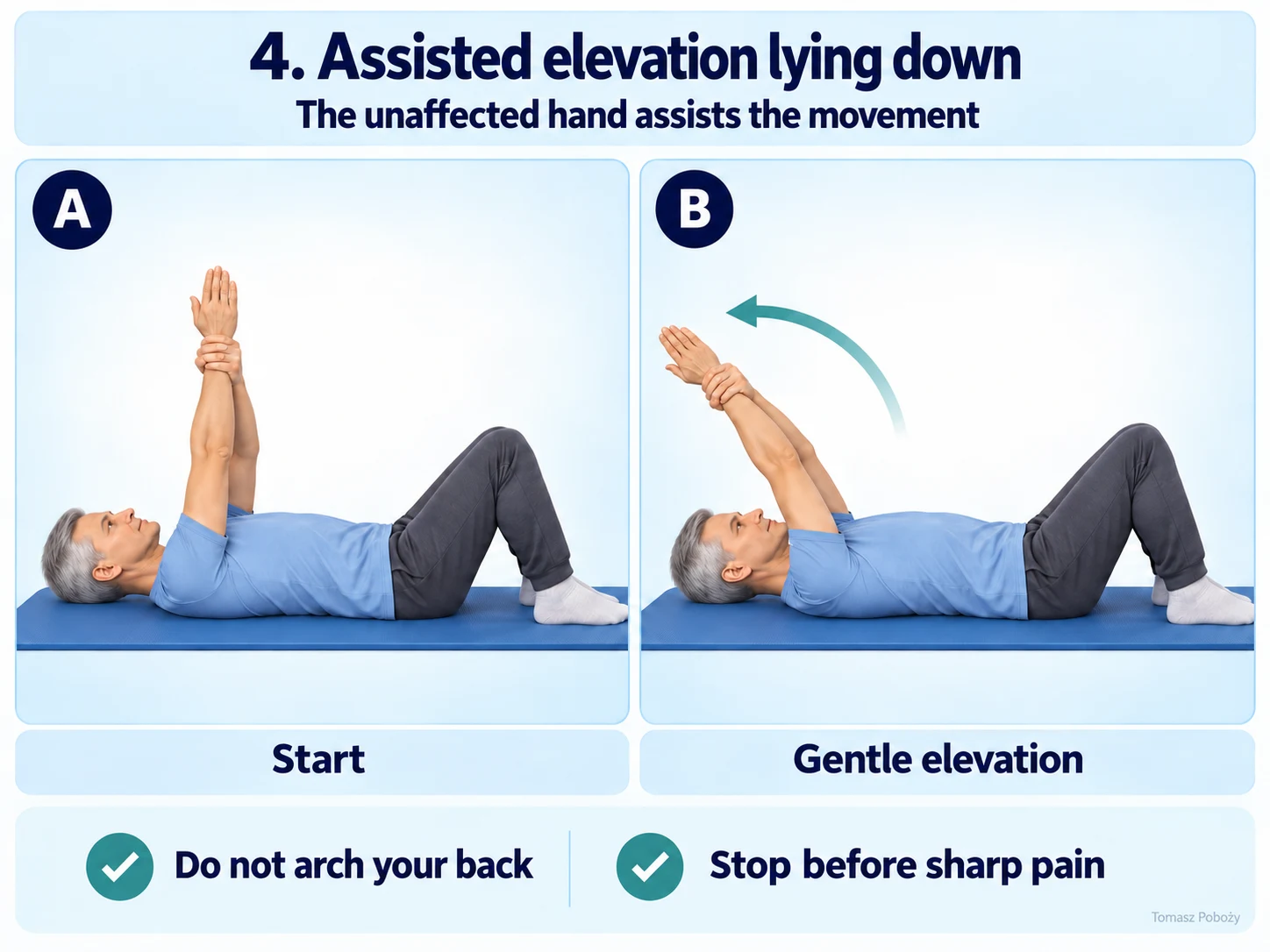
4. Assisted elevation lying down
Lie on your back on a bed or mat. Support the wrist or forearm of the affected arm with your unaffected hand, helping it rise above your chest and then towards your head. Begin in a position you can comfortably adopt. Do not arch your back to create the appearance of more shoulder movement.
To start: 5 repetitions. When pain is low, you may hold a gentle stretch for 5–10 seconds.
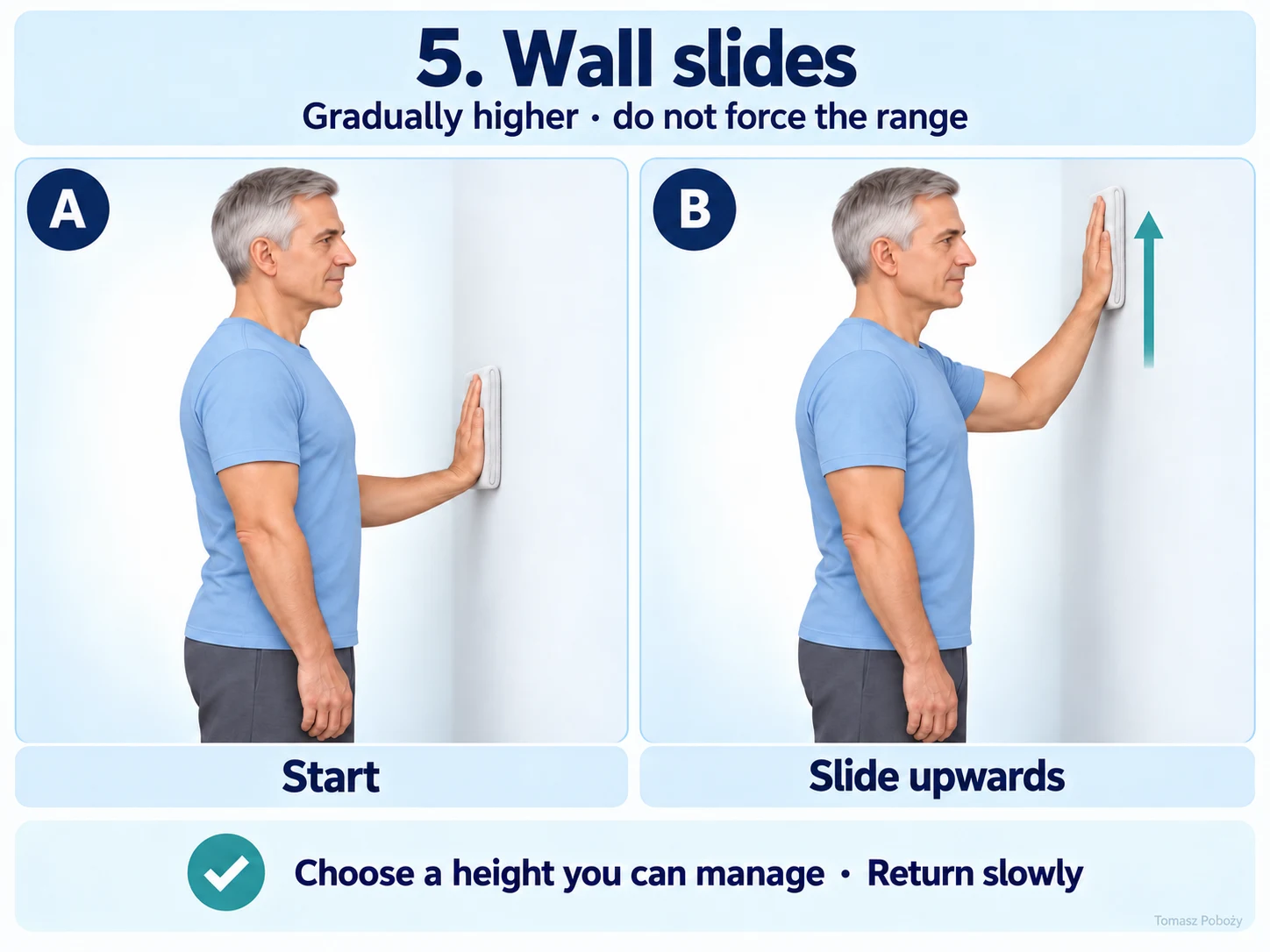
5. Wall slides
Face a wall with your hand resting on a towel. Slowly slide it upwards; a small step closer to the wall may help. Return under control. Allow your shoulder blade to move naturally with your arm, but avoid abruptly shrugging the shoulder or leaning your trunk backwards.
To start: 5 repetitions to a well-tolerated height. If this is too difficult, return to table slides.
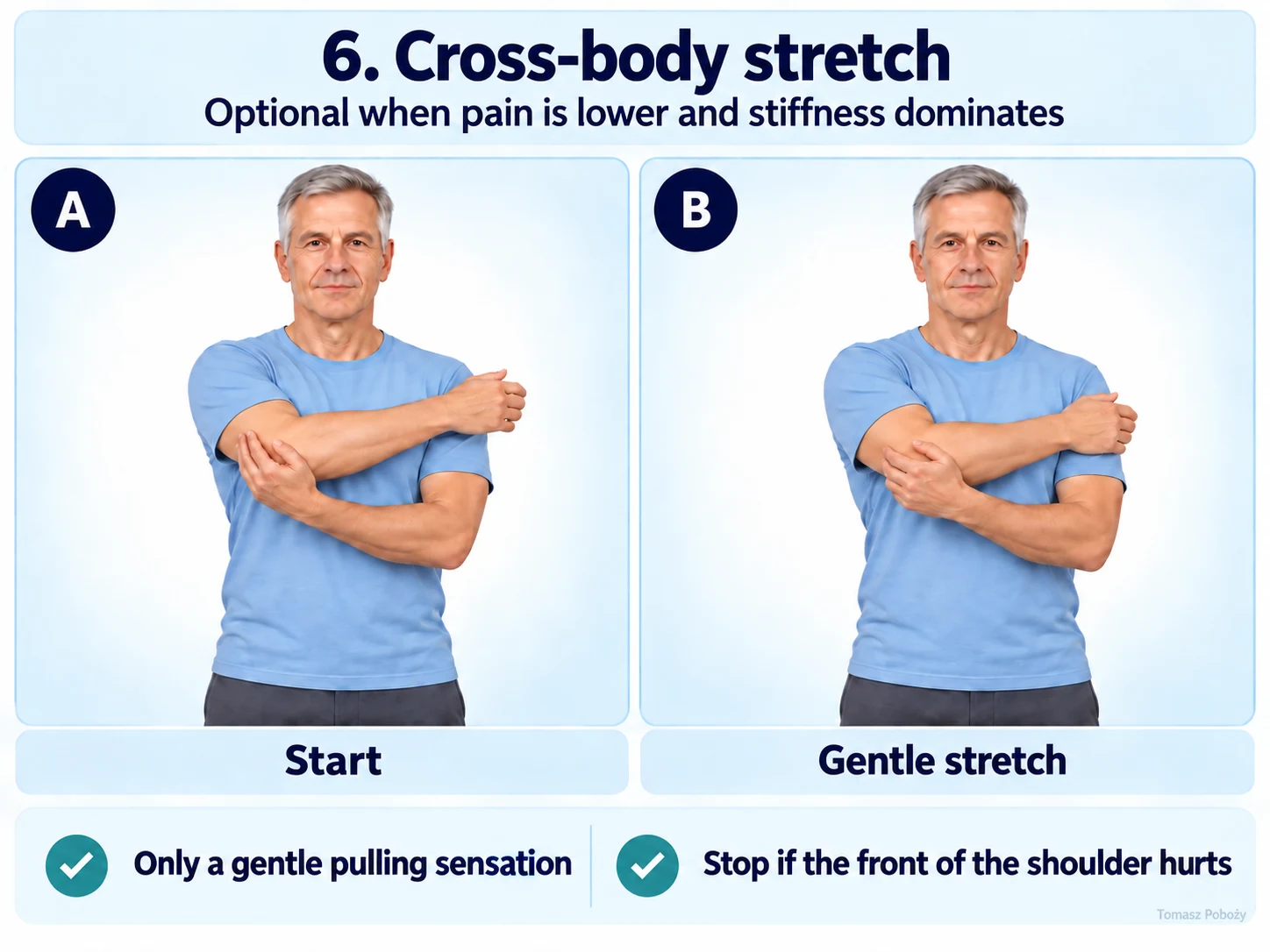
6. Cross-body stretch — optional
Bring the affected arm across your chest. Support the upper arm near the elbow with your other hand and gently bring it towards the opposite shoulder. Aim for a mild pulling sensation at the back of the shoulder. If you feel pain at the front or top of the shoulder, skip the exercise and check your technique with a physiotherapist.
To start: 3 repetitions, holding for 5–10 seconds, only when pain is low.
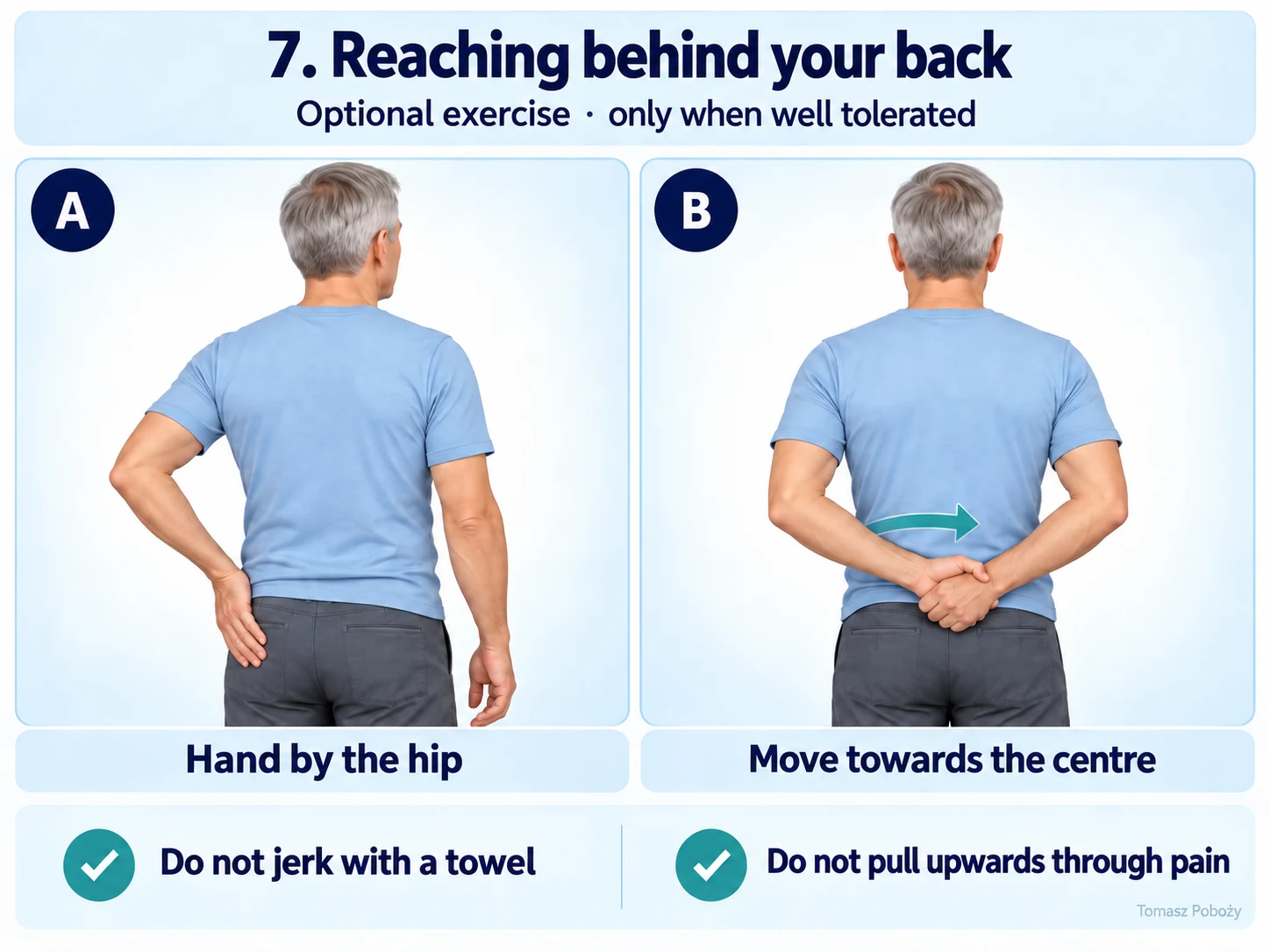
7. Reaching behind your back — optional
Place your hand near the back of your hip. Slowly move it towards the centre of your lower back; the other hand may gently assist. Initially, a movement at waist level is enough. Do not jerk with a towel or try to reach between your shoulder blades straight away.
To start: 3–5 repetitions. Introduce this only when the direction does not cause sharp pain or a later flare-up.
STAGE C · REBUILDING STRENGTH AND FUNCTION
Light resistance within your available range
Strengthening can be added when the movement is well tolerated. You do not need to regain the full range first, but resistance should not be used to force a stiff joint.
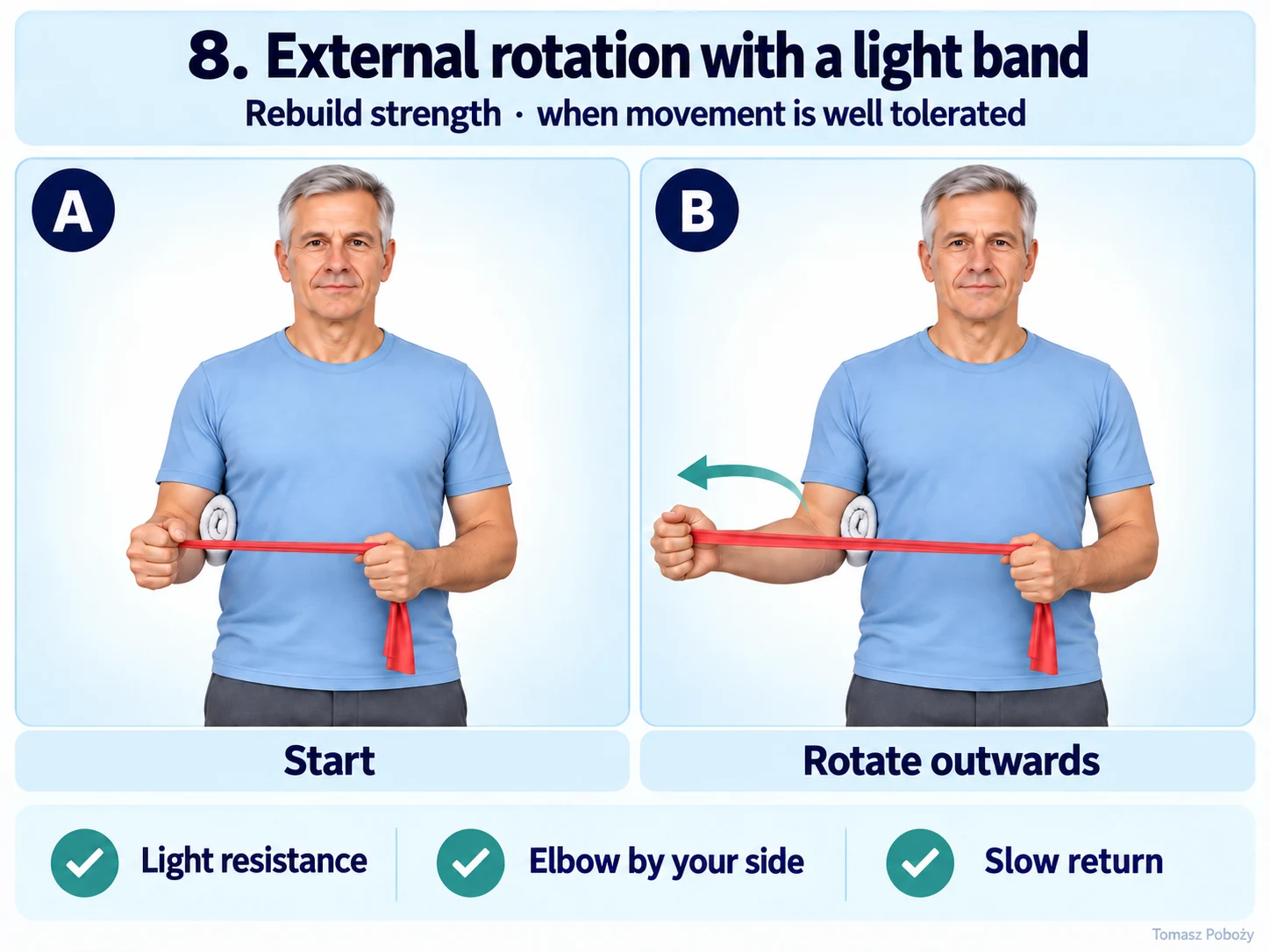
8. External rotation with a light band
Keep your elbow by your side, bent to about a right angle. Hold the band in front of your abdomen with your unaffected hand. Rotate the affected forearm slightly outwards, then return slowly. Do not compensate by twisting your trunk.
To start: 1 set of 8–10 repetitions, 2–3 days per week, with a rest day between resistance sessions. Use light resistance selected for your individual needs.
Daily activities and checking progress
Use your arm for light activities within the range available to you. Try supporting your forearm with a pillow when sleeping. When dressing, put the painful arm into clothing first; when undressing, take it out last. Gradually return to reaching higher and handling greater loads.
Once a week, check whether dressing, doing your hair and sleeping through the night are easier. No progress over several weeks, increasing stiffness or pain that prevents exercise calls for a review of your programme and treatment.
When should you stop exercising?
Stop the set if you experience sharp, increasing pain, new numbness or weakness. A hot, red shoulder with fever, a recent injury with loss of function, or a sudden loss of strength or sensation needs urgent medical assessment.
Read, listen and watch
Research paper I coauthored: the course and treatment of frozen shoulder →Konarski W, Poboży T, Hordowicz M, Poboży K, Domańska J. Orthopedic Reviews, 2020. An English-language review with free full text.
Frozen shoulder — diagnosis and treatment (in Polish) →After arthroscopic capsular release — postoperative protocol →YouTube: Frozen shoulder — why it hurts and how to regain movement (in Polish) →Part II of the “Painful shoulder” series.
Spotify: Shoulder pain — possible causes and where to start →An introductory episode about different causes of shoulder symptoms.
Sources and scope of the programme
The exercise selection and starting doses are a practical proposal for individual adjustment. Sources differ in recommended repetitions and stretching times; there is no single mandatory routine for every patient.
- Konarski W, Poboży T, Hordowicz M, Poboży K, Domańska J. Current concepts of natural course and in management of frozen shoulder: A clinical overview. Orthopedic Reviews. 2020;12(4):8832. DOI: 10.4081/or.2020.8832 · Free full text.
- Rupani N, Gwilym SE; BESS Frozen Shoulder Working Group. British Elbow and Shoulder Society patient care pathway: Frozen shoulder. 2025. BESS guidance.
- AAOS OrthoInfo. Frozen Shoulder.
- Cambridge University Hospitals. Frozen shoulder — information and exercises.
- MSK Dorset. Frozen shoulder — movement and response to exercise.
- MSK Bexley. Frozen Shoulder — range-of-movement exercises.
- Sherwood Forest Hospitals. Frozen shoulder — exercises and self-care.