 Skip to content
FOR CLINICIANS AND PHYSIOTHERAPISTS
Arthroscopic capsular release for shoulder stiffness — rehabilitation protocol
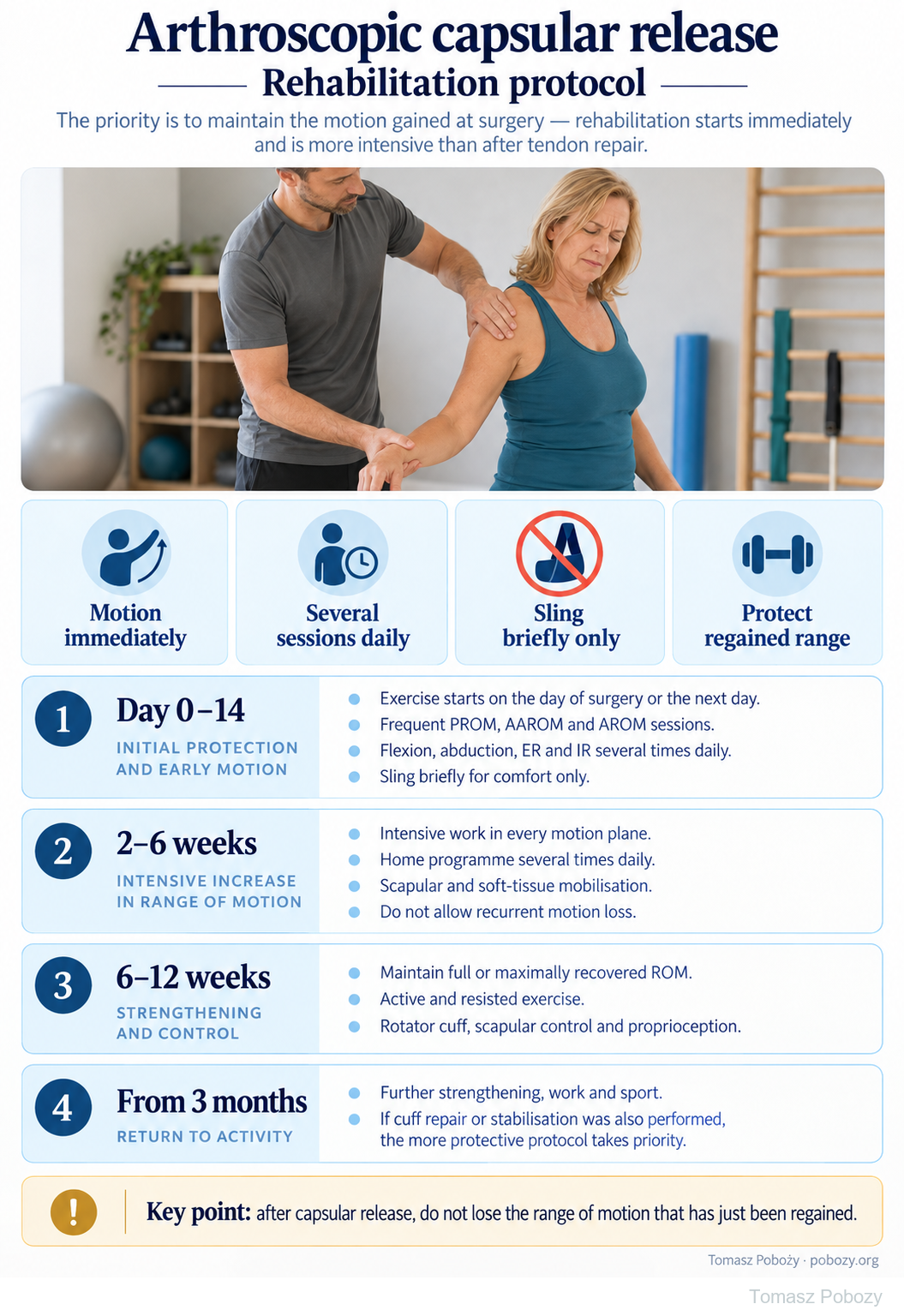
Frozen shoulder — rehabilitation after surgical release of the contracture. The priority is to maintain the range of motion gained during surgery. The poster outlines four rehabilitation phases; expandable details, exercise guidance, commentary and references follow below.
Using and loading the limb
Resume light activities early. Progress strengthening as tolerated; motion clearance after release does not permit sudden heavy lifting.
Full guidance ↓Brace or immobilisation
Use a sling briefly for comfort. Protect the limb during a nerve block; additional repair requires a separate plan.
Full guidance ↓Permitted movement
Passive, assisted and active motion starts on surgery day or the next day after assessment. Maintain gained range regularly without forceful stretching.
Full guidance ↓Permitted movement, loading and removal of a brace are separate decisions. Additional repairs may require a more protective programme.
Rehabilitation at a glance
Progression follows healing and functional criteria, not dates alone.
Rehabilitation boards
Restrictions from an additional tendon repair or stabilisation apply from the start. Early motion is the priority after isolated release; this does not mean forceful stretching through severe pain.
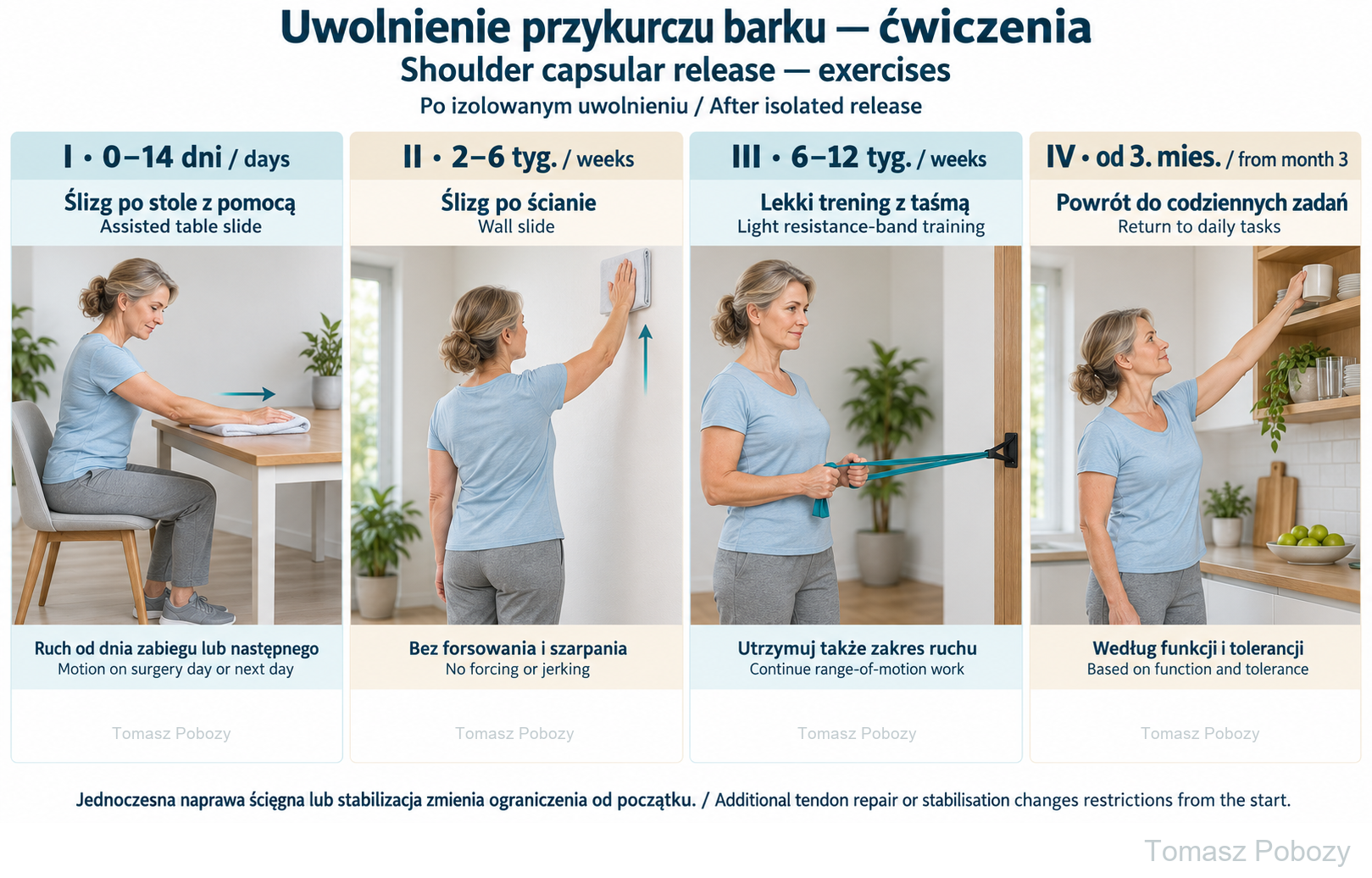
I, days 0–14: assisted table slide; motion on surgery day or the next day after assessment. II, weeks 2–6: wall slide without forcing or jerking. III, weeks 6–12: light resistance-band training while continuing range-of-motion work. IV, from month 3: daily tasks based on function and tolerance. Additional tendon repair or stabilisation changes restrictions from the start.
Exercises — a closer look
Use the complete boards above together with the instructions for the chosen stage. An exercise shown for a later stage is not permitted early.
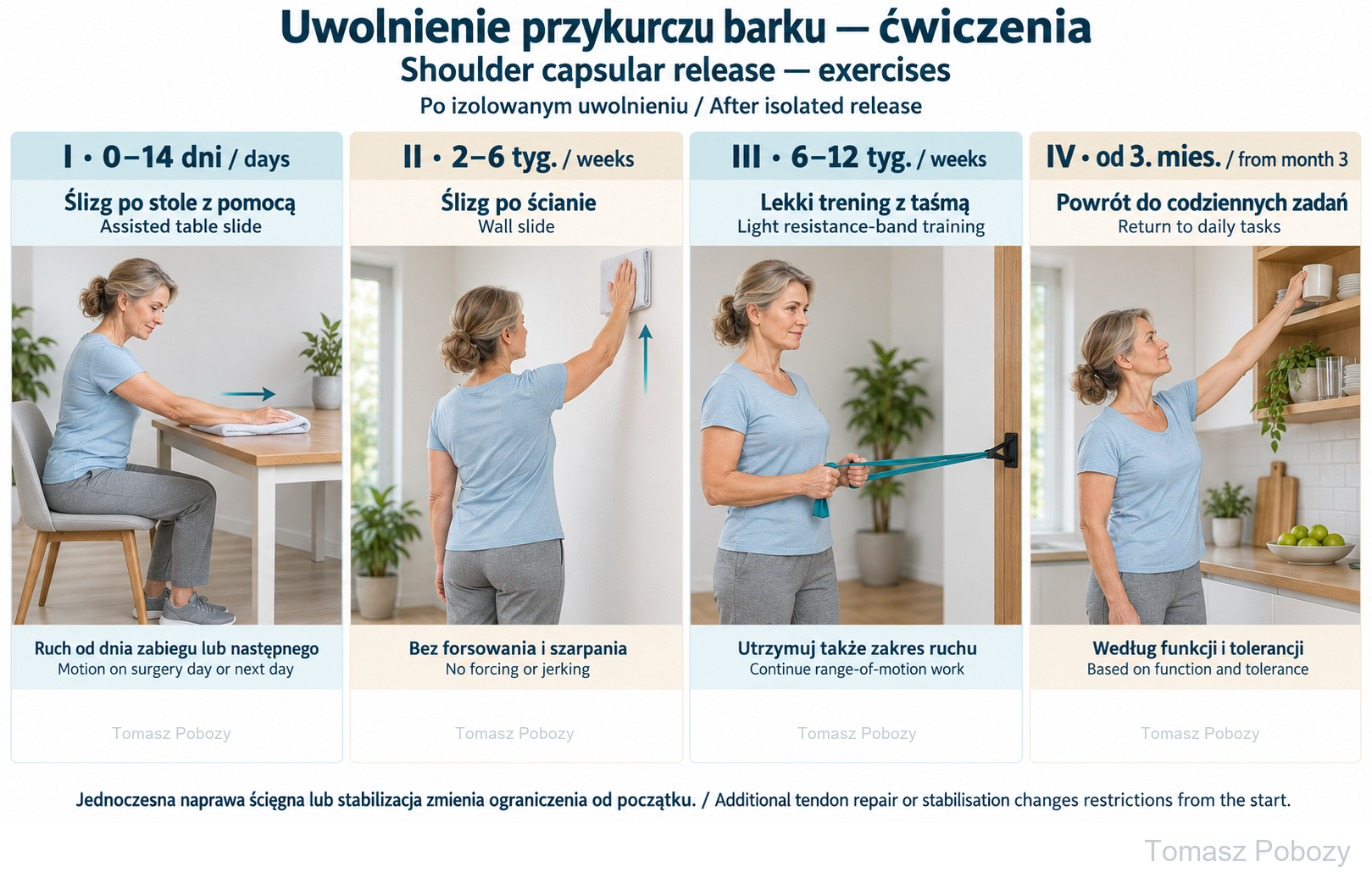
I, days 0–14: assisted table slide; motion on surgery day or the next day after assessment. II, weeks 2–6: wall slide without forcing or jerking. III, weeks 6–12: light resistance-band training while continuing range-of-motion work. IV, from month 3: daily tasks based on function and tolerance. Additional tendon repair or stabilisation changes restrictions from the start.
Open the relevant complete board and zoom in. The viewer retains all stages and captions.
Exercise instructions and progression are contained in the stage descriptions linked above.
Scope and protection
Scope and core principles
Who is this for?
Adults after arthroscopic shoulder capsular release, particularly for frozen shoulder, with a typical postoperative course. This is not a non-operative treatment programme or automatically a rotator cuff repair protocol. Information is needed about the extent of release, the motion gained during surgery and any associated procedures.
Maintain what has been regained
Unlike tendon repair, isolated release is intended to remove a restriction on movement. Routine prolonged immobilisation and rotation limits copied from other operations are therefore not introduced. Flexion, abduction and both rotations are addressed early, taking the shoulder’s response and the orthopaedic surgeon’s instructions into account.
Intensity and pain control
The foundation is several short sessions throughout the day and regular work with the physiotherapist. Stretching force and exercise dosage are adjusted to tolerance. Increasing, sharp or persistent pain is not a signal to force through resistance more strongly. Pain management should enable the prescribed movement.1, 2
When more than a release was performed
Concomitant rotator cuff repair, subscapularis repair, biceps tenodesis or stabilisation introduces its own movement or loading restrictions. Apply them from the beginning, not only in the final phase shown on the poster. Do not accelerate rehabilitation of a repaired structure simply because the capsule was released at the same operation.2
Exercises and the home programme
Abbreviations on the poster
PROM means passive range of motion; AAROM, active-assisted range of motion; AROM, active range of motion; and ROM, range of motion. ER means external rotation and IR, internal rotation. During passive movement the arm is guided externally; during assisted movement the patient contributes to the exercise.
Arm elevation
Depending on ability, use assistance from the unaffected hand or a stick, or a table or wall slide. Guide movement smoothly without jerking. Choose the position and assistance so that the shoulder moves rather than just the trunk. Then reinforce the gained range with active movement.
Rotation
External rotation can initially be practised with the upper arm supported and the elbow bent. Progress internal rotation and reaching behind the back according to the extent of release. Do not pull the arm abruptly behind the back. The physiotherapist selects the upper-arm position and checks whether the exercise genuinely increases shoulder movement.
Pendulums and the scapula
Pendulums are a supporting element, not the entire programme. Keep the arm relaxed and the swing small and controlled. Scapular exercises aim to improve coordination with the upper arm, not to rigidly hold the scapula still during every movement.
Dosage and consistency
The physiotherapist sets the range, repetitions, hold duration and frequency. Spread exercises across several sessions during the day. Every example need not be performed at every session. Mobility work and later resistance training have separately selected dosages and recovery intervals.
Stages and progression criteria
Phases I–II: surgery to week 6
Phase I — day of surgery to day 14
Goals: start movement without unnecessary delay, control pain, teach the home programme and preserve the range gained after release.
Exercise begins on the day of surgery or the next day, after assessing the patient’s condition. Use passive, active-assisted and active movement within the tolerated range. The programme covers flexion, abduction, external rotation and internal rotation; it is not limited to pendulums. Maintain hand, wrist and elbow movement from the start.2, 3
The sling is used only briefly for support and comfort, not for prolonged immobilisation. While a nerve block remains effective, the arm needs protection and supervised management. Reduced pain sensation does not authorise independently forcing movement.1
The patient completes several short daily sessions according to the physiotherapist’s instructions. Do not postpone the whole programme until the next appointment. If pain prevents exercise, promptly reassess pain management and dosage rather than allowing a prolonged break.
Progression: the patient can reproduce the exercises, tolerates the prescribed movement and has no concerning wound or general findings. Check whether range is also maintained between sessions.
Phase II — approximately weeks 2–6
Continue intensive, regular work in every direction, particularly the movement most limited before surgery. Develop active movement and scapular and soft-tissue mobility. The home programme continues several times daily.
Quality matters: arm elevation should not be replaced by progressively greater trunk leaning. Assess passive and active movement as well as practical activities. Do not allow increasing stiffness to continue without reassessment.
Progression: maintained or improving mobility, good active movement control and tolerance of the current dosage. The end of week 6 alone is not a reason to stop range-of-motion exercises.
Phases III–IV: strength, function and return to activity
Phase III — approximately weeks 6–12
Maintain full or maximally recovered functional range of motion. Develop active and resisted exercises, rotator cuff strength, scapular control and joint-position sense. Strengthening does not replace continued work on mobility.
Begin with loads that can be managed without losing technique. Increase one element at a time: resistance, repetitions or task difficulty. The aim is more effective use of the arm, not the heaviest possible weight. The schedule describes the main focus of this phase and does not mean that all forms of muscle activation must wait until week 6.
Progression: consistently maintained range, good movement control and tolerance of progressively increased loading without substantial deterioration after a session.
Phase IV — from approximately month 3
Continue strengthening and tasks needed for work, sport and everyday activity, including overhead tasks. Return to higher loads depends on function, tolerance and the actual procedure performed. Month 3 is neither a guaranteed date for full recovery nor a ban on earlier, lighter activities.
Criteria: sufficient range for the specific task, appropriate strength and control, and no marked loss of movement after activity. Some patients continue to improve over subsequent months; persistent restriction requires assessment of its cause rather than simply greater stretching force.4
Daily activities and follow-up
Daily activities follow the permitted shoulder and elbow motion, lifting and arm support for your procedure. Sling removal is not clearance for lifting or driving. The detailed guidance below explains the criteria and exceptions.
Daily activities and monitoring progress
Gradually resume use of the arm in light daily activities. Resting the shoulder in a sling alone will not maintain the benefit of release. At the same time, permission to move does not authorise sudden heavy lifting or maximal strength training.
Compare active and passive range in similar positions and assess function: arm elevation, dressing and reaching. Observe the shoulder in the evening, the next morning and between appointments, not just immediately after mobilisation.
A marked return of stiffness calls for prompt review of the programme, pain control and, when needed, contact with the surgeon. Maintaining movement is a treatment goal, not a guarantee. Temporary fluctuations in range do not automatically mean that surgery has failed.4
Warning signs
Pain management and warning signs
Take medicines according to the postoperative instructions. If prescribed exercises remain impossible despite treatment, contact the treating team. Do not independently increase doses to force a greater range of motion.1
Brief stretching discomfort is assessed differently from sharp, increasing or persistent pain. Marked deterioration after a session and the following day calls for a reduction in excessive dosage and reassessment; it does not automatically mean stopping all permitted movement.
Prompt medical contact: fever, wound discharge, increasing redness, uncontrolled pain, new weakness or persistent sensory changes beyond the expected duration of the anaesthetic. Stop exercising after an injury with deformity.
Immediate emergency help: sudden shortness of breath, chest pain or fainting. Do not wait for the next rehabilitation appointment.
For a life-threatening emergency, call your local emergency number immediately — 112 in the European Union. On the boards, 112 refers to the EU.
References
References
The division into days 0–14, weeks 2–6 and 6–12, and the period from approximately month 3 is the practical structure of this protocol, not a single universally applicable schedule. The sources support early movement, brief sling use and regular exercise, but differ in dosage details and the timing of strengthening.
Kim and Lee describe starting assisted and passive movement on the first postoperative day, while Trsek and colleagues commenced physiotherapy on the day of surgery. Barnes and colleagues assessed the course of functional recovery rather than comparing the effectiveness of different rehabilitation doses. Poster timings should therefore be read alongside progression criteria and the actual procedure performed.2, 3, 4
- Cambridge University Hospitals NHS Foundation Trust. Capsular release. Patient information and physiotherapy guidance. Version 6, approved 10 May 2024. Source guidance.
- Kim YS, Lee HJ. Essential Surgical Technique for Arthroscopic Capsular Release in the Treatment of Shoulder Stiffness. JBJS Essent Surg Tech. 2015;5(3):e14. doi:10.2106/JBJS.ST.N.00102.
- Trsek D, Cicak N, Zunac M, Klobucar H. Functional results and patient satisfaction after arthroscopic capsular release of idiopathic and post-traumatic stiff shoulder. Int Orthop. 2014;38(6):1205–1211. doi:10.1007/s00264-014-2283-4.
- Barnes CP, Lam PH, Murrell GAC. Short-term outcomes after arthroscopic capsular release for adhesive capsulitis. J Shoulder Elbow Surg. 2016;25(9):e256–e264. doi:10.1016/j.jse.2015.12.025.
Clinical commentary and terms of use
Commentary
A specific case, a specific patient, a specific surgeon
After capsular release, the priority differs from tendon repair: the regained mobility should be used before it starts to diminish again. The programme therefore begins immediately and requires consistent work at home as well. Do not copy prolonged restrictions from repair protocols.
Intensity is not about forcefully breaking through resistance. Effective pain management, an appropriate direction of movement and frequent repetition matter more than one very painful session. A concomitant reconstruction changes this approach and requires protection of repaired tissues.
Cooperation between surgeon and physiotherapist
The surgeon provides the extent of release, the movement gained during surgery and restrictions arising from associated procedures. The physiotherapist assesses motion and function, teaches exercises and adjusts dosage. Information should flow in both directions, especially when range decreases again or pain prevents a regular programme.
Do not simply wait for the end of another phase while the patient loses regained movement. Identify the cause and adjust management rather than only increasing exercise force.