 Skip to content
FOR CLINICIANS AND PHYSIOTHERAPISTS
Midshaft clavicle fracture — LCP plate fixation Postoperative rehabilitation protocol
Protection, movement and a gradual return to daily activity. Select the stage appropriate to the actual procedure and current clearance.
Using and loading the limb
Through week 6 in this protective pathway, no active elevation, resistance, lifting or support. Greater resistance follows healing review.
Full guidance ↓Brace or immobilisation
Sling for the first 2 weeks, including at night; remove for hygiene and prescribed exercises with support.
Full guidance ↓Permitted movement
Shoulder movement is passive only through week 6 in this pathway. Then assisted → active after review; sling removal does not permit active motion.
Full guidance ↓Permitted movement, loading and removal of a brace are separate decisions. Additional repairs may require a more protective programme.
Rehabilitation at a glance
Progression follows healing and functional criteria, not dates alone.
Rehabilitation boards
Exercises — a closer look
Use the complete boards above together with the instructions for the chosen stage. An exercise shown for a later stage is not permitted early.
Open the relevant complete board and zoom in. The viewer retains all stages and captions.
4. How to perform exercises and select the dose
Start with instruction and a technique check. During passive movement, support the arm’s weight throughout; the helper does not pull on the hand or press on the clavicle. The return to the starting position is also passive.
Home passive movement requires prior instruction in a safe technique. If the patient cannot relax the shoulder or the helper cannot maintain support, the physiotherapist must correct the exercise. A stick exercise or table slide is not automatically passive.
Until the end of week 6, do not independently add shoulder-driven pendulums, band exercises, strong ball squeezing or resisted scapular training. Finger, wrist and elbow movement must not cause active shoulder elevation.
Sets and repetitions are proposed starting doses within this programme, not a universally validated dose for every fixation. Stop for sharp pain, new fracture-site pain or loss of control; do not exercise through pain.
Scope and protection
1. Scope, protection and follow-up
Adults after stable locking compression plate (LCP) fixation of an acute, isolated midshaft clavicle fracture. This is not a protocol for a hook plate or acromioclavicular joint reconstruction. Open fractures, revision surgery, nonunion, bone grafting, multiple injuries and concomitant tendon repair require separate instructions.
Passive movement means that the operated shoulder stays relaxed while a therapist or trained helper moves the arm. Removing the sling after 2 weeks does NOT permit active elevation, lifting or weight-bearing through the arm.
Start with the operative report and discharge instructions: side, fixation stability, comminution, bone quality and associated injuries. The abbreviation LCP alone does not define construct strength or healing speed.
The review around week 2 includes wound healing and tolerance of protection; around week 6, clinical assessment and radiographs precede a change in movement type. A further review around week 12 informs loading decisions. The orthopaedic surgeon may change these dates or request earlier imaging for concerning symptoms.
Without clearance, retain the current safe programme rather than advancing independently. If crutches are needed for another condition, a separate mobility plan is required.
6. Pain management and support for healing
Use medication as prescribed at discharge; do not increase doses independently. This protocol does not prescribe a single drug regimen or routinely prohibit an entire drug class. Selection depends on comorbidities and the surgeon’s instructions.
A brief cool pack through a cloth may be used without pressure on the wound, checking the skin; avoid cold when sensation or circulation is impaired. Rest with arm support should ease pain, not replace prescribed movement.
Maintain regular meals, adequate protein intake and avoid smoking. Deficiencies and conditions affecting healing need treatment; routine high-dose supplementation without an indication is not recommended.
Stages and progression criteria
2. Phases during weeks 0–6
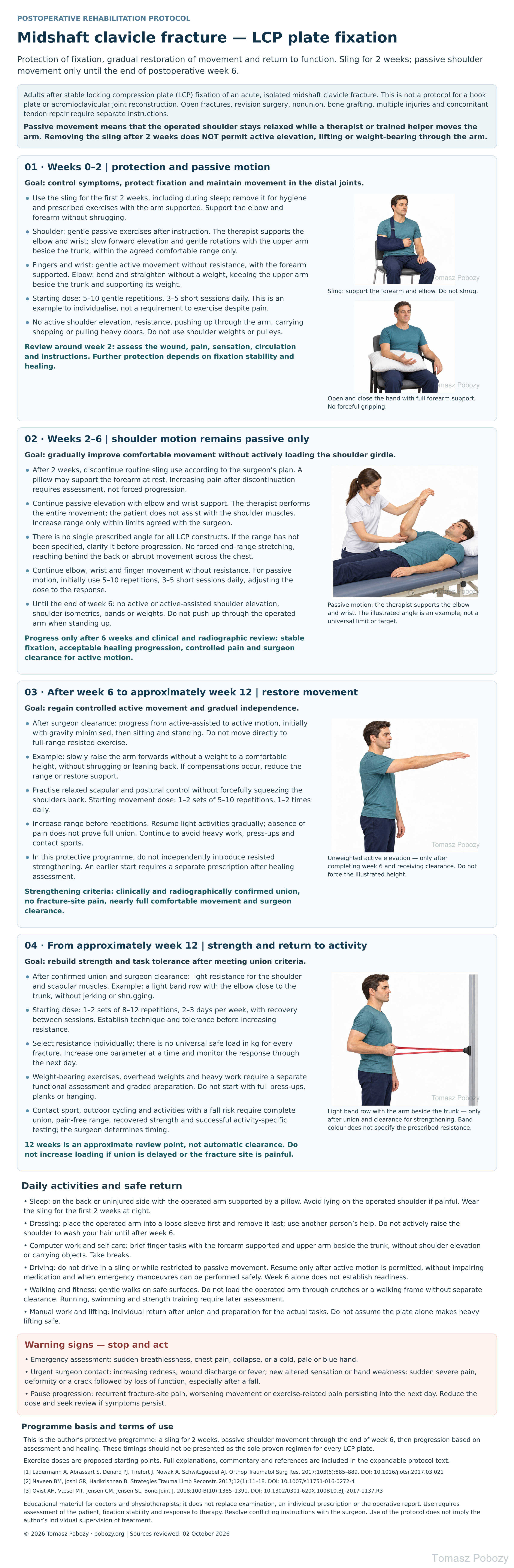
01 · Weeks 0–2 | protection and passive motion
Goal: control symptoms, protect fixation and maintain movement in the distal joints.
- Use the sling for the first 2 weeks, including during sleep; remove it for hygiene and prescribed exercises with the arm supported. Support the elbow and forearm without shrugging.
- Shoulder: gentle passive exercises after instruction. The therapist supports the elbow and wrist; slow forward elevation and gentle rotations with the upper arm beside the trunk, within the agreed comfortable range only.
- Fingers and wrist: gentle active movement without resistance, with the forearm supported. Elbow: bend and straighten without a weight, keeping the upper arm beside the trunk and supporting its weight.
- Starting dose: 5–10 gentle repetitions, 3–5 short sessions daily. This is an example to individualise, not a requirement to exercise despite pain.
- No active shoulder elevation, resistance, pushing up through the arm, carrying shopping or pulling heavy doors. Do not use shoulder weights or pulleys.
Review around week 2: assess the wound, pain, sensation, circulation and instructions. Further protection depends on fixation stability and healing.
02 · Weeks 2–6 | shoulder motion remains passive only
Goal: gradually improve comfortable movement without actively loading the shoulder girdle.
- After 2 weeks, discontinue routine sling use according to the surgeon’s plan. A pillow may support the forearm at rest. Increasing pain after discontinuation requires assessment, not forced progression.
- Continue passive elevation with elbow and wrist support. The therapist performs the entire movement; the patient does not assist with the shoulder muscles. Increase range only within limits agreed with the surgeon.
- There is no single prescribed angle for all LCP constructs. If the range has not been specified, clarify it before progression. No forced end-range stretching, reaching behind the back or abrupt movement across the chest.
- Continue elbow, wrist and finger movement without resistance. For passive motion, initially use 5–10 repetitions, 3–5 short sessions daily, adjusting the dose to the response.
- Until the end of week 6: no active or active-assisted shoulder elevation, shoulder isometrics, bands or weights. Do not push up through the operated arm when standing up.
Progress only after 6 weeks and clinical and radiographic review: stable fixation, acceptable healing progression, controlled pain and surgeon clearance for active motion.
3. After week 6 and rebuilding strength
03 · After week 6 to approximately week 12 | restore movement
Goal: regain controlled active movement and gradual independence.
- After surgeon clearance: progress from active-assisted to active motion, initially with gravity minimised, then sitting and standing. Do not move directly to full-range resisted exercise.
- Example: slowly raise the arm forwards without a weight to a comfortable height, without shrugging or leaning back. If compensations occur, reduce the range or restore support.
- Practise relaxed scapular and postural control without forcefully squeezing the shoulders back. Starting movement dose: 1–2 sets of 5–10 repetitions, 1–2 times daily.
- Increase range before repetitions. Resume light activities gradually; absence of pain does not prove full union. Continue to avoid heavy work, press-ups and contact sports.
- In this protective programme, do not independently introduce resisted strengthening. An earlier start requires a separate prescription after healing assessment.
Strengthening criteria: clinically and radiographically confirmed union, no fracture-site pain, nearly full comfortable movement and surgeon clearance.
04 · From approximately week 12 | strength and return to activity
Goal: rebuild strength and task tolerance after meeting union criteria.
- After confirmed union and surgeon clearance: light resistance for the shoulder and scapular muscles. Example: a light band row with the elbow close to the trunk, without jerking or shrugging.
- Starting dose: 1–2 sets of 8–12 repetitions, 2–3 days per week, with recovery between sessions. Establish technique and tolerance before increasing resistance.
- Select resistance individually; there is no universal safe load in kg for every fracture. Increase one parameter at a time and monitor the response through the next day.
- Weight-bearing exercises, overhead weights and heavy work require a separate functional assessment and graded preparation. Do not start with full press-ups, planks or hanging.
- Contact sport, outdoor cycling and activities with a fall risk require complete union, pain-free range, recovered strength and successful activity-specific testing; the surgeon determines timing.
12 weeks is an approximate review point, not automatic clearance. Do not increase loading if union is delayed or the fracture site is painful.
Daily activities and follow-up
Daily activities follow the permitted shoulder and elbow motion, lifting and arm support for your procedure. Sling removal is not clearance for lifting or driving. The detailed guidance below explains the criteria and exceptions.
5. Sleep, self-care, work and driving
Sleep: on the back or uninjured side with the operated arm supported by a pillow. Avoid lying on the operated shoulder if painful. Wear the sling for the first 2 weeks at night.
Dressing: place the operated arm into a loose sleeve first and remove it last; use another person’s help. Do not actively raise the shoulder to wash your hair until after week 6.
Computer work and self-care: brief finger tasks with the forearm supported and upper arm beside the trunk, without shoulder elevation or carrying objects. Take breaks.
Driving: do not drive in a sling or while restricted to passive movement. Resume only after active motion is permitted, without impairing medication and when emergency manoeuvres can be performed safely. Week 6 alone does not establish readiness.
Walking and fitness: gentle walks on safe surfaces. Do not load the operated arm through crutches or a walking frame without separate clearance. Running, swimming and strength training require later assessment.
Manual work and lifting: individual return after union and preparation for the actual tasks. Do not assume the plate alone makes heavy lifting safe.
Warning signs
7. Warning signs
Emergency assessment: sudden breathlessness, chest pain, collapse, or a cold, pale or blue hand.
Urgent surgeon contact: increasing redness, wound discharge or fever; new altered sensation or hand weakness; sudden severe pain, deformity or a crack followed by loss of function, especially after a fall.
Pause progression: recurrent fracture-site pain, worsening movement or exercise-related pain persisting into the next day. Reduce the dose and seek review if symptoms persist.
For a life-threatening emergency, call your local emergency number immediately — 112 in the European Union. On the boards, 112 refers to the EU.
Additional scope notes
Protection of fixation, gradual restoration of movement and return to function. Sling for 2 weeks; passive shoulder movement only until the end of postoperative week 6.
Adults after stable locking compression plate (LCP) fixation of an acute, isolated midshaft clavicle fracture. This is not a protocol for a hook plate or acromioclavicular joint reconstruction. Open fractures, revision surgery, nonunion, bone grafting, multiple injuries and concomitant tendon repair require separate instructions.
Passive movement means that the operated shoulder stays relaxed while a therapist or trained helper moves the arm. Removing the sling after 2 weeks does NOT permit active elevation, lifting or weight-bearing through the arm.
References
9. References
- Lädermann A, Abrassart S, Denard PJ, Tirefort J, Nowak A, Schwitzguebel AJ. Functional recovery following early mobilization after middle third clavicle osteosynthesis for acute fractures or nonunion: A case-control study. Orthop Traumatol Surg Res. 2017;103(6):885–889. doi:10.1016/j.otsr.2017.03.021
- Naveen BM, Joshi GR, Harikrishnan B. Management of mid-shaft clavicular fractures: comparison between non-operative treatment and plate fixation in 60 patients. Strategies Trauma Limb Reconstr. 2017;12(1):11–18. doi:10.1007/s11751-016-0272-4
- Qvist AH, Væsel MT, Jensen CM, Jensen SL. Plate fixation compared with nonoperative treatment of displaced midshaft clavicular fractures: a randomized clinical trial. Bone Joint J. 2018;100-B(10):1385–1391. doi:10.1302/0301-620X.100B10.BJJ-2017-1137.R3
Clinical commentary and terms of use
8. Commentary
This is the author’s protective programme: a sling for 2 weeks, passive shoulder movement through the end of week 6, then progression based on assessment and healing. These timings should not be presented as the sole proven regimen for every LCP plate.
Lädermann and colleagues described substantially earlier movement after LCP fixation, but did not randomise patients between rehabilitation schedules. This does not justify independently shortening the protection prescribed here. 1
Naveen and colleagues introduced strengthening after union was established. Their study used a different plate and does not establish a universal strengthening date after LCP fixation. Assessment of union is distinct from the approximate week ranges in this programme. 2
The randomised trial by Qvist and colleagues compared locking-plate fixation with nonoperative care, not optimal exercise dosage. It is not the source of the sets and repetitions used here. 3