 Skip to content
FOR CLINICIANS AND PHYSIOTHERAPISTS
Biceps tenodesis — rehabilitation protocol
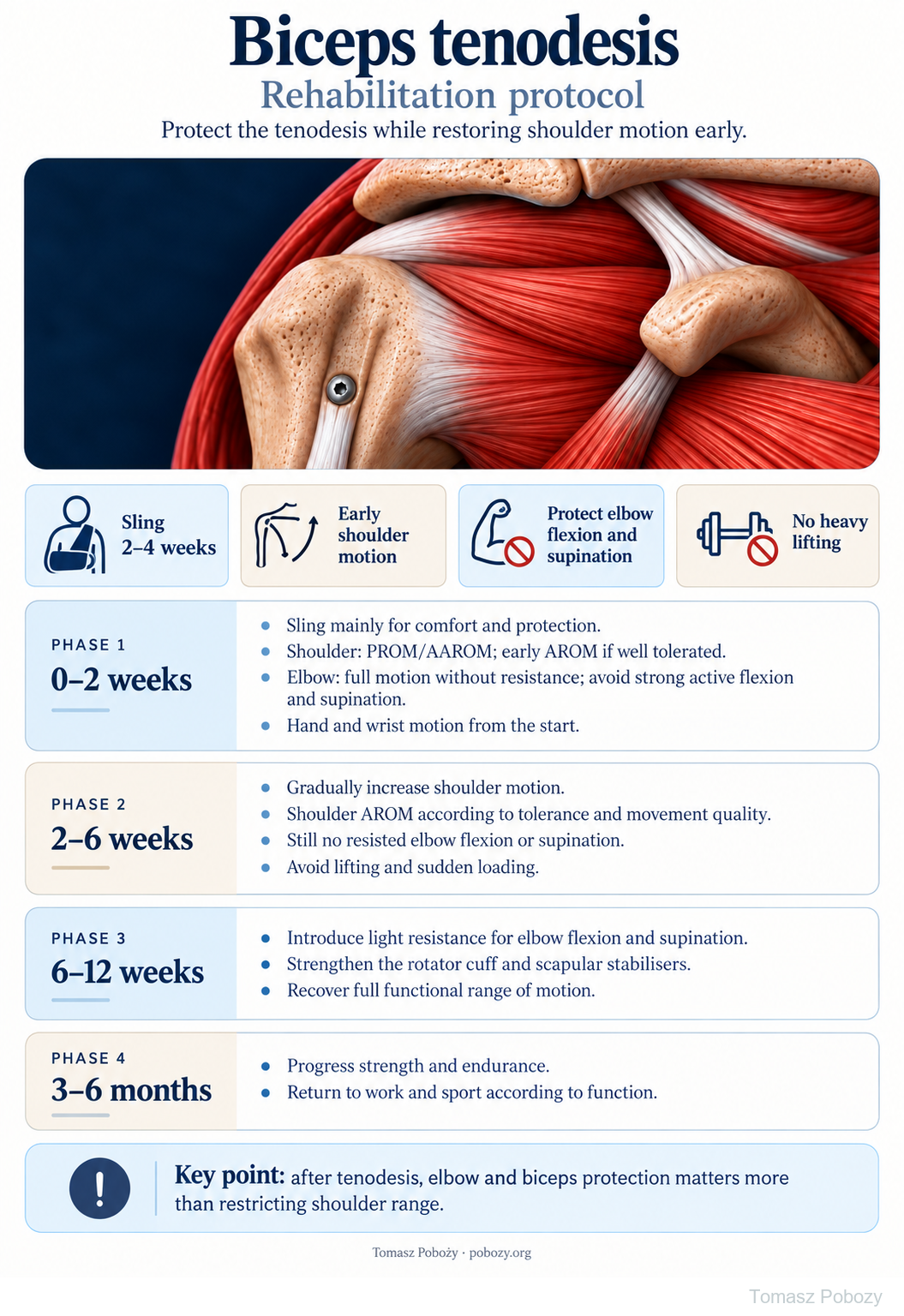
Protect the tenodesis while restoring shoulder motion early. Shoulder movement and biceps loading follow separate progression rules. The poster outlines the rehabilitation phases; expandable details, exercise guidance, commentary and references follow below.
Using and loading the limb
Until resistance is cleared, avoid resisted elbow flexion, supination and lifting. Light resistance generally starts around week 6 in this pathway after review.
Full guidance ↓Brace or immobilisation
Sling usually 2–4 weeks as prescribed, supporting the forearm. It does not imply immobilising the whole shoulder for 6 weeks.
Full guidance ↓Permitted movement
Move the shoulder early as tolerated without added load. Active elbow flexion and supination need separate tenodesis-specific clearance.
Full guidance ↓Permitted movement, loading and removal of a brace are separate decisions. Additional repairs may require a more protective programme.
Rehabilitation at a glance
Progression follows healing and functional criteria, not dates alone.
Rehabilitation boards
“Full elbow motion without resistance” on the board does not remove active-motion restrictions. Active elbow flexion and supination follow separate instructions; resistance requires clearance.
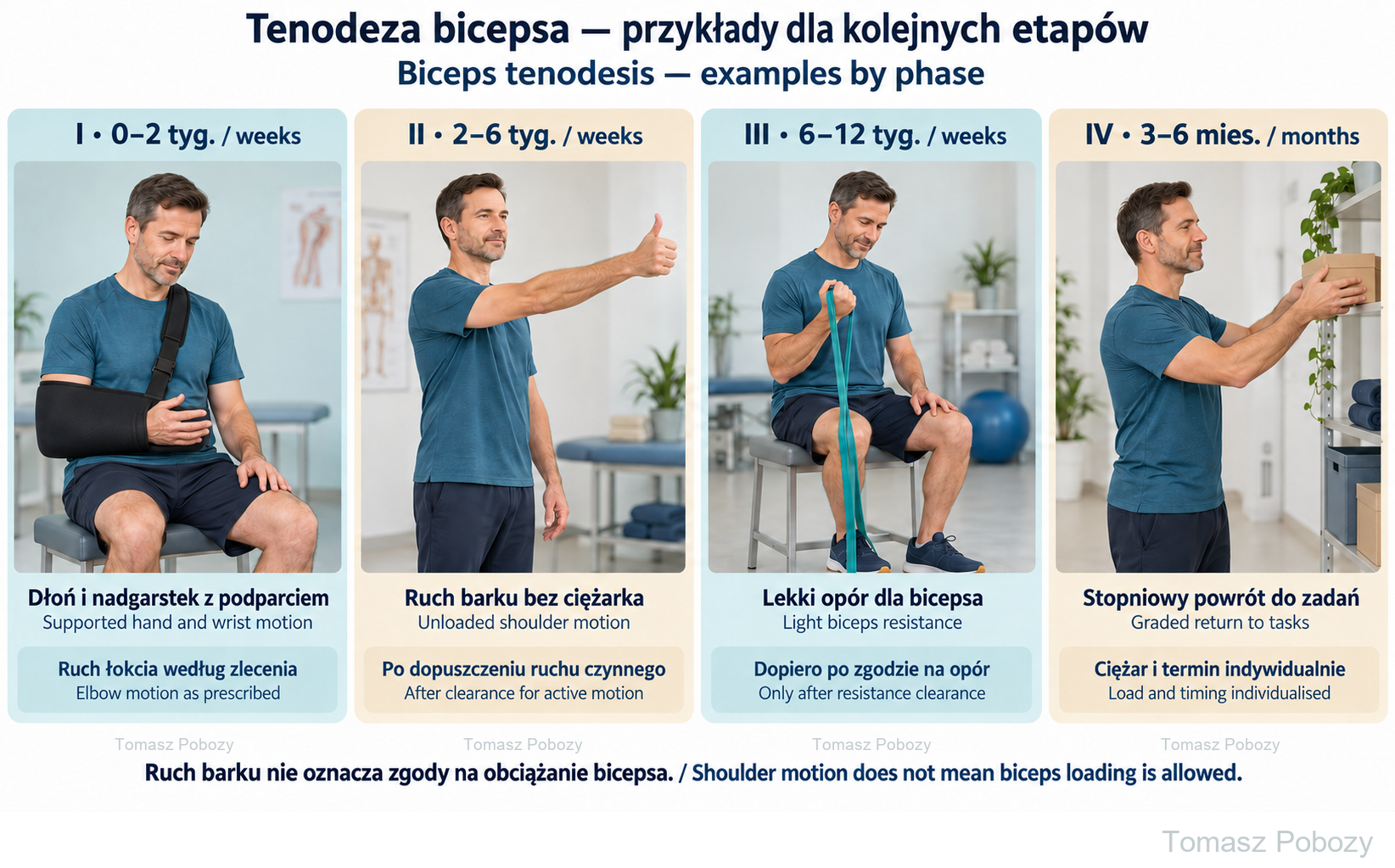
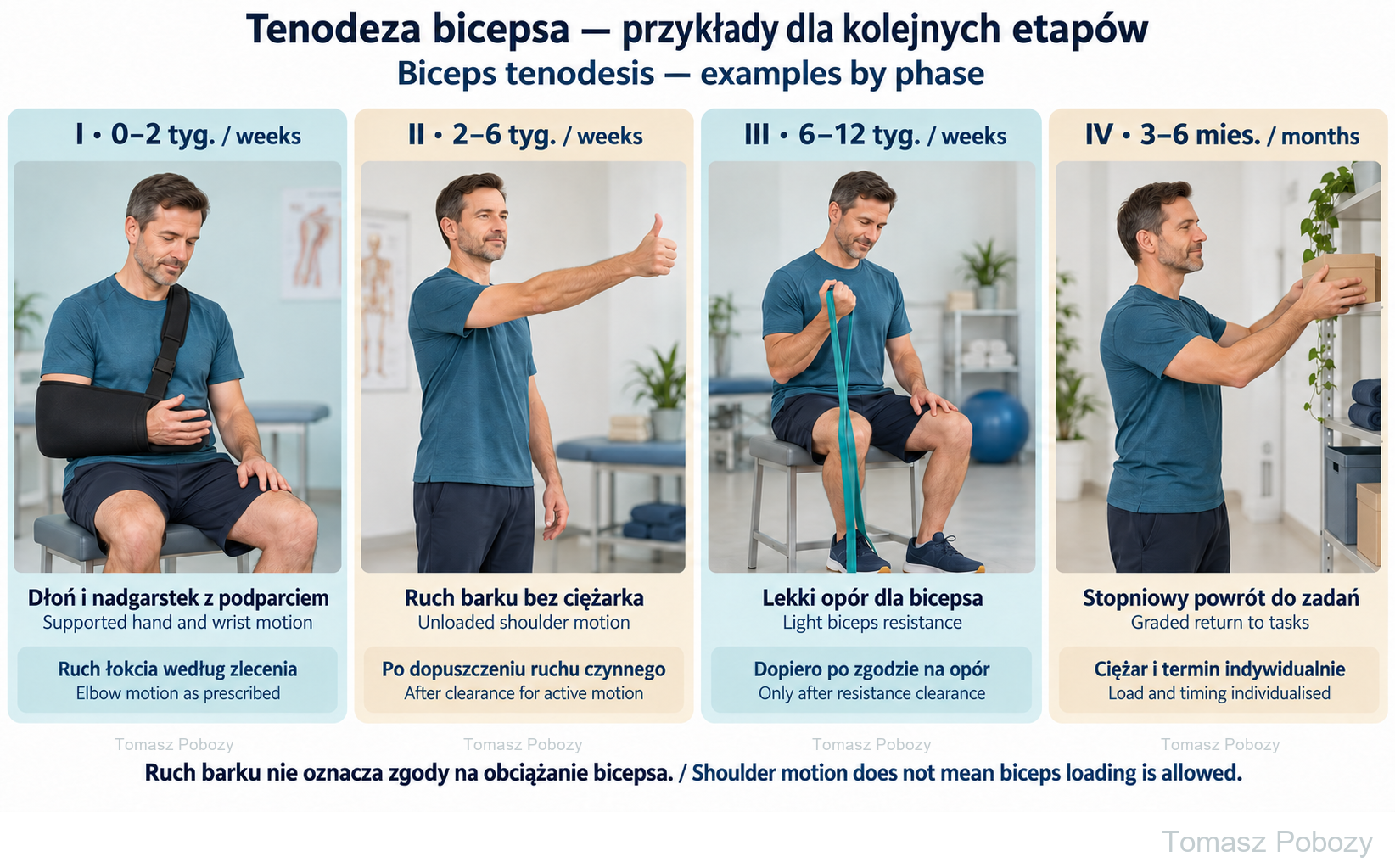
I, weeks 0–2: hand and wrist motion with the forearm supported; elbow motion follows a separate prescription. II, weeks 2–6: unloaded shoulder movement after active-motion clearance. III, weeks 6–12: light elbow-flexion resistance only after clearance for biceps loading. IV, months 3–6: progressive functional tasks with individualised load and timing. Shoulder motion does not mean biceps loading is allowed.
Exercises — a closer look
Use the complete boards above together with the instructions for the chosen stage. An exercise shown for a later stage is not permitted early.
I, weeks 0–2: hand and wrist motion with the forearm supported; elbow motion follows a separate prescription. II, weeks 2–6: unloaded shoulder movement after active-motion clearance. III, weeks 6–12: light elbow-flexion resistance only after clearance for biceps loading. IV, months 3–6: progressive functional tasks with individualised load and timing. Shoulder motion does not mean biceps loading is allowed.
Open the relevant complete board and zoom in. The viewer retains all stages and captions.
Exercise instructions and progression are contained in the stage descriptions linked above.
Scope and protection
Scope, movement precautions and loading
Who is this for?
Adults after isolated tenodesis of the long head of the biceps, with a typical postoperative course. The tendon fixation site and method, tissue quality, associated procedures and surgeon’s instructions must be known. This programme is not automatically a protocol for rotator cuff, subscapularis or labral repair.
Shoulder and elbow — two separate decisions
We do not prolong restrictions on the entire shoulder simply because the tenodesis needs protection. Early shoulder movement remains unloaded and within the tolerated range. If active movement is painful, passive or assisted movement is used initially. Active movement of the shoulder itself is not routinely delayed until week 6.1
Restrictions on active elbow flexion and supination — turning the forearm palm upwards — arising from the specific tenodesis still apply. In this programme, resisted elbow flexion and resisted supination are avoided for the first 6 weeks. Permission for greater shoulder movement does not authorise lifting or testing biceps strength.1, 2
Sling use and elbow movement
The sling is used initially, usually for 2–4 weeks according to the orthopaedic surgeon’s instructions, to support the forearm and keep the elbow flexed. It is removed for hygiene and prescribed exercises. It is not intended to prevent all shoulder movement for six weeks.
The poster’s phrase “full motion without resistance” does not override an individual restriction on active elbow flexion or supination. While such a restriction applies, permitted mobility is maintained passively or with appropriate assistance. Do not force elbow extension or keep the elbow completely still unless this has been prescribed.
Exercises and the home programme
Passive, assisted and active movement
Passive movement is guided by a therapist, a trained helper or a suitable aid; the patient does not generate it through deliberate contraction of the operated limb’s muscles. During active-assisted movement, the patient contributes while receiving help. Active movement is performed independently. The poster’s abbreviations mean: PROM — passive range of motion; AAROM — active-assisted range of motion; AROM — active range of motion.
Early shoulder movement
Initially choose a comfortable lying or seated position with the arm supported. If active movement is painful, the unaffected hand or physiotherapist helps guide the operated arm. Progress to independent elevation without a weight. Do not force movement by twisting or leaning the trunk or abruptly shrugging the shoulder.
Elbow and forearm
Perform permitted movement with the upper arm supported and without added load. If active flexion or supination is temporarily prohibited, use passive or assisted movement as instructed. The absence of a weight does not mean that every movement is passive or free of biceps contraction.
Later strengthening
Elbow flexion with a light band and supination exercises belong to the phase after resistance is permitted, not the first postoperative weeks. Begin with low resistance and avoid jerking. Develop rotator cuff and scapular strength alongside this, adding more demanding functional tasks later.
A daily programme and separate resistance training
The physiotherapist selects the exercises, range, repetitions and frequency and checks technique. Later resistance training has its own dosage and recovery intervals. Patients do not need to perform every possible exercise or make up for a missed session with heavier loading.
Stages and progression criteria
Phases I–II: surgery to week 6
Phase I — the first 2 weeks
Goals: protect the fixation site, control pain, maintain hand and wrist motion and restore shoulder mobility early.
Begin progressive shoulder movement in the first postoperative days. If independent movement is painful, start with passive or active-assisted movement in a comfortable supported position. Introduce active movement early as tolerated, without added weight, jerking or forcing end range. Progress from gravity-reduced positions towards sitting and standing.1
Hand and wrist movement begins from the start. Elbow and supination exercises must respect the postoperative restrictions on biceps activity. Avoid strong active elbow flexion, resisted supination and lifting.
Progression: pain is controlled, there are no concerning wound findings, and permitted movements can be reproduced correctly without abrupt biceps contraction.
Phase II — approximately weeks 2–6
Increase shoulder range and the contribution of active movement according to tolerance and movement quality. Do not artificially restrict shoulder range solely because a tenodesis has been performed. Wean from the sling as instructed, without abruptly moving to loaded use of the arm.
Continue to protect fixation: no resisted elbow flexion or supination, lifting or sudden loading. Active elbow movement resumes according to the separate instructions for the tenodesis, not simply because the shoulder already moves more freely.
Progression: good tolerance of the existing programme, improving mobility and arm control, and clearance for the next loading stage. Absence of pain does not replace assessment of healing.
Phases III–IV: from week 6 and return to activity
Phase III — approximately weeks 6–12
Restore full functional active range of motion. Once this phase is permitted, introduce light resistance for elbow flexion and supination progressively from approximately week 6. Strengthen the rotator cuff and scapular stabilisers as well. Starting light resistance does not authorise heavy lifting.1, 2
Controlled technique and tolerance of a low load come first. Increase one variable at a time: resistance, repetitions or task difficulty. If movement deteriorates or pain increases substantially after exercise, return to the previous dose.
Phase IV — approximately months 3–6
Around weeks 12–16, develop biceps, shoulder and scapular strength and endurance. Then progressively reproduce the loading required for work and sport.
Return to higher loads is usually considered around months 4–6, depending on the operation, recovered strength, mobility and activity demands. This is not a guaranteed date or automatic clearance for full training.3
Criteria: functional range of motion, good arm control, strength appropriate to the task and tolerance of repeated loading without significant pain or deterioration the following day.
Daily activities and follow-up
Daily activities follow the permitted shoulder and elbow motion, lifting and arm support for your procedure. Sling removal is not clearance for lifting or driving. The detailed guidance below explains the criteria and exceptions.
Daily activities and monitoring progress
Daily activities also load the biceps. Greater freedom of shoulder movement does not yet authorise carrying shopping, forceful pulling or pushing, or suddenly supporting a heavy object. During the protective phase, the forearm remains appropriately supported at rest.
Assess movement quality, recovery of function and tolerance of the current level. Increase one element at a time rather than adding range, resistance and more exercises simultaneously.
A marked increase in pain, loss of previously regained movement or deterioration the next day calls for a lower dose and reassessment. Protection of fixation is related to the specific operation, not just a calendar date.
Warning signs
Pain management and warning signs
Take pain medicines according to the postoperative instructions. Pain management should enable rest and permitted exercises, not forced movement. Increasing pain, loss of regained range or new weakness requires assessment.
Prompt medical contact: fever, wound discharge, increasing redness, persistent numbness or sudden loss of strength. Do not continue exercising after an injury with deformity.2
Immediate emergency help: sudden shortness of breath, chest pain or fainting. Do not wait for the next rehabilitation appointment.
For a life-threatening emergency, call your local emergency number immediately — 112 in the European Union. On the boards, 112 refers to the EU.
References
References
This programme uses earlier active shoulder movement after isolated tenodesis. Institutional protocols differ: Hamilton Orthopedics allows early active shoulder movement, whereas Mass General Brigham describes a more protective initial phase. Galetta and colleagues document this variability. These are not identical schedules or a single universally applicable programme.1, 2, 3
- Hamilton Orthopedics, Spine & Sports Medicine. Biceps Tenodesis Protocol. Source protocol.
- Mass General Brigham. Rehabilitation Guidelines for Biceps Tenodesis. Source protocol. [historical link — PDF currently unavailable at this address]
- Galetta MD, Cheng TTW, Keller RE, Harris E, Oh LS. Rehabilitation Variability After Biceps Tenodesis. Orthopaedic Journal at Harvard Medical School. 2021;22:6–12. Source publication.
Clinical commentary and terms of use
Commentary
A specific case, a specific patient, a specific surgeon
After isolated tenodesis, protection of the biceps fixation site should not be equated with prolonged restriction of the entire shoulder. The sling initially supports the arm and protects the biceps. Shoulder movement starts early as tolerated; passive movement is helpful when independent movement is painful. Permission to move the shoulder does not remove restrictions on elbow activity or biceps loading.
Do not automatically apply this programme to a patient who also underwent rotator cuff repair or stabilisation. In that setting, protection also depends on the other procedure.
Cooperation between surgeon and physiotherapist
The physiotherapist helps develop the plan, assesses function and selects exercises and dosage. The surgeon provides information about fixation conditions and restrictions. Information should flow in both directions — about progress and proposed changes as well as complications.
If information needed to agree variations is missing, follow the postoperative instructions. Do not test the strength of a fresh tenodesis with a forceful manoeuvre.