 Przejdź do treści
FOR CLINICIANS AND PHYSIOTHERAPISTS
Revision total hip arthroplasty — rehabilitation
Protection, movement and a gradual return to daily activity. Select the stage appropriate to the actual procedure and current clearance.
Using and loading the limb
First establish revision extent. Acetabular/femoral reconstruction, fracture, ETO and abductor repair may require different loading limits.
Full guidance ↓Brace or immobilisation
Bracing is not universal after every revision. If prescribed for instability or tissue repair, document settings, duration and removal rules.
Full guidance ↓Permitted movement
Motion and active abduction depend on approach and repairs. Do not automatically apply a primary-replacement timetable to complex revision.
Full guidance ↓Permitted movement, loading and removal of a brace are separate decisions. Additional repairs may require a more protective programme.
Rehabilitation at a glance
Progression follows healing and functional criteria, not dates alone.
Rehabilitation boards
Exercises — a closer look
Use the complete boards above together with the instructions for the chosen stage. An exercise shown for a later stage is not permitted early.
Open the relevant complete board and zoom in. The viewer retains all stages and captions.
Exercise instructions and progression are contained in the stage descriptions linked above.
Scope and protection
Main principle
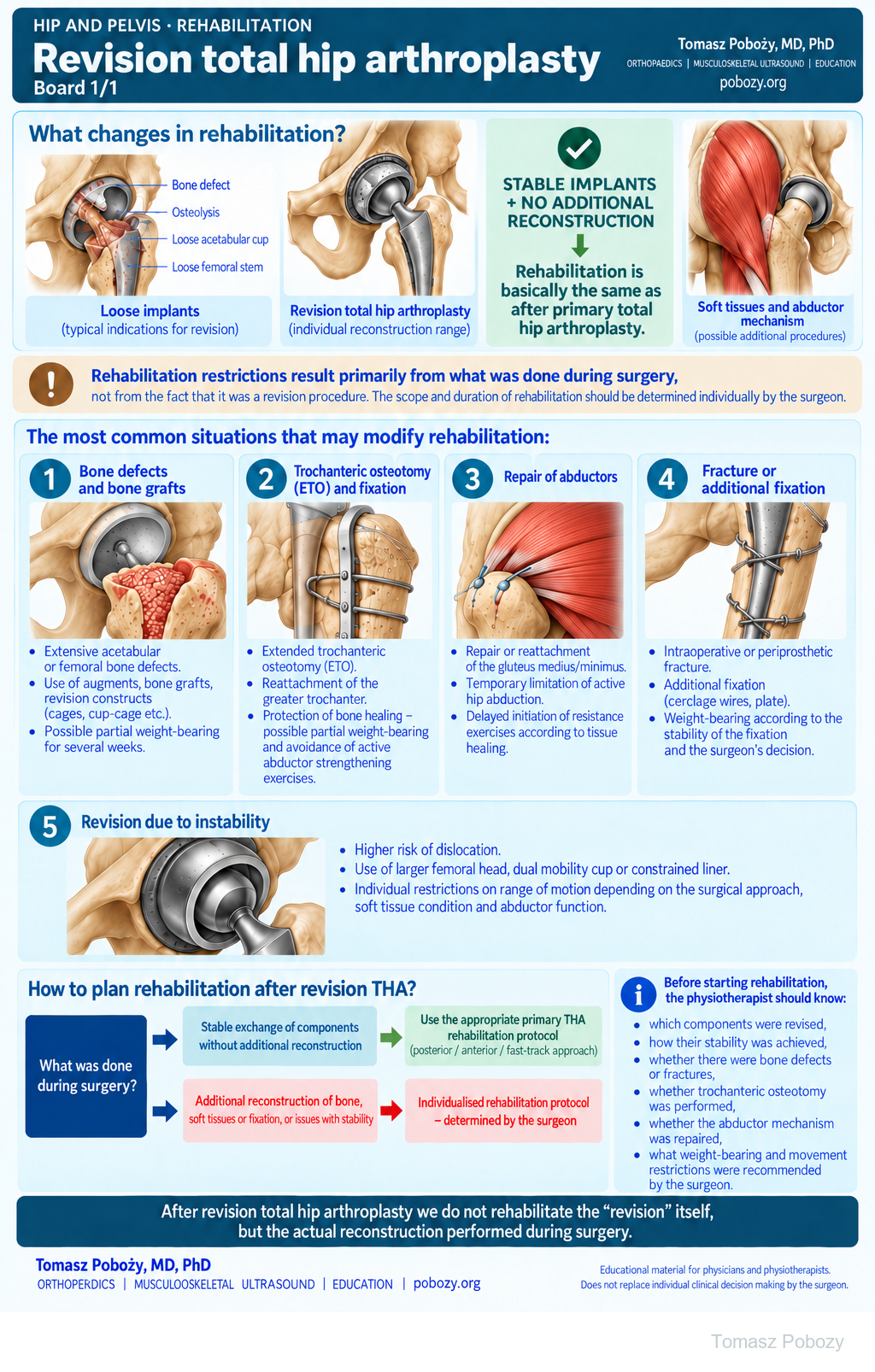
Rehabilitation restrictions arise primarily from what was performed during surgery, not simply from the fact that the procedure was a revision. With stable implants, satisfactory joint stability and no additional reconstruction requiring protection, rehabilitation may be very similar to that following primary THA.
Bone defects, grafts and extensive reconstruction
Extensive acetabular or femoral bone loss, bone grafts, augments, cage/cup-cage constructs or other complex reconstructions may require temporary restriction of weight bearing. The orthopaedic surgeon determines the degree and duration of protection according to reconstruction stability and bone quality.
Trochanteric osteotomy and ETO
Extended trochanteric osteotomy (ETO), greater trochanteric osteotomy or reattachment requires protection of healing bone. This may include restricted weight bearing and temporary limitation of exercises that strongly recruit the abductor mechanism, depending on fixation and progression of union.
Abductor mechanism repair
Repair or reattachment of the gluteus medius and/or minimus may require temporary limitation of active hip abduction and delayed introduction of resisted exercises. Progression should reflect repair quality and tissue healing.
Fracture or additional fixation
Intraoperative or periprosthetic fracture and additional fixation with cerclage wires, a plate or another construct may change permitted weight bearing. Fixation stability, fracture location, bone quality and the surgeon’s instructions determine progression.
Revision for instability
After revision for recurrent dislocation, movement restrictions should be individualised. They depend on surgical approach, soft-tissue and abductor condition, and the implants used, such as a larger femoral head, dual-mobility cup or constrained liner. There is no single set of “revision precautions” appropriate for every patient.
When can a primary THA protocol be used?
If components are stable, bone and soft tissues do not require additional protection, and the surgeon has not prescribed specific restrictions, rehabilitation may follow the appropriate primary THA protocol.
What should the physiotherapist know before rehabilitation starts?
Which components were revised and how stability was achieved; whether bone defects or fractures were present; whether trochanteric osteotomy/ETO was performed; whether the abductor mechanism was repaired; whether grafting or additional fixation was used; and what weight-bearing and movement restrictions were prescribed.
Warning signs
Warning signs
Seek urgent assessment for fever, wound discharge or increasing leg pain, swelling or redness. New breathlessness or chest pain needs emergency medical help. Stop exercise progression while a possible complication is assessed. NHS — hip replacement complications
Further guidance
HIP AND PELVIS · FOR DOCTORS AND PHYSIOTHERAPISTS
Rehabilitation after revision total hip arthroplasty does not necessarily need to be slower than after primary THA. If stable implant fixation is achieved, no fracture occurs and no additional reconstruction requires protection, rehabilitation may generally follow the appropriate primary THA pathway.
Prepared by: Tomasz Poboży, MD, PhD · Updated: 03 October 2026
Key message: after revision THA, rehabilitation should address the actual reconstruction performed rather than the label “revision”.
Watch or listen
Conversations with Tomasz Poboży on Radio Rekord Mazowsze (in Polish). General background on treatment; follow this protocol for procedure-specific restrictions.
References
References and scope of supporting evidence
- The Diagnosis and Treatment of Acetabular Bone Loss in Revision Hip Arthroplasty: An International Consensus Symposium. HSS Journal. 2022;18(1):8–41. DOI: 10.1177/15563316211034850.
- Extended trochanteric osteotomy in revision hip arthroplasty: a case series study and systematic literature review. Arthroplasty. 2022. DOI: 10.1186/s42836-022-00115-w.
- Ilizaliturri VM Jr et al. Rehabilitation After Gluteus Medius and Minimus Treatment. Arthroscopy, Sports Medicine, and Rehabilitation. 2022;4:e41–e50. DOI: 10.1016/j.asmr.2021.10.024.
These sources support specific reconstruction-related precautions. They do not establish one validated timetable for all revision hip replacements. Protected loading after complex acetabular reconstruction and precautions after ETO or abductor repair must be matched to the procedure.