 Skip to content
FOR CLINICIANS AND PHYSIOTHERAPISTS
Reverse shoulder arthroplasty — rehabilitation protocol
Rehabilitation after elective primary reverse shoulder arthroplasty (RSA) for glenohumeral arthritis with an irreparable rotator cuff tear, particularly involving the supraspinatus tendon. The protocol covers preservation of subscapularis continuity and modifications after its release and repair.
Using and loading the limb
No body-weight support through the operated arm for 12 weeks in this pathway, including pushing out of a chair, crutches and walkers. Lifting and resistance need separate clearance.
Full guidance ↓Brace or immobilisation
Without subscapularis refixation: sling mainly for comfort for 7–14 days. After refixation: usually 4 weeks, up to 6 as prescribed; keep pathways separate.
Full guidance ↓Permitted movement
Movement depends on subscapularis management. After refixation, protect ER; this pathway avoids active IR for 6 weeks and resisted IR for 12 weeks.
Full guidance ↓Permitted movement, loading and removal of a brace are separate decisions. Additional repairs may require a more protective programme.
Rehabilitation at a glance
Progression follows healing and functional criteria, not dates alone.
Rehabilitation boards
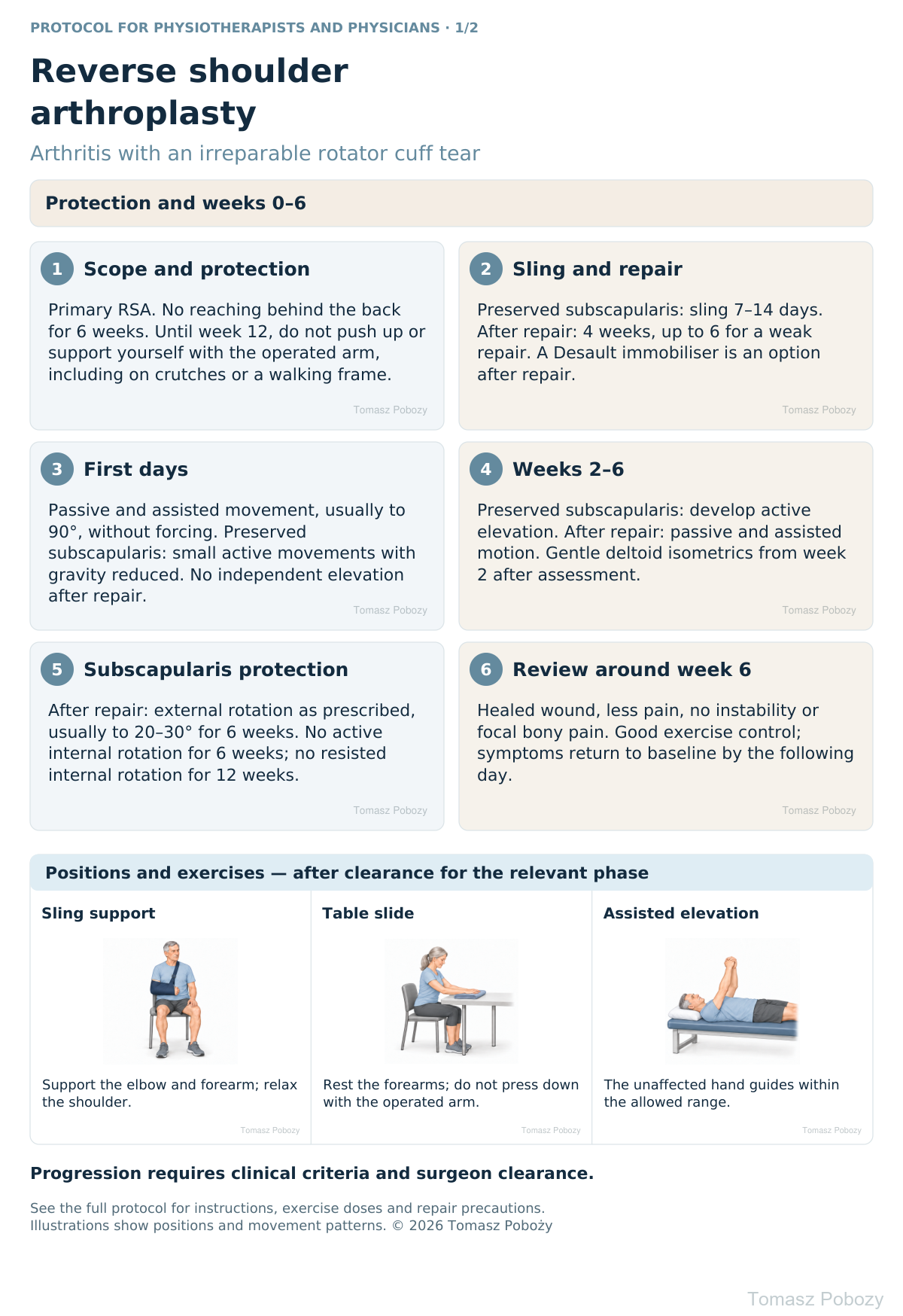
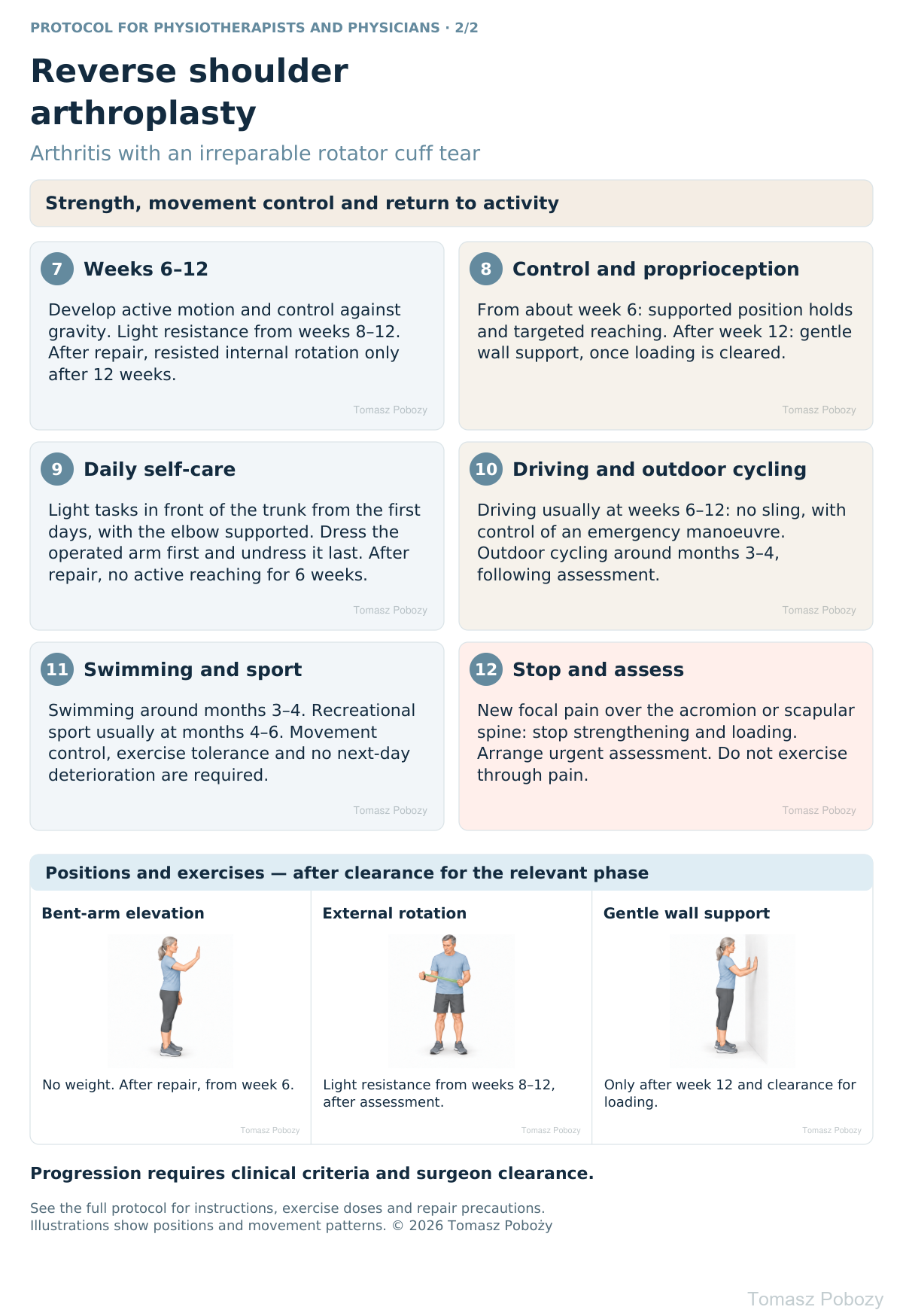
Exercises — a closer look
Use the complete boards above together with the instructions for the chosen stage. An exercise shown for a later stage is not permitted early.
Open the relevant complete board and zoom in. The viewer retains all stages and captions.
How should the illustrated exercises be performed?
The illustrations show example positions. Perform each exercise only after clearance for its phase. Subscapularis repair precautions remain in force even after sling discontinuation.
| Exercise / position | Technique and dose | Timing and precautions |
|---|---|---|
| Sling support | Support the elbow and entire forearm in the sling, keeping the hand visible. The strap must not press into the neck. Check skin and positioning several times daily; support the upper arm with the other hand for elbow exercises. | First 7–14 days in the standard pathway; usually 4 weeks after repair, up to 6 weeks if prescribed. Use a Desault immobiliser only on the surgeon’s instruction. |
| Forearm table slide | Sit at a table. Rest the forearms on a towel and gently lean the trunk forward, sliding the hands forwards. Keep the shoulder relaxed without pressing the hands into the table or hitching the shoulder girdle. Initially 5–10 repetitions, 3–5 times daily. | From the first days after instruction. Follow phase-specific motion limits. After repair, movement must be passive or assisted without active pushing through the operated hand. |
| Assisted supine elevation | Lie on the back with the head supported and the elbow supported in the starting position. Guide the operated arm with the unaffected hand, keeping the elbow slightly bent. Raise the hands in front without moving the upper arm behind the trunk. Initially 5–10 repetitions, 3–5 times daily. | From the first days after instruction. Stay within the prescribed range and do not use the unaffected arm to force a stretch. |
| Short-lever active elevation | Bend the elbow and raise the upper arm forwards and slightly outwards in the scapular plane. Start supine, progress to reclined and then upright. Avoid shoulder shrugging and trunk leaning. 1–2 sets of 5–10 repetitions, 1–2 times daily. | Develop during weeks 2–6 with preserved subscapularis; from week 6 after repair. No weight. The illustration shows the later upright position. |
| External rotation with light band | Keep the elbow bent and close to the side. Rotate the forearm outwards through a small range without moving the elbow backwards or turning the trunk. The unaffected hand anchors the other end of the band. 1–2 sets of 8–12 repetitions, 2–3 times weekly. | From weeks 8–12 once active control is established and resistance is cleared. After repair, do not stretch the repair. If external rotators are insufficient, adapt the exercise with the therapist. |
| Gentle wall support | Stand close to a wall. Place both hands at chest height with slightly bent elbows. Transfer a small amount of weight through both hands without deeply bending the elbows. 5–10 repetitions of 5 seconds, every other day. | Only after week 12 and clearance for loading. Do not progress directly to floor push-ups or full body-weight support. |
Deltoid isometrics: after instruction, gently contract the muscle with the arm supported, without visible movement or pushing the elbow behind the trunk. Initially 5 contractions of 5 seconds, 1–2 times daily. Avoid maximal contractions and exercises provoking focal bony pain.
Scope and protection
Scope, movement precautions and loading
Goal: reduce pain, regain independence and useful motion, and gradually rebuild deltoid and scapular muscle endurance. Also train any remaining functional rotator cuff muscles without forcing movements the patient cannot control.
The protocol may also be used after RSA for a chronic irreparable rotator cuff tear without advanced arthritis, following individual surgeon assessment. It does not cover arthroplasty for fracture, revision surgery, tendon transfers or reconstructions requiring separate protection.
Assessment before rehabilitation: review the operative report and establish subscapularis status, implant and joint stability, bone quality, deltoid status and any additional procedures. Record permitted external rotation. Assess the wound, pain, swelling, sensation, circulation and axillary nerve function; document baseline motion and function, for example QuickDASH or ASES. If subscapularis status is unclear, maintain repair precautions until clarified.
| Element | Preserved subscapularis | Repaired subscapularis |
|---|---|---|
| Support | Sling supporting the elbow and forearm, mainly for comfort for 7–14 days. Wean earlier when pain and limb control permit. | Supportive sling, usually for 4 weeks. A Desault-type shoulder immobiliser is an option when the surgeon requires greater movement control. Continue protection to 6 weeks for poor tissue quality or a repair under tension. |
| Removal and night use | Remove from the outset for hygiene, exercises and light self-care. Initially use at night according to comfort and safe positioning. | Remove for hygiene and prescribed exercises. Wear at night during the prescribed protection period; the surgeon determines when to discontinue. |
| Elevation | Passive and assisted movement from the first days; initially usually to about 90° without forcing. Small active movements with gravity reduced as control permits. Gradually increase motion during weeks 2–6. | Initially passive and assisted elevation, usually to 90°. During weeks 2–6, motion may gently progress within the prescribed limits towards about 120° without stressing the repair. Independent elevation from week 6. |
| Rotation | Gentle external rotation within a comfortable range approved by the surgeon. Internal rotation in front of the trunk without resistance. | Limit external rotation to the surgeon’s stated range, usually no more than 20–30° for the first 6 weeks. For a repair under tension or an unspecified limit, stop at neutral until clarified. No isolated active internal rotation exercises for 6 weeks; no resisted internal rotation for 12 weeks. |
Shared precautions: for the first 6 weeks, do not move the upper arm behind the trunk or combine extension with adduction and internal rotation. Do not reach behind the back or make sudden movements. When lying down, support the elbow to prevent the arm falling backwards.
Loading: during the first 6 weeks, use the hand only for light tasks close to the trunk; do not carry shopping, pull or push. Until week 12, do not push up or support yourself with the operated arm, for example when getting out of a chair or bed, or when using crutches or a walking frame. The forearm may rest on a table during exercises, but do not press down on the table or use the arm to support the trunk.
After week 6, gradually recover functional extension and hand-behind-back movement following review, without forced stretching. For osteoporosis, uncertain stability, neurological impairment or marked pain, slow activation and loading and agree an adapted schedule with the orthopaedic surgeon.
Stages and progression criteria
Phases I–III: surgery to week 6
| Phase and goal | Management | Progression criteria / reassessment |
|---|---|---|
| I · Days 0–3 Protection and safe independence | Fit the sling and teach hygiene, dressing and transfers without pushing through the operated hand. Move the fingers, wrist and elbow. Gentle scapular positioning. Once the block has resolved and control has returned, start passive and assisted movement. With preserved subscapularis, small active movements with gravity reduced are permitted. | Normal sensation and circulation, pain allowing exercise, safe walking and understanding of precautions. A new neurological deficit or wound concern requires assessment. |
| II · Days 4–14 Gentle motion and self-care | Short movement sessions 3–5 times daily, initially 5–10 repetitions. Forearm table slides and assisted supine elevation. Scapular control without forceful shoulder-blade squeezing. Wean sling use in the standard pathway; maintain protection after repair. Wound review around days 10–14. | Appropriate wound healing; no increasing swelling or sensation of the joint slipping. Exercise-related symptoms return to baseline by the following day at the latest. |
| III · Weeks 2–6 Movement control and muscle activation | With preserved subscapularis, develop active elevation: supine → reclined → upright, using a short lever. From week 2, gentle pain-free deltoid isometrics may be introduced after therapist assessment. After repair, continue predominantly passive and assisted movement; do not exercise active internal rotation. No weights, weight-bearing exercises or forceful stretching. | Review around week 6 before increasing activity. Healed wound, decreasing pain, no instability or focal acromial pain. The patient performs existing exercises without marked substitution or symptoms persisting the following day. |
The early 90° range and progression towards about 120° in later weeks guide gentle rehabilitation. Do not force an angular target at the expense of pain, repair tension or shoulder-girdle hitching. After repair, do not exceed the prescribed external rotation limit.
Phases IV–V: from week 6 and return to activity
| Phase | Goals and interventions | Progression requirements |
|---|---|---|
| IV · Weeks 6–12 | Following review, develop active movement and functional motion. After repair, begin independent elevation and gentle active internal rotation without resistance. Gradually increase external rotation. During weeks 6–8, train control against gravity; introduce light external resistance during weeks 8–12. Train the deltoid, scapular muscles and remaining external rotators. | Pain-free control within available motion, without marked shoulder hitching or trunk leaning. No resting pain increasing after exercise, instability or focal bony tenderness. Continue to avoid resistance to the repaired subscapularis; do not push up or support yourself with the operated arm. |
| V · From week 12 | Increase endurance and task-specific loading. After repair assessment, add light resisted internal rotation. Begin gentle wall support and gradual partial weight transfer. Train reaching, handling light objects and work tasks. Recreational activities involving the shoulder generally progress during months 4–6. | Good active control, task-appropriate functional motion, tolerance of repeated movements and no deterioration the following day. Clear greater loading, manual work and sport separately. |
Strength, coordination and proprioception
Teach awareness of scapular position and a controlled movement path from the outset. From about week 6, introduce supported arm-position holds, targeted reaching and very gentle perturbations under therapist supervision. Reduce support and lengthen the lever only after the task is controlled. Begin weight-bearing exercises after week 12.
Start resistance exercises with 1–2 sets of 8–12 slow repetitions, 2–3 times weekly, with at least 1 rest day between sessions. Improve movement quality first, then repetitions and finally resistance. After repair, all resisted internal rotation remains excluded until 12 weeks have elapsed.
Return to sport: the patient performs sport-specific movements without pain, loss of control or apprehension, tolerates gradually longer training and has no deterioration over the next 24 hours. Assess strength against task demands; do not automatically require symmetry with the unaffected shoulder. Progress from technical drills to partial training and then full recreational activity.
Daily activities and follow-up
Daily activities follow the permitted shoulder and elbow motion, lifting and arm support for your procedure. Sling removal is not clearance for lifting or driving. The detailed guidance below explains the criteria and exceptions.
Daily activities, rest and return to sport
| Activity | Timing and conditions |
|---|---|
| Eating, phone use, writing and hygiene | Light tasks in front of the trunk from the first days, with the elbow supported. For the first 6 weeks after repair, avoid active pulling-in and reaching with the operated arm. Dress the operated arm first and undress it last; do not place the hand behind the back. |
| Computer work | Short periods with the forearm supported, as tolerated. Regular desk work usually after 2–4 weeks, with breaks and workstation adjustments. |
| Driving | Assess readiness from week 6; return usually during weeks 6–12. No sling or medication impairing performance; the patient must use both hands, seat belts and controls effectively and perform a rapid emergency manoeuvre. Time alone is insufficient. |
| Housework and lifting | For the first 6 weeks, only light objects close to the trunk. Gradually introduce light housework during weeks 6–12. Greater loads from month 3 after assessment; heavy manual work usually requires at least 6 months and separate clearance. |
| Pushing up to stand; crutches and walking frame | Until week 12, do not push up with the operated arm when getting out of a chair or bed, or lean on it when using crutches or a walking frame. Use the legs and unaffected hand to rise. If the patient cannot walk without bilateral support, an individual mobility plan is required before discharge. |
| Outdoor cycling | Around months 3–4 after reliable steering and braking have returned. Begin with a short, level route; avoid off-road riding and situations with a fall risk. |
| Swimming | Gentle return around months 3–4, with a healed wound and sufficient movement control. Increase volume during months 4–6. Do not dive or pull out of the pool through the operated arm. |
| Recreational sport involving the shoulder | Usually months 4–6 once criteria are met. Start golf and racquet sports with short, controlled movements. Powerful strokes, throws and prolonged overhead repetitions require separate assessment. |
| Heavy weights and contact sport | These are not routine rehabilitation goals after RSA. Heavy overhead pressing, jerking, impacts and sports with a high fall risk require an individual surgeon decision; reaching 6 months does not provide automatic clearance. |
Safe mobility: adapt walking and stair use to balance and general function. Use the handrail with the unaffected hand and arrange assistance when needed.
Sleep and rest: initially lie supine or reclined with a pillow under the elbow and forearm. When lying on the unaffected side, support the operated arm in front of the trunk. Avoid lying on the operated shoulder while pressure causes pain or compromises repair protection. Do not pull the patient by the operated arm during repositioning.
Warning signs
Pain management and warning signs
Use analgesia according to the postoperative prescription. Cooling through a cloth for 10–15 minutes may reduce pain and swelling; inspect the skin and do not cool areas with impaired sensation. After a regional block, protect the numb arm from injury, pressure and extreme temperatures.
Exercise response: mild, transient tension may be acceptable. Sharp pain, increasing pain with successive repetitions or deterioration persisting the following day indicates excessive loading. Reduce range, repetitions or resistance; contact the surgeon if symptoms persist.
| Symptom | Action |
|---|---|
| New focal pain over the acromion or scapular spine; sudden deterioration in elevation | Stop strengthening and loading and support the arm. Arrange urgent surgeon assessment for a stress reaction or stress fracture. Do not exercise through the pain; a normal early radiograph does not exclude the problem. |
| Sudden severe pain, deformity or a sensation of joint displacement | Stop exercise, support the arm comfortably and arrange urgent assessment. Do not attempt reduction or forcefully test motion. |
| Increasing redness, wound drainage, fever or deterioration after initial improvement | Contact the surgeon urgently to assess infection or impaired healing. |
| New or worsening numbness, hand weakness or marked arm swelling | Check that the support is not compressive and obtain urgent assessment. A cold, pale or blue hand requires immediate care. |
| Breathlessness, chest pain or fainting | Call emergency services. Do not continue rehabilitation. |
For a life-threatening emergency, call your local emergency number immediately — 112 in the European Union. On the boards, 112 refers to the EU.
References
References
- Torrens C, González-García C, Díez-Izquierdo M, et al. Three-week immobilization vs. no immobilization in primary reverse total shoulder arthroplasty: a randomized controlled trial Journal of Shoulder and Elbow Surgery. 2025;34(11):2543-2549. doi:10.1016/j.jse.2025.02.015.
- Jacquot A, Cuinet T, Peduzzi L, et al. Deltopectoral approach without subscapularis detachment for reverse shoulder arthroplasty. Technique and results of a safe and reproducible subscapularis-sparing approach JSES Reviews, Reports, and Techniques. 2025;5(1):14-21. doi:10.1016/j.xrrt.2024.09.006.
- Kornuijt A, de Vries L, van der Weegen W, et al. Direct active rehabilitation after reverse total shoulder arthroplasty: an international multicentre prospective cohort safety study with 1-year follow up BMJ Open. 2023;13(4):e070934. doi:10.1136/bmjopen-2022-070934.
- Hagen MS, Allahabadi S, Zhang AL, et al. A randomized single-blinded trial of early rehabilitation versus immobilization after reverse total shoulder arthroplasty Journal of Shoulder and Elbow Surgery. 2020;29(3):442-450. doi:10.1016/j.jse.2019.10.005.
- Edwards PK, Ebert JR, Joss B, et al. A randomised trial comparing two rehabilitation approaches following reverse total shoulder arthroplasty Shoulder & Elbow. 2021;13(5):557-572. doi:10.1177/1758573220937394.
- Engel NM, Holschen M, Schorn D, et al. Results after primary reverse shoulder arthroplasty with and without subscapularis repair: a prospective-randomized trial Arch Orthop Trauma Surg. 2023;143(1):255-264. doi:10.1007/s00402-021-04024-6.
- Hasan S, McGee A, Garofolo G, et al. Changes in Driving Performance Following Shoulder Arthroplasty The Journal of Bone and Joint Surgery. 2016;98(17):1471-1477. doi:10.2106/jbjs.15.00162.
- Kim HG, Kim SH, Kim SC, et al. Return to Sports Activity After Reverse Total Shoulder Arthroplasty Orthopaedic Journal of Sports Medicine. 2023;11(11):23259671231208959. doi:10.1177/23259671231208959.
- Su F, Kucirek N, Goldberg D, et al. Incidence, risk factors, and complications of acromial stress fractures after reverse total shoulder arthroplasty Journal of Shoulder and Elbow Surgery. 2024;33(1):65-72. doi:10.1016/j.jse.2023.06.008.
Clinical commentary and terms of use
Commentary
Preserving subscapularis continuity allows rehabilitation to emphasise early controlled movement and brief sling use. After release and repair, tendon healing also determines progression: protection duration, the external rotation limit and delayed resisted internal rotation must be specified in the instructions. A Desault immobiliser remains an option to protect the repair when clinically required.
Active movement does not imply readiness for lifting or using the operated arm to push up or support yourself. Develop deltoid strength and endurance gradually, considering bone quality and the tolerance of the acromion and scapular spine. With osteoporosis, individually agree the timing and dose of active and resisted exercise; do not automatically apply an accelerated pathway.
The goal is function for daily life and selected activities. Do not force full anatomical shoulder motion or strength symmetry. Rotation recovery also depends on the remaining muscles. Persistent absence of active elevation despite available passive motion requires assessment of its cause rather than increased resistance.
At each review, document pain, active and passive motion, movement quality, task tolerance and the next-day response. Change one loading variable at a time. Failure to meet criteria means maintaining or stepping back a phase and reassessing.