 Skip to content
FOR CLINICIANS AND PHYSIOTHERAPISTS
Anatomic shoulder arthroplasty — rehabilitation protocol
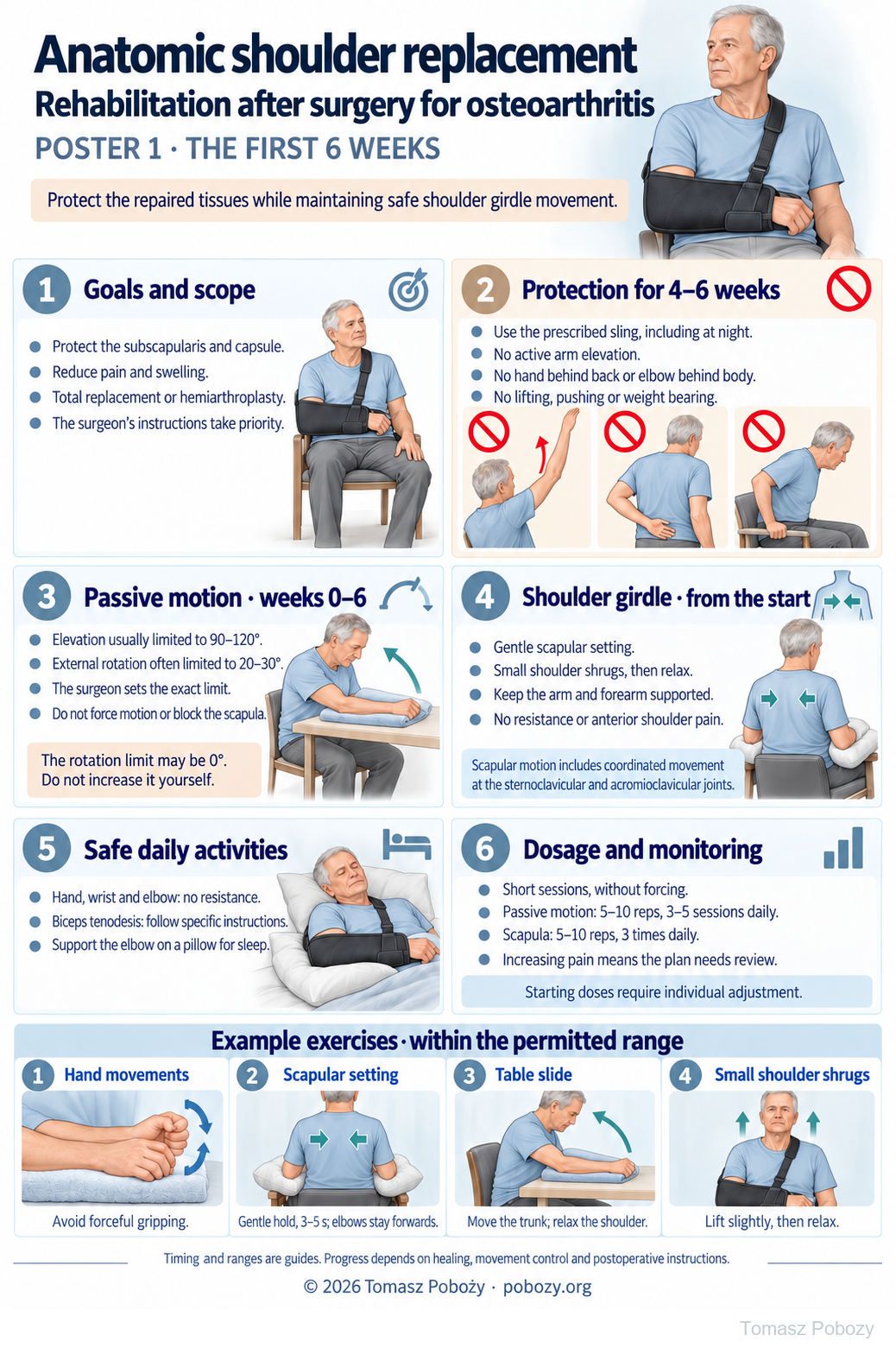
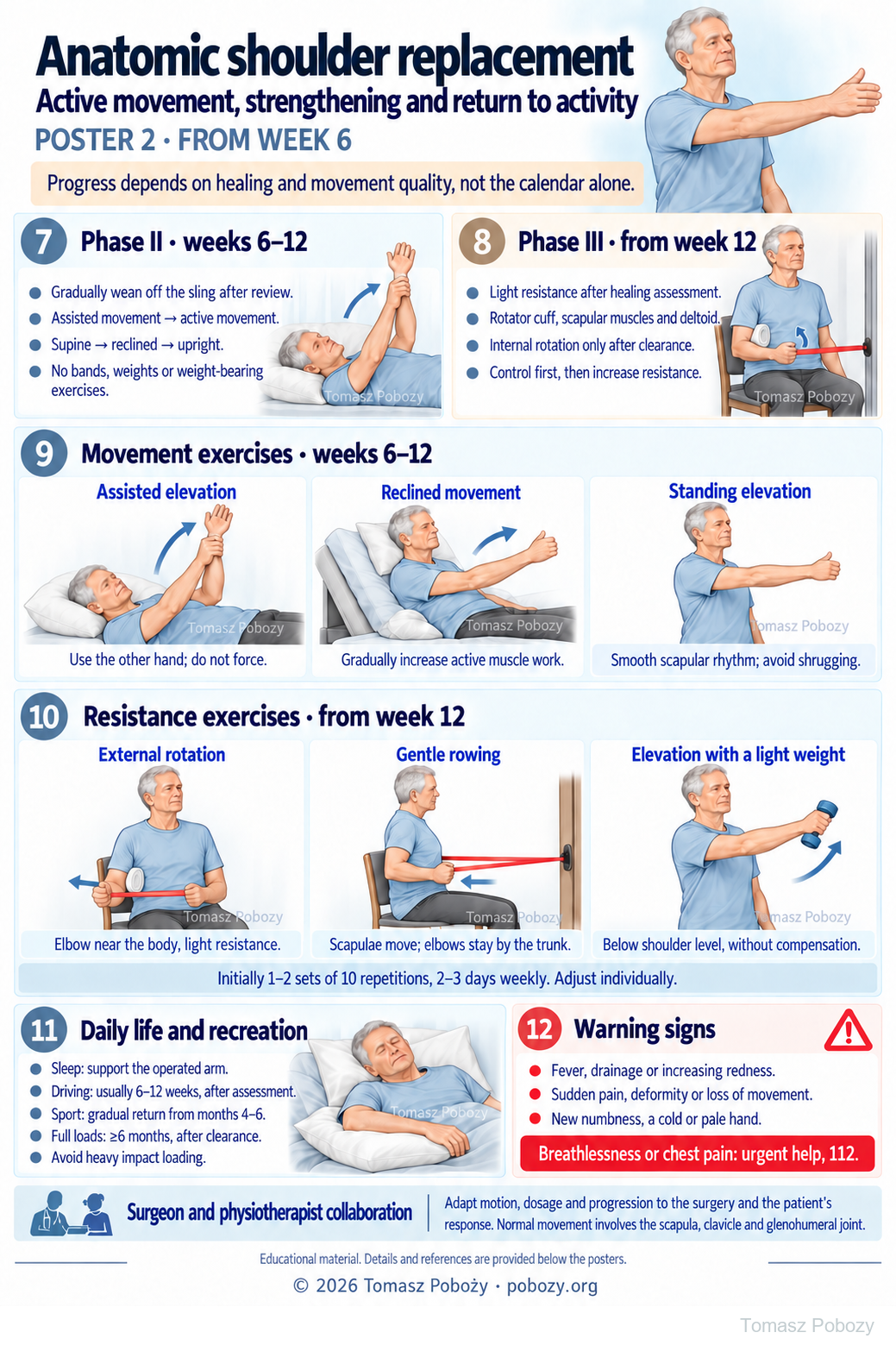
Two posters present the rehabilitation phases, protective measures and example exercises. Expand the sections below for the full protocol, clinical commentary and references.
Using and loading the limb
During protection, avoid lifting, pushing and body-weight support. Strengthening follows clearance, around week 12 in this pathway; protect the repaired subscapularis.
Full guidance ↓Brace or immobilisation
Sling usually 4–6 weeks, including at night. Remove for hygiene and prescribed exercise with the limb supported.
Full guidance ↓Permitted movement
Initially passive motion: elevation usually 90–120°, ER at the side 20–30° or neutral only. The surgeon’s recorded safe limit takes priority.
Full guidance ↓Permitted movement, loading and removal of a brace are separate decisions. Additional repairs may require a more protective programme.
Rehabilitation at a glance
Progression follows healing and functional criteria, not dates alone.
Rehabilitation boards
Exercises — a closer look
Use the complete boards above together with the instructions for the chosen stage. An exercise shown for a later stage is not permitted early.
Open the relevant complete board and zoom in. The viewer retains all stages and captions.
6. Exercise technique and dosage
- Passive movement: 5–10 slow repetitions, 3–5 short sessions daily. Example: forearm supported on a towel, move the body away from the table, keeping the arm relaxed.
- Active movement: short sets, stopping before persistent shoulder or trunk compensation.
- Resistance: only at the appropriate stage. Increase one variable at a time.
Mild brief pulling can be acceptable. Sharp pain, worsening night pain or deterioration the following day means reducing the dose and seeking advice. Do not force movement.[2,4,5]
Scope and protection
1. Scope and protection of repaired tissues
For primary anatomic shoulder replacement for osteoarthritis with a functioning cuff, after humeral head or total replacement. Cement fixation, stem length and glenoid replacement usually do not determine rehabilitation.
Tissue quality, subscapularis repair, biceps tenodesis and surgical stability guide progression. Revision, fracture, additional cuff repair and ream-and-run require individual instructions. Reverse replacement is excluded. The orthopaedic surgeon’s instructions take priority.[1,2]
3. Shoulder girdle — scapula, SC and AC joints
Early shoulder girdle exercises involve coordinated scapular, sternoclavicular (SC) and acromioclavicular (AC) movement. They do not completely isolate the replaced glenohumeral joint.[7]
- Scapular setting: sit upright, elbow and forearm supported. Gently bring the shoulder blades slightly together, without pulling downward or moving the elbows backward. Hold 3–5 seconds, then relax.
- Small shrugs: with the arm supported, slightly lift the shoulders, then relax. No arm circles.
5–10 repetitions, 3 times daily, without resistance or anterior shoulder pain. During arm elevation, allow natural scapular movement; avoid rigidly holding it “down and back”.[4,5]
8. Notes for the surgeon and physiotherapist
Confirm the subscapularis procedure, intraoperative safe rotation range, biceps procedure and additional repairs before treatment. The aim is coordinated glenohumeral and shoulder girdle movement, without substituting scapular elevation for the entire movement.
SC and AC motion is addressed as part of shoulder girdle function. Complete unloading of the replacement is not assumed, and routine aggressive mobilisation of these joints is not recommended. Consider preoperative mobility. Monitor pain, movement quality and function.[2,7]
Stages and progression criteria
2. Weeks 0–6 — protection and passive movement
Wear the sling for approximately 4–6 weeks, including nights; remove for hygiene and prescribed exercises. Agree weaning with your surgeon.
- Keep the operated arm relaxed during passive movement guided by the other hand, therapist or body movement with forearm support.
- Scapular-plane elevation: commonly 90–120°. External rotation at the side: often 20–30°, sometimes 0°. Follow your individual limit; do not force these targets.
- No active arm elevation, reaching behind the back, elbow behind the trunk or pushing up through the arm.
- Move fingers, wrist and elbow. Confirm elbow instructions after tenodesis; avoid loaded biceps exercises.
No resisted internal rotation or unsupervised subscapularis isometrics.[1–3]
4. Weeks 6–12 — assisted to active movement
After review, increase mobility and wean off the sling. Progress from assisted to active movement: initially supine, elbow bent, then reclined and finally upright.
- Aim for smooth movement without abrupt shoulder hiking or leaning backward.
- Increase external rotation as permitted by the repair; do not force it.
- Introduce reaching behind the back only when cleared, initially toward the sacral area. Avoid forceful towel stretches.
- In this programme, resistance bands, weights, push-ups and planks are deferred.
Progression requires a healed wound, improving pain and adequate movement control. Time since surgery alone is insufficient.[1–3]
5. From week 12 — strengthening and return to activity
After healing is confirmed, introduce light resistance for rotator cuff, deltoid and scapular muscles. Start with 1–2 sets of 10 repetitions, 2–3 days weekly, adjusted by your physiotherapist.
Improve control before adding load. During band rows, stop the elbow alongside the trunk. Demanding work and sport require several months; greater loads are often considered around six months. Heavy weights, impact loading and repetitive overhead activity require individual advice.[1,3]
Daily activities
Support the forearm during rest, sleep and hygiene; follow the prescribed sling schedule. Dress the operated arm first and undress it last. Do not push out of a chair through the operated hand during the protection period. Desk work requires a supported arm, breaks and compliance with motion limits. Driving requires removal of the sling, permitted active control sufficient for emergency manoeuvres and no impairing medication. Heavy work and sport require procedure-specific progression and assessment.
Warning signs
7. Daily activities and warning signs
Support the elbow and forearm with a pillow when sleeping. Dress the operated arm first. Follow discharge instructions for wound care. Walk regularly; do not push through the operated arm when getting up.
Driving requires being out of the sling, adequate steering control and freedom from medication effects that impair performance. Agree timing at follow-up.
Contact the surgical team urgently: fever, wound discharge or increasing redness, a sudden rise in pain, new deformity or loss of previously regained function. Seek emergency help: breathlessness, chest pain, or a hand that suddenly becomes pale or cold.[2,5,6]
For a life-threatening emergency, call your local emergency number immediately — 112 in the European Union. On the boards, 112 refers to the EU.
Additional scope notes
References
9. References
- Kennedy JS, Garrigues GE, Pozzi F, et al. The American Society of Shoulder and Elbow Therapists’ consensus statement on rehabilitation for anatomic total shoulder arthroplasty. J Shoulder Elbow Surg. 2020;29(10):2149–2162. doi:10.1016/j.jse.2020.05.019. Source.
- Calderdale and Huddersfield NHS Foundation Trust. A Patient Guide to Shoulder Replacement. Post Op Physiotherapy Protocol: Anatomical Total Shoulder Replacement. Leaflet suor0076, version 4; review date May 2028. Source.
- Maddocks C, Lloyd Evans J. Rehabilitation Guide Following Anatomic Total Shoulder Replacement. The Robert Jones and Agnes Hunt Orthopaedic Hospital NHS Foundation Trust. February 2024. Source.
- Frimley Health NHS Foundation Trust. Total Shoulder Replacement — Exercises. Reference BB/065. Approved 30 April 2026. Source.
- Royal Devon and Exeter NHS Foundation Trust. Combined Shoulder Replacement. Patient information RDE 18 112 002. June 2021. Source.
- Gateshead Health NHS Foundation Trust. Shoulder Replacement Surgery. Patient information. 2025. Source.
- Bruttel H, Spranz DM, Wolf SI, Maier MW. Scapulohumeral rhythm in patients after total shoulder arthroplasty compared to age-matched healthy individuals. Gait Posture. 2020;82:38–44. doi:10.1016/j.gaitpost.2020.08.111. Source.
Use of this protocol
© 2026 Tomasz Poboży – orthopaedic surgeon · pobozy.org · pobozy.com